Shelf Sag Calculator
Estimate shelf deflection, sag ratio, pass/fail margin, and stiffener improvement from span, material, load, support style, and humidity.
Shelf sag estimate
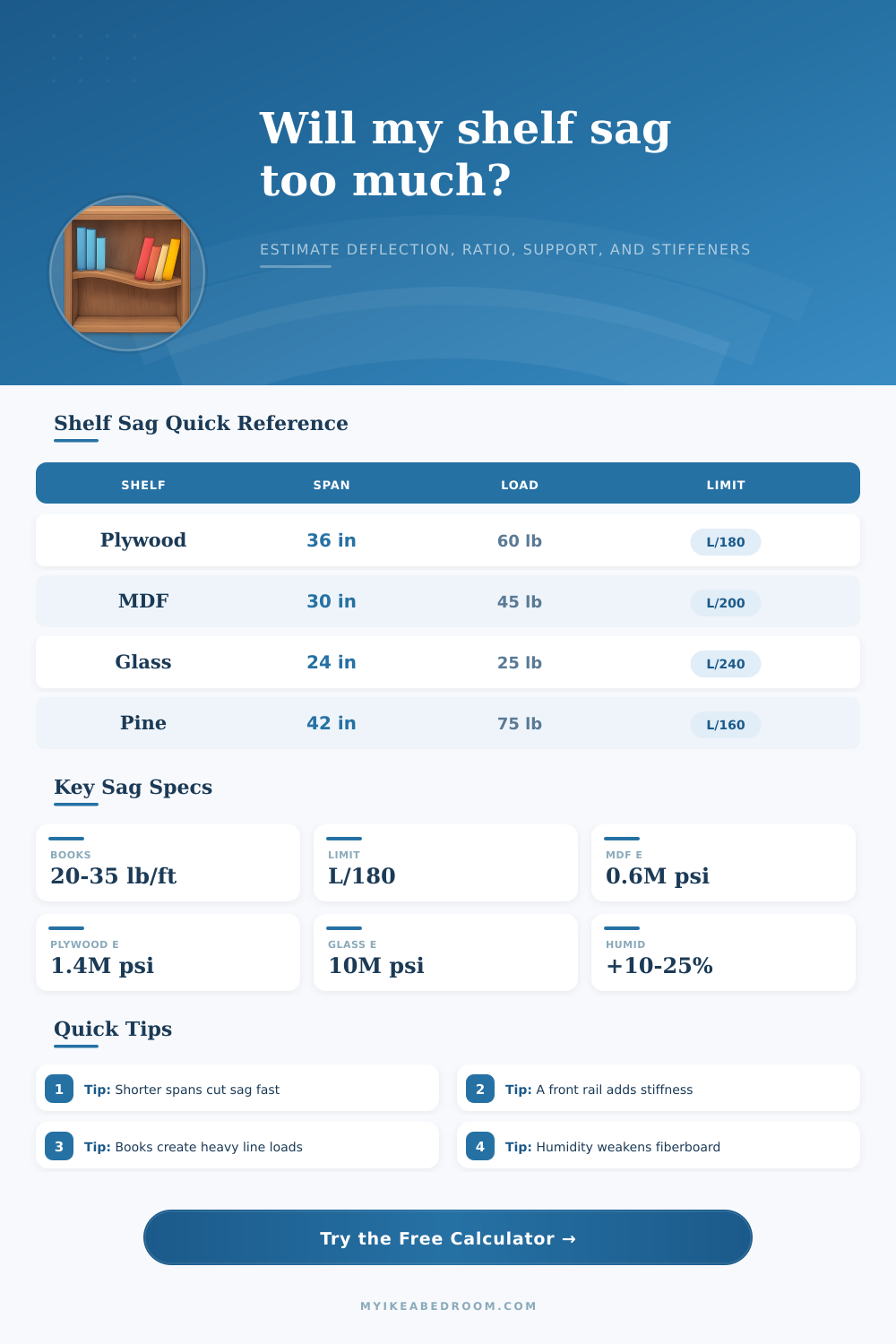
| Material | Typical modulus | Relative stiffness | Planning note |
|---|---|---|---|
| MDF / particleboard | 0.5M to 0.8M psi | Low | Short spans or strong front rails help control sag. |
| Melamine particleboard | 0.8M to 1.1M psi | Low-medium | Good finish surface, but thickness and support spacing matter. |
| Cabinet plywood | 1.2M to 1.6M psi | Medium | Often a good balance for bookcases and closet shelves. |
| Pine / softwood | 1.2M to 1.8M psi | Medium | Grain direction and knots affect real performance. |
| Hard maple / birch | 1.6M to 2.0M psi | Medium-high | Useful for shelves where a clean front edge is visible. |
| Tempered glass | 9M to 10M psi | High | Use glass-specific thickness and support rules for safety. |
| Allowable limit | Example use | 36 in span max | 48 in span max |
|---|---|---|---|
| L/120 | Utility storage | 0.300 in | 0.400 in |
| L/160 | Pantry shelf | 0.225 in | 0.300 in |
| L/180 | Bookshelf target | 0.200 in | 0.267 in |
| L/200 | Closet shelf | 0.180 in | 0.240 in |
| L/240 | Display shelf | 0.150 in | 0.200 in |
| L/360 | Very stiff shelf | 0.100 in | 0.133 in |
| Support or load case | Calculator factor | What it means | Use carefully when |
|---|---|---|---|
| Simple side pins | 1.00x | Baseline simply supported shelf | Pins are shallow or holes are worn. |
| Dado side supports | 0.75x sag | Ends are better restrained | Dados are loose or shallow. |
| Fixed ends | 0.35x sag | Strong end restraint assumed | Fasteners or side panels can flex. |
| Center divider | 0.08x sag | Span is effectively split | The divider is not load-bearing. |
| Floating brackets | 1.25x sag | Extra bracket rotation allowed | Wall anchoring is uncertain. |
| Point load | Formula change | Single heavy item at center | Equipment feet concentrate load. |
| Stiffener option | Approx stiffness gain | Sag reduction | Best fit |
|---|---|---|---|
| Thin edge banding | 1.05x | About 5% | Appearance edge, light duty only. |
| Hardwood nosing | 1.60x | About 38% | Bookcases and visible shelves. |
| 1 x 2 front rail | 2.20x | About 55% | Long closet or pantry shelves. |
| Steel angle | 2.80x | About 64% | Utility shelves with concealed metal. |
| Front and rear rails | 3.00x | About 67% | Deep shelves with both edges supported. |
Shelf sag are the bending of a shelf due to the weight of the objects on that shelf. Shelf sag typicaly occur slowly over many month. You can feel the bending of the shelf if the shelf is bowing due to the weight of the books, dish, or linens that are placed upon it.
The goal of the homeowner is not to avoid any sagging at all, as all material will bend to some extent under a load. However, the goal is to ensure that the amount of bend is small enough to keep the shelf and its contents safely and visually flat. There are four main variable that affect the amount of bend that will occur in a shelf.
Why Shelves Bend and How to Fix Them
These variables are the span of the shelf, the thickness of the shelf, the material of the shelf, and the condition under which it is supported. The most important of these variables is the span of the shelf. The relationship between the span and the amount of bend is not linear; increasing the span of a shelf will lead to a dramatic increase in the amount of bend of that shelf.
Thus, reducing the span of a shelf by moving a support inward is more effective than increase the thickness of the shelf. The second most important of these variables is the thickness of the shelf. Increasing the depth and thickness of a shelf will increase its stiffness.
Thus, a thicker shelf will bend less than a thin shelf. The third main variable of a shelf that impacts the bend of that shelf is the material of the shelf. Some materials is stiffer than others.
For instance, plywood has a moderate level of stiffness. Particleboard and medium density fiberboard (MDF) has lower levels of stiffness. Glass has a high level of stiffness; however, it is a brittle material, so the support of the shelf with glass are very important.
Finally, the humidity of the air impact the stiffness of the shelf. The moisture in the air can lead to the bending of the shelf; wood product soften in the presence of moisture. Thus, a shelf in a humid area will bend more then a shelf in a dry area.
The fourth variable of a shelf that impacts the bend of that shelf is the conditions under which the shelf is supported. Supports that permit movement at the end of the shelf will allow more movement of the shelf than supports that does not permit movement. For instance, fastening a shelf to the wall at the end with a dado will reduce the movement of that shelf; the same is true for adding a divider in the center of the shelf.
Adding a divider in the center of a shelf is the most common and effective way to reduce the amount of bend in the shelf. However, using floating brackets to support a shelf may increase the amount of bend in the shelf since floating brackets allow the shelf to rotate on the wall. The placement of the load upon the shelf can also impact the bend of the shelf.
Placing heavy object in the same distribution along the shelf will result in a shelf that has a curve that is even along the length of the shelf. However, if one heavy object is placed in the center of the shelf, that will lead to an increased amount of bend at the center of the shelf. Thus, the distribution of the load impact the bend of the shelf.
Another way to reduce the amount of bend of a shelf is to attach stiffeners to the front edge of the shelf. Using a thin piece of edge banding will not provide much increase in the depth of the shelf; however, using a deep rail or a steel angle will increase the depth of the shelf. Using a deeper shelf will lead to a reduction in the amount of bend.
However, since these stiffeners will take up visual space on the shelf, it will be important to consider the visual appearance of the shelf when adding such stiffeners. Common mistakes when calculating the amount of bend that will occur in a shelf is to either use the total length of the shelf rather than the span of the shelf. Additionally, people often forget to include the weight of the shelf itself in the calculation; the shelf itself may be made of a dense material.
One way of determining the span, thickness, and material of a shelf that will be built is to refer to a reference table of the expected bend of different types of shelves. These tables typicaly indicate the stiffness of the different types of materials used to construct the shelf. Additionally, the tables often indicate the allowable bend of a shelf with certain span of that shelf.
The goal of such a table is to ensure that the deflection of the shelf is not so great that the shelf is no longer able to perform its function for the space in which it will be placed. Thus, a goal of zero deflection is unrealistic; instead, ensuring that the deflection is small enough for the shelf to function and look flat is the goal. Once all of the variables that impact the bend of a shelf are understood, you can construct the shelf for a specific job or function.