Table Leg Size Calculator
Calculate table leg length, load per leg, inset stability, overhang balance, and apron clearance for furniture builds.
Table leg sizing results
Material planning capacities used by the calculator
| Table type | Finished height | Common leg length | Clearance focus |
|---|---|---|---|
| Coffee table | 16-18 in | 14-16 in | Sofa seat alignment |
| Kids table | 20-24 in | 18-22 in | Child chair fit |
| Dining table | 28-30 in | 26-29 in | Knee room |
| Desk | 28-30 in | 26-29 in | Chair arms and thighs |
| Console table | 30-34 in | 28-32 in | Wall and sofa scale |
| Kitchen island | 34-36 in | 32-35 in | Counter stool fit |
| Leg count | Best use | Load behavior | Layout note |
|---|---|---|---|
| 3 legs | Small round tops | Self-leveling | Needs wide stance |
| 4 legs | Most tables | Simple sharing | Check equal contact |
| 5 supports | Center support | Helps long tops | Hide center leg |
| 6 legs | Long tables | Lower per-leg load | Good for 8 ft tops |
| 8 legs | Benches and heavy tops | Very distributed | Align pairs cleanly |
| Trestle pair | Farm tables | Rail supported | Leave foot room |
| Inset from edge | Overhang feel | Stability read | Common use |
|---|---|---|---|
| 0-1 in | Almost flush | Very stable | Workbench, heavy desk |
| 2-4 in | Balanced | Stable | Dining, desk, island |
| 5-8 in | More float | Check load | Console, coffee table |
| 9-12 in | Large overhang | Use stretchers | Style-focused tops |
| 12 in+ | Cantilevered | Engineer it | Special cases only |
| Apron height | Dining clearance | Desk clearance | Planning note |
|---|---|---|---|
| 0 in | Maximum | Maximum | Plate or slab-mounted legs |
| 2 in | Usually easy | Good for arms | Light apron or metal rail |
| 3 in | Classic table | Check tall chairs | Common wood apron |
| 4 in | Can feel low | Often tight | Use on taller tables |
| 5 in+ | Low knee room | Not ideal | Better for consoles |
| Scenario | Typical top | Leg approach | Stretcher choice |
|---|---|---|---|
| Small nightstand | 20 x 18 in | 4 slim legs | Usually none |
| Dining for 6 | 72 x 36 in | 4 hardwood legs | Side or box frame |
| Long desk | 78 x 30 in | 4 legs plus rear rail | Back stretcher |
| Workbench | 72 x 30 in | 4 or 6 heavy legs | Box frame |
| Console table | 60 x 14 in | Tall legs | Low stretcher |
| Kitchen island | 72 x 36 in | Heavy legs | Box or side rails |
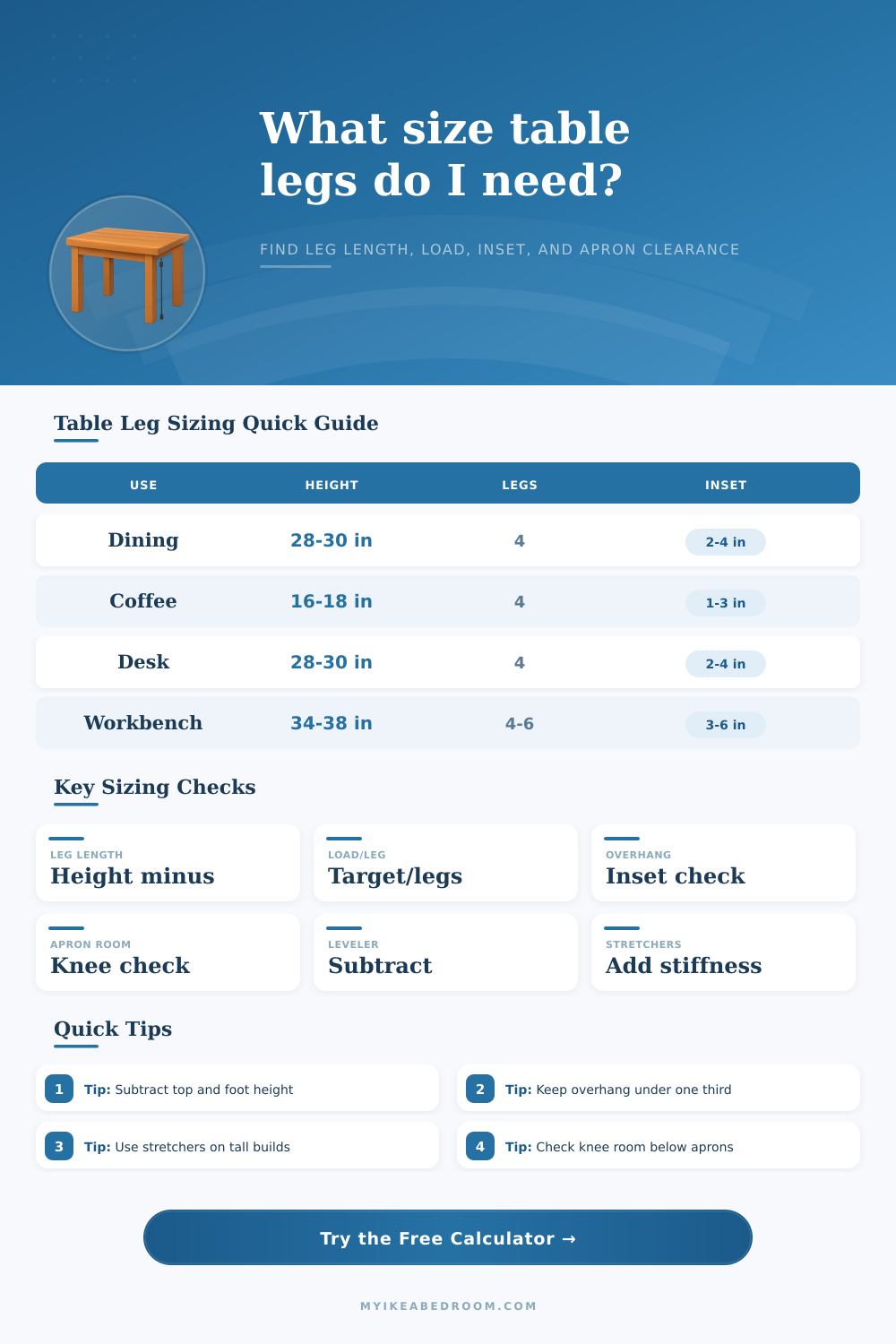
Calculating the length of the legs on an new table require several different measurement. The height of the finished table must be considered, the thickness of the table top must be considered, the height of any adjustable feet must be considered, and the drop of the apron below the table must be considered. If any of these measurement are missed, the leg may not have the proper height for the table.
The calculator will perform the math for you based off the measurements that you provide to the calculator. The leg length for a table impact how the table will relate to the floor. For example, dining table often need to have some space for the thighs of the diner to slide under the table.
How to Measure Table Legs and Check Table Stability
Coffee tables, however, do not need this many space for the legs of the person sitting at the table. Each of these requirements is based upon the way that the table will be used, and the way that people typically move their chairs toward the table. By entering the height that you would like to build the finished table to, and the thickness of the top that you will build, the calculator will subtract these measurements and the height of any leveling feet that you plan to use.
The load that you will place onto each leg of the table is another measurement that you must consider when building the table. Tables of heavy use will need to be built with a higher load per leg than a table that will only be used for decorative purpose. The calculator will adjust for the way in which the table will be used by pre-programming the load per leg based upon the material that you have chosen to build the table legs.
This helps you to determine whether or not the legs will be under there load limit. The distance of the legs from the nearest edge of the table impact the stability of the table. If the legs are close to the tables edge, the table will tend to be more stable and resist tipping when someone leans on a corner of the table.
If the distance between the legs and the table edge is too great, however, the table will be less stable. The stability score that is provided will allow you to understand the stability of the table based upon these two variable. The apron clearance impact the comfort of those using the table and its clearance from the chair.
The calculator takes into account the distance between the apron and the typical height of the seat of a chair and provides a suggestion as to whether the apron will be comfortable for those using the table. Tables that require individuals to bend their knees to fit beneath the table has more clearance than tables used for different purposes. The apron clearance value will allow you to determine the correctness of the apron height that you have selected.
Many wood shop builders will utilize the presets that are built into the calculator. These presets provides realistic values for the height, the load, and the inset of the table legs. The builder can adjust any of these preset values, and this adjustment is effective due to the fact that these presets were built with combinations of these variables that work well for specific types of furnitures.
Any alteration of one of the values will impact the adjustment of the other values in the preset table. Reference tables are provided on the calculator that provide information regarding common table height and leg counts. These tables show the relation of the inset distance to different types of furniture.
These tables help inform the users of the calculator as to why the values is requested. These tables are not rules to be followed, but they do provide context to the calculator should the values that you are selecting for your table differ from the presets. The use of stretchers will also impact the stability of your tables base.
The calculator will ask if you have selected side stretchers, a full box frame, or no stretcher. The selection of a box frame, for example, will increase the stability of the table if you are selecting a greater inset for the legs. This recommendation is provided to help make your decision regarding the use of stretchers prior to cutting your table part.
This table leg calculator is not a tool that will measure every variable that will impact the stability of the completed table. For example, wood movement and the straightness of the planed legs of the table are two variable that the calculator will not account for. However, because of this, many woodshop professional will make the legs slightly longer than the calculator suggests; they will then cut the legs to the appropriate size after the tabletop has been assembled and allowed to dry.
Overall, the goal of using a table leg calculator is to ensure that each of the parts of the table are intentional in relation to each of the other part. When each of the measurements for the cut length of the legs, the load per leg, the stability score, and the apron clearance correlate to the use of the completed table, the building of the table will proceed more smooth for the builder. You could of used it more effectivey if you want to get perfect results.