Bed Sheet Size Calculator
Calculate fitted sheet cut size, flat sheet dimensions, duvet cover panels, pocket depth, fabric yardage, seam allowance, shrinkage, elastic wrap, topper depth, and pillowcase yardage from one mattress measurement.
Pick a common mattress size, then adjust the depth, topper, tuck, elastic wrap, seam, fabric width, shrinkage, and pillowcase count.
Cut blank: Calculate to begin.
Pocket depth and elastic wrap use the depth inputs.
Cut size: Calculate to begin.
Tuck allowance affects side drop and bottom tuck.
Panels: Calculate to begin.
Two faces are counted with seam and ease.
Yardage: Calculate to begin.
Envelope pillowcases are added to total fabric.
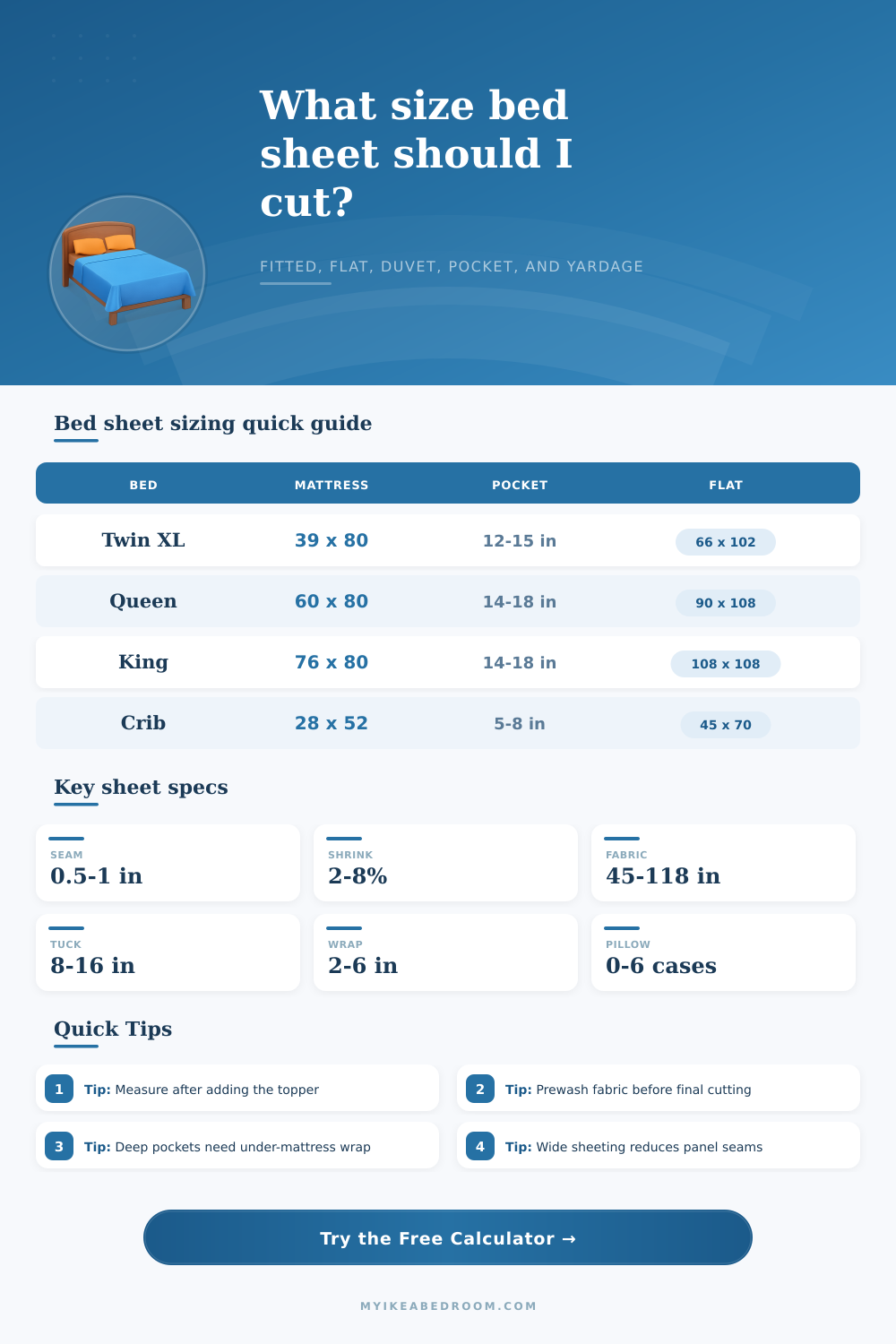
| Bed size | Mattress top | Typical fitted pocket | Typical flat sheet |
|---|---|---|---|
| Twin | 38 x 75 in | 10 to 14 in | 66 x 96 in |
| Twin XL | 39 x 80 in | 10 to 15 in | 66 x 102 in |
| Full | 54 x 75 in | 12 to 16 in | 81 x 96 in |
| Queen | 60 x 80 in | 14 to 18 in | 90 x 108 in |
| King | 76 x 80 in | 14 to 18 in | 108 x 108 in |
| California king | 72 x 84 in | 14 to 18 in | 108 x 112 in |
| Crib | 28 x 52 in | 5 to 8 in | 45 x 70 in |
| European 160 x 200 | 63 x 79 in | 12 to 16 in | 94 x 108 in |
| Mattress plus topper | Suggested pocket label | Elastic wrap | Practical read |
|---|---|---|---|
| 5 to 8 in | Crib or shallow | 2 to 3 in | Small depth needs controlled corners. |
| 9 to 12 in | Standard | 3 to 4 in | Works for many foam and guest mattresses. |
| 13 to 16 in | Deep pocket | 4 to 5 in | Good for pillow-top or topper stacks. |
| 17 to 22 in | Extra deep pocket | 5 to 6 in | Needs stronger elastic and more corner depth. |
| Fabric width | Best use | Sheet seam notes | Yardage behavior |
|---|---|---|---|
| 45 in | Small crib, pillowcases, pieced sheets | Almost always needs multiple panels. | Higher panel count. |
| 54 to 60 in | Twin flat sheets and decorative cottons | Often needs a center seam for larger beds. | Moderate panel count. |
| 90 in | Twin, full, some queen work | Can avoid seams on narrower cuts. | Efficient for many flat sheets. |
| 108 to 118 in | Queen, king, duvet covers | Often easiest for wide bedding panels. | Lower panel count. |
| Allowance | Typical range | Where it applies | Planning note |
|---|---|---|---|
| Seam allowance | 0.5 to 1 in | Edges, corner seams, panel seams | Add before shrinkage compensation. |
| Cotton shrinkage | 3 to 8% | Length and width | Prewash fabric when possible. |
| Linen shrinkage | 4 to 10% | Length and width | Expect more change on hot drying. |
| Flat sheet tuck | 8 to 16 in | Sides and bottom | Increase for restless sleepers or high mattresses. |
Tip 1: Measure the mattress after protectors and toppers are on the bed. A fitted sheet that looks correct on the label can still pull loose if the topper adds two inches of working depth.
Tip 2: For wide beds, compare the fabric panel count before cutting. Extra-wide sheeting may use fewer seams, while narrow fabric can work well when the center seam is planned deliberately.
When making new sheets, there are certain step that you must follow in order to ensure that your sheets will properly fit the bed that is to be used with the sheets. The measurements of the mattress are not always the best way to determine the size of sheets that are to be created, as the mattress measurements do not always account for any mattress topper that may be used on the bed, or for any mattress protectors. Additionally, the fabric will often change with washing so the measurements must account for that as well.
Mattress depth is a measurement that those who are unaware of the depth of any mattress toppers that may be placed upon the mattress often incorrectly calculate. If the sheets are to properly wrap around the mattress, the sheet depth must account for the thickness of the topper. Therefore, the depth measurement that is obtained for the sheets must account for the mattress and any topper that may be placed upon it.
How to Make Bed Sheets That Fit
The width of the fabric is another factor in the creation of the sheets. If the fabric is narrow, more seam will be required in the sheet designs, and the fabric may begin to twist or form puckers after it is washed. If the fabric is wider, the seams will be fewer but more fabric will be wasted if only pillowcase are to be created.
The width of the fabric should be chosen to allow for the largest piece of the sheet to be cut from the fabric bolt. Additionally, you should prewash the fabric to reveal the amount of shrinkage that the fabric will undergo during washing. Using the shrinkage percentage from the prewashing of the fabric will ensure that the sheets will accurately reflect the size that is chosen for them.
Fitted sheets require a certain amount of geometry to properly wrap around the corners of the mattress. The depth of the mattress into the bed must be accounted for, as well as the amount of wrap that is to go under the mattress. If the wrap is too narrow, the sheets will ride up the mattress when the sleeping person move in the bed.
If the wrap is too wide the sheets will have bulky elastic element. The calculations of fitted sheets must account for the depth of the mattress, the amount of wrap, and the seams required by the sheet design prior to applying the shrinkage to determine the size of the blank sheets. Flat sheets are created in a slightly different process.
However, you must take the same care in accounting for the tuck allowance of the sheet. If the tuck allowance is too narrow the sheet may not remain in place upon the mattress. A large tuck allows for the blanket to be folded over the edge of the sheet which is useful for those who like to fold their blanket in the morning.
The size of the flat sheet will be smaller than the flat sheet that is cut due to shrinkage of the fabric. Duvet covers require an ease allowance for the insert of the duvet. The ease must be sufficient for the duvet to still loft when the comforter is shaken but not so much that the sheet slide around on the duvet.
The duvet cover must be cut in two faces which will require twice as much fabric as a flat sheet of the same size. Should the bed sheets for the bed be made of wide fabric, you can cut the duvet cover from the same fabric bolt. The last of the bed sheet designs is the pillowcases.
Even though pillowcases may seem insignificant to the design of bed sheets, it is necessary to plan for the pillowcases to ensure that there is enough fabric for the pillowcases. The more pillows that an individual uses the more fabric will be required for the pillowcases. To create a complete set of bed sheets that may be rotated multiple times during the week, you will need to purchase extra fabric for the pillowcases.
Common mistakes include using the measurement of the bare mattress to determine the size of the sheets. Another common mistake is using a standard percentage for fabric shrinkage rather than actualy testing the fabric for shrinkage. Finally, another common mistake is using narrow fabric bolts to reduce the cost of the sheets but creating more seams in the sheets that may begin to twist after being washed.
Each of these mistake may seem small but have an impact upon the sheets design. The reference tables include typical depths of pockets for various sizes of mattresses as well as the impact that the width of the fabric will have upon the number of panels required for the sheet. A calculator is provided for those who have finalized the dimensions of their sheets.
The measurements and calculations will ensure that the sheets will stay in place on the bed, the corners of the sheet will not pop and the duvet will not slide off of the duvet insert.