Pillow Loft Calculator
Estimate pillow loft from shoulder width, sleep position, fill material, mattress firmness, neck gap, compression, pillow size, layer count, and preferred loft feel.
Choose a realistic sleep setup, then fine-tune the body measurements, compression, material, and pillow size to match the pillow being compared.
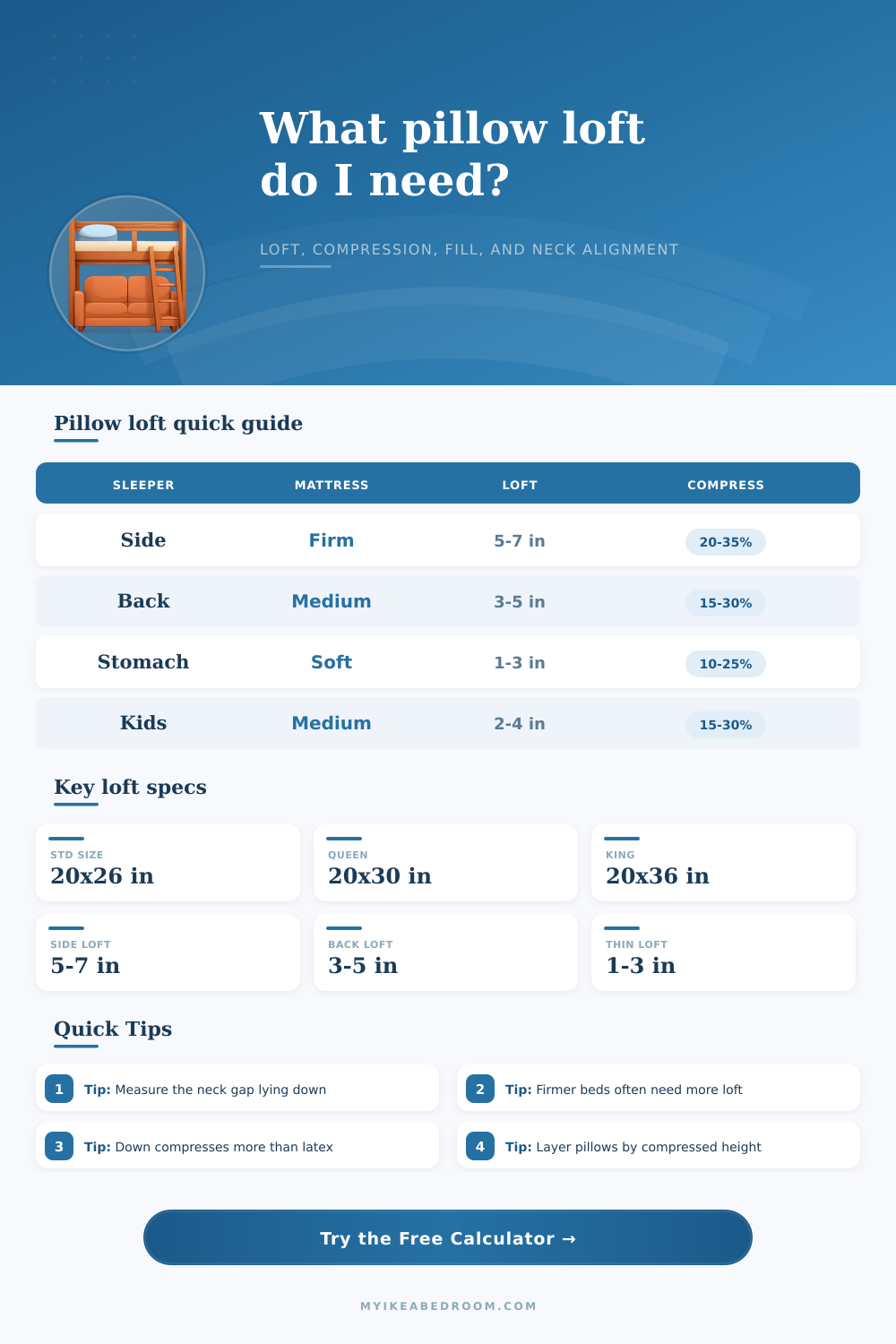
| Sleep position | Common compressed loft | Typical uncompressed loft | Best alignment cue |
|---|---|---|---|
| Side sleeper | 4.0-6.0 in | 5.0-8.0 in | Nose, chin, and sternum feel stacked without tilting down. |
| Back sleeper | 2.5-4.0 in | 3.0-5.5 in | Chin stays neutral without being pushed toward the chest. |
| Stomach sleeper | 0.8-2.2 in | 1.0-3.0 in | Neck twist is minimized by a very low, soft pillow. |
| Combination sleeper | 2.8-4.8 in | 3.8-6.4 in | Loft stays usable after rolling between side and back. |
| Kids pillow | 1.5-3.0 in | 2.0-4.0 in | Head rests level without forcing the chin up or down. |
| Material | Typical compression | Support feel | Loft planning note |
|---|---|---|---|
| Down cluster fill | 35-55% | Very soft | Needs extra uncompressed loft because it collapses easily. |
| Feather and down blend | 30-45% | Moldable | Good for sleepers who scrunch a pillow into shape. |
| Polyester fiberfill | 25-40% | Soft-medium | Plan for flattening if the pillow is lightly filled. |
| Shredded memory foam | 20-35% | Medium-firm | Remove or add fill to tune the compressed height. |
| Solid memory foam | 12-25% | Contour firm | Compression is lower, so the starting loft can be closer to target. |
| Shredded latex | 15-28% | Springy firm | Returns loft quickly and usually suits side sleepers well. |
| Buckwheat hulls | 8-18% | Dense moldable | Height is controlled mainly by fill amount, not bounce. |
| Pillow size | Dimensions | 3 in loft volume | 5 in loft volume | Typical use |
|---|---|---|---|---|
| Kids | 13 in × 18 in | 0.41 ft³ | 0.68 ft³ | Small sleepers and travel cribs. |
| Travel | 12 in × 16 in | 0.33 ft³ | 0.56 ft³ | Compact support for short trips. |
| Standard | 20 in × 26 in | 0.90 ft³ | 1.50 ft³ | Most twin, full, and queen beds. |
| Queen | 20 in × 30 in | 1.04 ft³ | 1.74 ft³ | Wider profile for queen beds. |
| King | 20 in × 36 in | 1.25 ft³ | 2.08 ft³ | Broad beds and wide shoulder spans. |
| Euro | 26 in × 26 in | 1.17 ft³ | 1.96 ft³ | Square support, reading, and layered beds. |
| Mattress feel | Calculator adjustment | Why it matters | Check after lying down |
|---|---|---|---|
| Soft mattress | Lower 0.4 in | Shoulders and torso sink, reducing the neck gap. | Use less loft if the head feels pushed upward. |
| Medium mattress | No change | Average sink keeps the measured gap close to target. | Confirm the pillow compresses evenly. |
| Firm mattress | Add 0.4 in | Less shoulder sink usually leaves a larger side-sleep gap. | Add loft if the head drops toward the mattress. |
| Extra firm mattress | Add 0.7 in | Minimal sink can make broad shoulders need taller support. | Watch for shoulder pressure and downward neck tilt. |
Best match: stomach, low back, or adjustable comfort layers.
Use more starting loft because down, feather, and fiberfill lose height under load.
Best match: back sleepers and contour pillows.
Solid foam changes less under weight, while shredded foam lets loft be tuned.
Best match: side sleepers wanting springy support.
Latex keeps more height through the night and usually needs less over-lofting.
Best match: sleepers who shape the pillow by hand.
Buckwheat and dense hull fills are heavier and hold a molded ridge well.
Measure compressed height: Press the pillow with roughly head-weight pressure and measure the height that remains, then compare that value to the calculator target.
Adjust in layers: If stacking pillows or inserts, divide the recommended loft across layers and prioritize a stable bottom layer with a softer top layer.
A pillow that is not the correct heights can cause discomfort for a person who sleeps with that pillow. Additionally, using an incorrect pillow for a persons can change the way that a person sleeps and wake up from sleep. Furthermore, an incorrect pillow can cause neck discomfort for a person throughout the day following there sleep with the incorrect pillow.
Most people realizes that their pillow is incorrect only after they have purchased and used the pillow. A pillow can be too tall, too flat, or too soft once the person settle into the pillow. The height of a pillow is referred to as the “loft” of the pillow, which is both the measurement of the height of the pillow before the head of the sleeper compress the pillow, as well as the measurement of the height of the pillow after the head of the sleeper compress the pillow.
How to choose the right pillow height for your sleep
In order to determine the correct loft of a pillow for the individual that will use the pillow, the person should understand their body, their sleeping position, and the pillow that best fill their sleeping needs. The sleeping position of an individual, as well as their shoulder width, can help to determine the loft that their pillow needs to accommodate their sleeping position. For instance, an individual that sleeps on their side may require more loft within their pillow to help to accommodate the distance between their shoulder and the mattress surface.
An individual that sleeps on their back will require less loft within their pillow than an individual that sleeps on their side, as their head naturally rest closer to the mattress. An individual that sleeps on their stomach will require the least amount of loft within their pillow, as loft that is too high will force their neck into an awkward sleeping position. In each of these sleeping positions, an individual’s neck should remain in alignment with their spine while sleeping.
Any deviation from alignment between the neck and spine can result in the development of muscular discomfort in the neck and upper back of the individual while sleeping. The firmness of the mattress upon which an individual sleeps can change the amount of loft that is required for the pillows that an individual use. For instance, an individual whose mattress is soft will naturally have their shoulders sink into the mattress while sleeping, leaving them less room for the loft of their pillows to provide for those sleeping positions.
An individual whose mattress is firm will have their shoulders remain in a higher state on the mattress, forcing their pillows to have more loft to accommodate their sleeping positions. Additionally, the materials within the pillow will impact the loft that a pillow have. For instance, down-fill mattresses will naturally compress more than pillow fill alternatives, such as shredded latex or buckwheat.
Finally, foam fill pillows sit in the middle in terms of the amount of loft that each type of pillow has, but allow for adjustments to the height of the pillow by adding or removing the foam fill within the pillow. Another factor for determining the loft that a person’s pillow needs is the compression percentage of the pillow. The compression percentage is a factor that indicates the amount of height that a pillow will lose when the individual places their head on the pillow.
For most pillows, the compression percentage of the pillow will range between 20% and 40% of the height of the pillow. Additionally, if an individual enters a higher percentage of compression into the calculation of the height of their pillow, the calculation will suggest that the individual requires more height within the pillow for the pillow to maintain its intended loft during sleep. This suggested adjustment for compression percentage is used for accommodating the way that most pillows will sink into an individual while sleeping.
Another consideration of pillows is the amount of fill that each pillow has and the weight of that pillow. The volume and weight of pillows are important considerations when comparing the different types of pillows available for purchase or for refilling an existing pillow. For instance, if an individual purchases a king size pillow, their king size pillow will have a larger footprint that requires more fill material than a smaller size pillow.
Additionally, if an individual uses a more dense material to fill their pillow, that pillow will have less volume of material required to reach the same loft of a pillow that uses a less dense pillow fill material. However, the density of the material also adds to the weight of the pillow. Additionally, an individual may ignore the importance of fill volume when purchasing items such as a king size pillow.
However, because a king size pillow has a more extensive area to fill, it will require more fill to maintain the loft of the pillow, or the pillow will sink too low in the middle of the pillow when the individual sleeps on their side or back. Factor in the measurements of the individual that will use the pillow will result in the neck alignment result for their pillow indications whether the height of their pillow is correct. For instance, if the measurements of an individual indicate that their pillow should leave their head level with the rest of their body and spine, if the pillows leaves their head too low or too high, their neck will be forced to compensate for that difference.
For instance, when a pillow too low results in an individual’s head tilting downward in sleep, their neck will have to compensate for that tilt. Additionally, pillows that are too high will result in an individual whose chin is pushed toward their chest, which can place tension upon their neck. An individual can use multiple pillows to provide the same loft as one large pillow.
Using multiple pillows is a consideration that many individuals only discover after purchasing their pillows. For instance, two thin pillows may work better for an individual than one thick pillow of the same weight. In calculating the height and loft of pillows for an individual, the total loft can be divided by the number of pillows that the individual will use to determine the correct height for each individual pillow.
Common mistakes when purchasing pillows include not considering any factors related to the body, sleep, and neck alignment. For instance, purchasing a pillow that is recommended for individuals who sleep on their side, but who do not account for their gap between their sleeping shoulder and the mattress. Another example of a mistake would be to change the mattress upon which an individual sleeps, but to not change the pillow that they use.
Finally, purchasing an adjustable pillow for an individual to fill with additional material, but failing to make the adjustments to the pillows loft to reflect their change in body or sleeping position. To avoid any discomfort within the neck and upper back of the body, an individual should measure their pillow requirements while sleeping in their normal sleeping position. Additionally, those requirements should be measured again after sleeping with their pillow for a few nights to ensure that the pillow aligns with their neck and body in sleep.
If their neck feels strained upon waking, their pillows loft is likely incorrect. In this case, the individual can adjust the fill within the pillow, change pillow sizes, or change the number of layers of pillows that they use while sleeping. Through understanding each of these factors related to pillows, individual can ensure that their body, their bed, and their pillow have been balanced to ensure that their pillow will not interfere with their sleep.