Headboard Fabric Calculator
Estimate upholstery fabric yardage, batting coverage, foam area, wrap allowance, panel seams, pattern repeat, and tufted button layout for rectangular, arched, and wingback headboards.
Choose a common bedroom headboard style, then adjust the exact width, height, thickness, fabric width, repeat, seams, and tufting layout.
| Headboard type | Typical width | Typical height | Usual shape | Upholstery note |
|---|---|---|---|---|
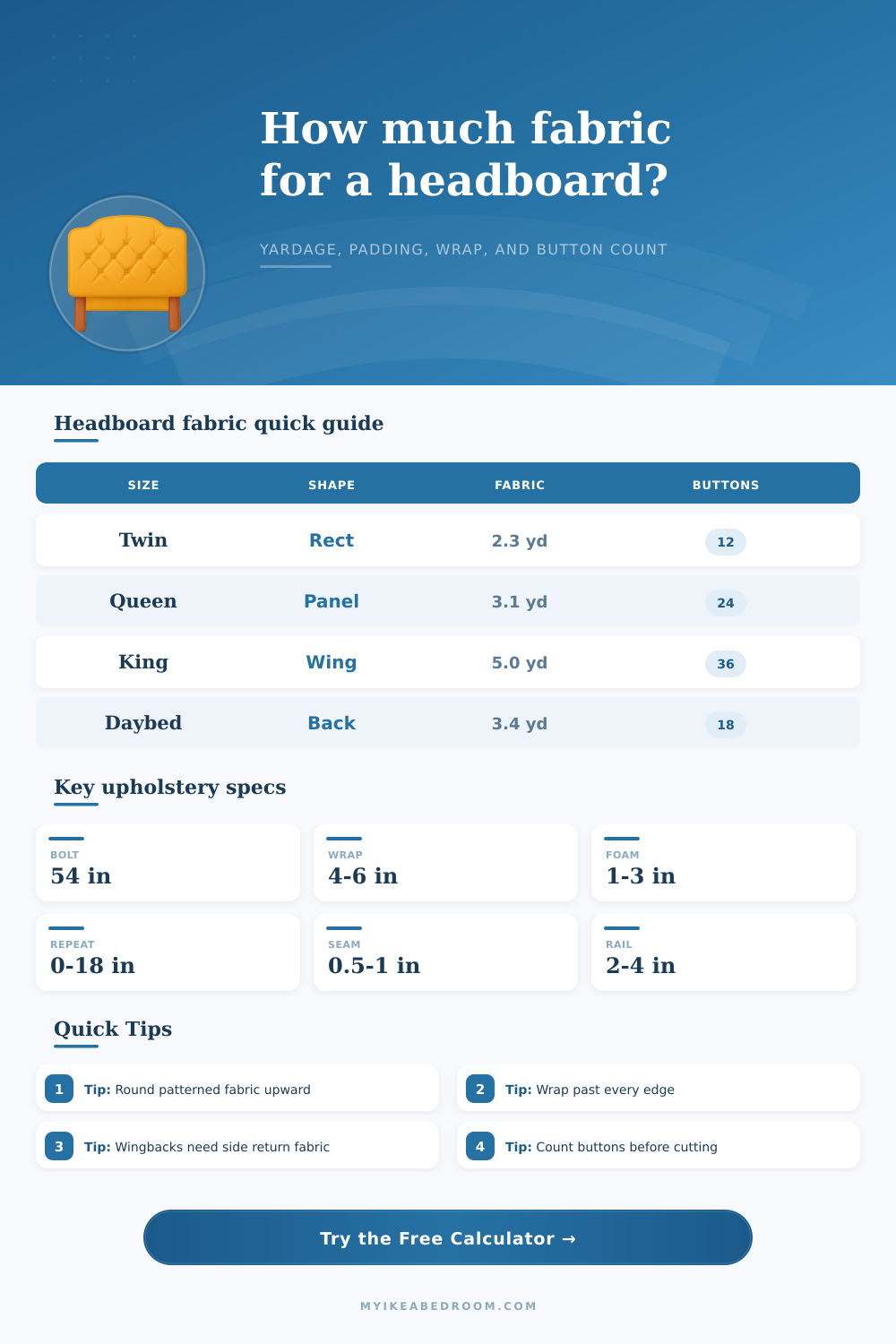
| Twin panel | 39-44 in | 36-48 in | Rectangle | Often fits one face panel plus wrap on 54 in fabric when height is modest. |
| Full panel | 54-59 in | 42-54 in | Rectangle | May need a vertical seam if the full cut width exceeds fabric width. |
| Queen panel | 62-68 in | 48-60 in | Rectangle or arched | Plan for seams, railroaded fabric, or extra length on standard bolts. |
| King wingback | 78-84 in | 54-68 in | Wingback | Side returns add face area and should be matched left to right. |
| Daybed back | 74-80 in | 28-42 in | Long rectangle | Low height can sometimes rotate more efficiently on wide fabric. |
| Build style | Padding thickness | Wrap depth | Seam allowance | Fabric behavior |
|---|---|---|---|---|
| Flat upholstered board | 0.5-1 in | 3-4 in | 0.5 in | Clean edge, low bulk, little corner compression. |
| Soft padded panel | 1.5-2.5 in | 4-6 in | 0.5-0.75 in | Needs extra ease at corners and around top thickness. |
| Deep tufted panel | 2-4 in | 5-8 in | 0.75-1 in | Allow take-up for buttons, pleats, channels, and loft. |
| Wingback frame | 2-3 in | 5-7 in | 0.75-1 in | Side returns may require mirrored cuts or separate wing panels. |
| Arched headboard | 1-3 in | 5-7 in | 0.75 in | Use a rectangular rough cut, then trim arch relief after fitting. |
| Layout style | Button formula | Spacing target | Take-up allowance | Best use |
|---|---|---|---|---|
| No tufting | 0 | Not needed | 0-1 in | Smooth panels, patterned fabric, or channel-free shapes. |
| Square grid | Rows x columns | 8-14 in | 2-4 in | Modern padded panels with simple button rows. |
| Diamond grid | Rows x columns | 7-12 in | 3-6 in | Traditional tufting with deeper fabric pull and folds. |
| Vertical channels | Columns - 1 pulls | 4-8 in | 2-5 in | Tall channel headboards and narrow paneled looks. |
| Horizontal channels | Rows - 1 pulls | 6-10 in | 2-5 in | Low daybed backs and long contemporary panels. |
| Fabric setup | Useful width | Repeat handling | Seam note | Calculator effect |
|---|---|---|---|---|
| Solid 54 in fabric | 54 in | No repeat | Seam only if cut is wider | Uses exact length plus overage. |
| Small repeat | 52-54 in | 4-8 in | Center motif when visible | Rounds length to the next repeat. |
| Large repeat | 50-54 in | 12-27 in | Match panels across seams | Adds repeat rounding and higher buffer. |
| Railroaded fabric | 54-118 in | Check direction | Can reduce vertical seams | Enter the usable roll width. |
| Separate wings | 54 in | Mirror if patterned | Allow left and right return cuts | Wingback shape adds side surface area. |
Allowance: straight cut width plus edge wrap.
Best for panels, low headboards, and fabric with strong directional patterns.
Allowance: rough rectangular cut with arch-rise waste noted.
Foam face area is reduced, but fabric should still be cut generously for the curve.
Allowance: adds two side returns to width and surface area.
Useful for statement beds where side panels wrap toward the mattress.
Allowance: channels add fabric take-up before wrapping.
Count channel pulls or seams separately from decorative face buttons.
Patterned fabric: Enter the vertical repeat and use at least a 15% buffer when centering motifs, matching wingbacks, or joining multiple fabric panels.
Thick padding: Increase wrap depth and tufting take-up when foam is soft or deep; compressed corners can consume more fabric than the flat face suggests.
Calculating the correct amount of fabrics for your headboard is a necessary task before you begin your project. The amount of fabric that is require for your headboard will depend on several different measurements of your headboards and its components. If you purchase too little fabric to cover your headboard project, you will encounter several problems.
You must account for every surface that the headboard fabric will need to cover. Headboard fabric does not just cover the front face of your headboard. The headboard fabric must also reach around the sides of the headboard, the fabric must fold behind the headboard frame for stapling, and there must be enough fabric for the shaping element of the headboard.
How Much Fabric Do You Need for a Headboard
If your headboard features any wings or an arched top, these measurement will add to the total amount of fabric that the headboard will require. Additionally, if the padding for your headboard is thicker, it will require more fabric to cover the headboard properly when you pull the buttons of the headboard tight to the padding. The fabric calculator will provide the math for your project given the measurements of your headboard and your chosen style.
The calculator will take the finished width and height of the headboard. The calculator will add the thickness of the padding to the height measurement, as will the depth of the wrap of the headboard. Additional space for seam will also be calculated.
The calculator will provide you with a total yardage measurement of the amount of fabric that you will need. This measurement will include the overage for fabric waste. The calculator will also provide measurements for the batting area and the face area of the foam for your headboard.
With these measurements, you can order all of the supplies that you will need for your project. Pattern repeat is a measurement that will commonly cause people to order too little fabric for their headboards. For fabrics that are solid in color, you can simply order the calculated length of the fabric.
For fabrics that have a pattern, however, people must order more fabric to account for the pattern. For instance, if the design element of the fabric is every twelve or eighteen inches, the length of each fabric panel will need to start at the same point in the design. This will add inches to each headboard panel of the fabric, and if headboards are to be made in bulk, or if the headboard has a wide wingback, this initial calculation of inches will add up to a greater measurement of fabric than just the area of the headboard face.
In order to allow for these design elements, you can use the overage percentage field to provide more fabric than the basic calculation for headboard dimension. This can also ensure that large motifs can be center in the middle of the headboard face. The tufting elements of the headboard will require a certain amount of fabric to properly allow the buttons to pull the fabric inwards.
The tufting will consume fabric that will not be seen in the flat drawing of the headboard. The take-up allowance field will provide extra fabric for tufting elements. For tufting in the form of diamonds, more fabric will be required because the folds of the headboard will be deeper than for other forms of tufting.
Vertical channel will pull fabric across the width of the headboard, while horizontal channels will impact the height of the headboard. The button count will provide a multiplication of the rows and columns of tufting elements for people to order the correct amount of tufting supplies for the headboard prior to beginning the project. Wingback and arched headboard shapes require adjustments to the calculations made for fabric needed.
A headboard with a wing will require two returns of the fabric to cover the area of the wing of the headboard. If the fabric has a directional pattern, the wing may require mirrored cuts of the fabric panels. An arched headboard will reduce the amount of fabric required for the foam, but the fabric will still need to be a rectangular shape and later trimmed to the arc of the arched top of the headboard.
Both the wing and arched headcorps will require additional fabric to cover these areas of the headboard. Common dimensions for headboards can be used as starting measurements for the size of the headboard. Twin sized headboards will have a narrow width that will allow the fabric to be covered by a standard bolt of fabric.
Queen and king sizes may be too wide to fit on a standard bolt of fabric, which will require either a vertical seam in the headboard or a switch to a type of railroaded fabric. Daybeds will have a longer length but lower height, which may allow for the rotation of the fabric to save yardage when using wide fabric widths. These dimensions are generalizations that should be based off the actual measurements of headboards.
The thickness of the padding will impact the amount of fabric required for the headboard. Thin headboards with half an inch of padding will require a wrap depth for the headboard that is thin as well. For headboards with two or three inches of foam padding, more fabric will be required to allow the padding to be covered, and there is the chance that the padding will show through the face of the headboard.
These values are requested separately from one another with the calculation of the headboard fabric needs. The seam allowance and the bottom rail allowance of the headboard are small measurements, but they are important to the cutting of the headboard fabric. The seam allowance prevents the edges of the fabric from unraveling within the headboard.
The bottom rail allowance allows for the fabric to be folded under a lower stretcher or to reach the area where the cleat will be attached to the headboard. If these allowances are not accounted for in the measurement of the headboard, the headboard may not allow for proper seams and the ability to attach the lower portion of the headboard. The amount of overage that people would like to purchase for their headboard project can be determined based on a variety of factors.
For solid fabrics, 5% or 10% overage is sufficient. For fabrics with large patterns or mirrored wings, 15% or 20% overage is better. Because the cost of purchasing fabric is significantly less than purchasing an additional yard of fabric, the fabric calculator will apply an overage percentage to the total length of the headboard fabric calculation before it is converted to yards of headboard fabric.
Once the headboard fabric calculator calculates the length of the headboard fabric, that length can be ordered based on the width of the fabric bolt. Most upholstery fabric bolts are 54 inches in width. Other fabrics may be wider or narrower than 54 inches.
If the width of the headboard fabric required is greater than the width of the headboard fabric bolt after the seams are accounted for, the fabric calculator will indicate that the panels of the headboard will need to be joined together. This will allow people to either purchase additional length of fabric to allow the panels to match in color and design or to find a fabric that is wider in width that will allow the headboard to be created in one wide bolt of fabric rather than separate bolts of fabric. The use of these headboard fabric dimensions will allow people to have enough fabric to cut their headboard fabric confidently.
The order for headboard fabric will include enough batting to cover the headboard padding and enough buttons for the headboard to be completed. When people have all of the necessary element, the upholstery portion of the project will be completed.