Ottoman Yardage Calculator
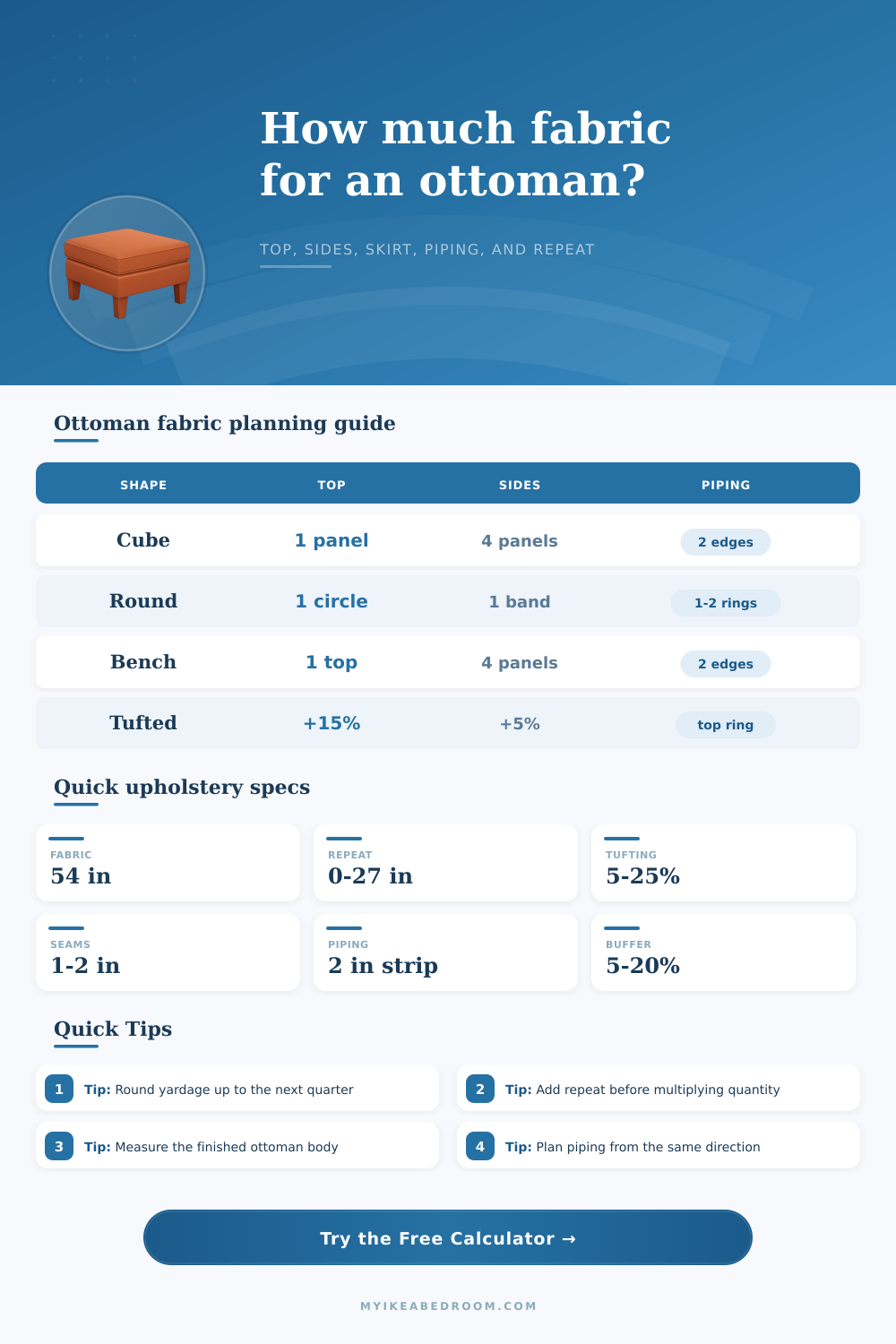
Estimate upholstery fabric for square, rectangular, round, and oval ottomans with top fabric, side or skirt panels, button tufting allowance, pattern repeat, piping length, and quantity.
Choose the closest build, then adjust the shape, dimensions, skirt drop, tufting, fabric width, pattern repeat, piping style, and quantity.
| Shape | Primary measurement | Perimeter basis | Top cutting note |
|---|---|---|---|
| Square ottoman | Finished width across the top | Four equal sides | One square top panel plus seam and tufting allowance |
| Rectangular bench | Finished width and depth | Two widths plus two depths | Long top panels may need repeat rounding along the length |
| Round pouf | Finished top diameter | Circumference from diameter | Top yardage uses a square cutting envelope for the circle |
| Oval ottoman | Finished width and depth | Oval circumference estimate | Top yardage uses an oval cutting envelope with allowance |
| Detail | Typical allowance | Calculator input | Use when |
|---|---|---|---|
| Plain tight top | 0% to 5% | Tufting allowance | The top is flat with light padding and no button pulls |
| Shallow button tufting | 8% to 15% | Tufting allowance | Buttons are visible but the depressions are not deep |
| Deep cocktail tufting | 18% to 30% | Tufting allowance | The fabric drops into a grid of deeper button wells |
| Separate cushion boxing | Perimeter times cushion height | Side style | The top cushion has its own band before the base panel |
| Fabric situation | Common entry | Yardage effect | Planning check |
|---|---|---|---|
| Solid or small texture | Repeat 0 | No repeat rounding | Check nap direction before cutting all panels |
| Small geometric print | Repeat 4 to 9 in | Small increase on top and bands | Keep side seams on the same motif line |
| Medium floral or stripe | Repeat 12 to 18 in | Each major cut rounds to repeat | Center the top panel before cutting boxing strips |
| Large statement repeat | Repeat 24 to 36 in | Can add a full repeat to each cut | Increase buffer if matching across corners matters |
| Piping layout | Length basis | Fabric strip basis | Best fit |
|---|---|---|---|
| No piping | 0 | No strip fabric added | Minimal modern ottomans and hidden seams |
| Top edge only | One perimeter | Perimeter times strip width | Box cushions and storage ottoman lids |
| Top and lower edge | Two perimeters | Both edge runs plus small joining allowance | Benches, cubes, and poufs with defined top and base |
| Full piping | Edges plus vertical seams | Extra strips for corners or panel joins | Tailored square and rectangular upholstered frames |
Yardage focus: lid top, cushion boxing, base panels.
Measure the lid separately if it overhangs the storage box.
Yardage focus: circular top and continuous side band.
The calculator estimates circumference and a square top cutting envelope.
Yardage focus: top allowance and pattern centering.
Use higher tufting values when buttons pull fabric into deep wells.
Yardage focus: extra drop and side panel height.
Enter the skirt as drop below the upholstered body, not total height.
Measure finished upholstery dimensions. The calculator assumes the visible ottoman width, depth, diameter, and body height before seam and turn allowances are added.
Cut patterned tops first. Center large motifs on the top, then cut boxing, skirt, and piping strips from the remaining layout so the most visible panel has priority.
An ottoman yardage calculator is a tool that allow you to calculate the amount of fabric that is necessary to cover an ottoman. An ottoman yardage calculator convert the individual measurements of the ottoman into a total amount of fabric because ottomans is rarely a single piece of fabric. In order to provide an accurate calculation to the ottoman yardage calculator, you must provide the individual measurements of your ottoman.
The area of the ottoman that fabric covers is the area of the top of the ottoman. That area is the width of the ottoman, the depth of the ottoman, and the thickness of the ottoman (or cushion). The area of the sides of the ottoman require fabric that covers the vertical body of the ottoman.
How to Use an Ottoman Yardage Calculator
If the ottoman feature a skirt, the vertical height of the ottoman must also include the length of the skirt. If the ottoman features tufting, the tufting require an additional amount of fabric in order to cover the depressions created by the buttons. An ottoman yardage calculator includes a percentage of fabric for tufting so that the ottoman does not appear too tightly when the buttons are fastened to the ottoman.
The amount of fabric necessary for an ottoman may change according to the type of fabric that is use for the ottoman. If the fabric feature a solid color, it does not feature a pattern repeat. If the ottoman fabric features a pattern repeat, the pattern may need to be waste in order to ensure that it is consistent on each of the sides of the ottoman.
To account for this, ottoman yardage calculators will round the length of each cut of the fabric up to the next full pattern repeat. Many individuals under-order the amount of fabric necessary for an ottoman because they dont account for this wasted fabric for the pattern repeat. An ottoman may include piping along the edges of the ottoman.
The piping may be included along the top of the ottoman, along each of the lower edge of the ottoman, or along each of the vertical seams of the ottoman. Each of these strips of fabric will require an additional strip of fabric to be purchased to allow for the piping to cover the edges of the ottoman. The ottoman yardage calculator will calculate this additional yardage.
The style of the side of the ottoman will change the vertical measurement of that side. For ottomans with tight upholstered bodies, the vertical measurement will use the height of the body of the ottoman and the seam allowance for that vertical cut of the ottoman. For ottomans with a separate cushion for the side of the ottoman, the vertical cut will also require the amount of fabric necessary for the boxing around that cushion.
For ottomans with skirts, the vertical measurement will be the height of the body of the ottoman and the skirt. For ottomans with slipcovers, the vertical cut will require additional fabric to allow for the slipcover to be easily remove for cleaning. Each of these changes will affect the vertical length of that side of the ottoman, and thus impact the total yardage of the ottoman.
A buffer percentage can be applied to the total amount of yardage of the ottoman to allow for mistakes in cutting the fabric. For example, mistakes can occur with shifting of the fabric from the pattern to the cutting table, or the pattern may not match on the corner joins of the ottoman. A common buffer is 10% for projects that use upholstery fabric.
However, if the ottoman features a large pattern repeat, a 15% or 20% buffer may be required. It is better to have extra fabric than to run out of fabric during the ottoman upholstery process. In order to avoid potential mistakes, it is important to measure the ottoman according to its finished size.
Ottomans are often measured according to the bare frame of the ottoman (or the foam within the ottoman) when ordered from a size chart. However, it is important to remember to include the thickness of the padding when measuring the ottoman for the yardage calculator. If more than one ottoman is to be covered by the same fabric, it is important to include the quantity of ottomans to be covered in the yardage calculator.
For example, if two ottomans are to be covered, the quantity should be entered into the calculator. Additionally, if the ottomans are to be covered with a patterned fabric, the pattern may need to be wasted on each ottoman to ensure that the pattern is the same on each of the sides of the ottomans. Thus, quantity will impact the amount of yardage of fabric necessary for the ottomans.
An ottoman yardage calculator will provide a breakdown of the yardage of each component of the ottoman. Each breakdown will include the yardage necessary for the top of the ottoman, the yardage for the sides or skirt of the ottoman, and the yardage for the piping of the ottoman. This yardage calculation allows the buyer to plan how the fabric will be cut.
For example, the top of the ottoman can be cut first with the largest portion of the fabric, and the remaining fabric can be cut to the size of the remaining component of the ottoman. Within the ottoman yardage calculator, there are various fields within which the measurements of the ottoman can be changed. Each of these variables will impact the yardage of the ottoman.
For example, altering the depth of the tufting will impact the yardage of the top of the ottoman. Adding a skirt will impact the yardage of the sides of the ottoman. Additionally, increasing the size of the pattern repeat will increase the yardage needed for both the top and sides of the ottoman because their measurements will be round to the next pattern repeat.