Cushion Curve Calculator
Estimate curved cushion arc length, segment panel area, boxing strip length, piping length, foam allowance, fabric repeats, and total yardage from chord width, curve rise, cushion thickness, seam allowance, and quantity.
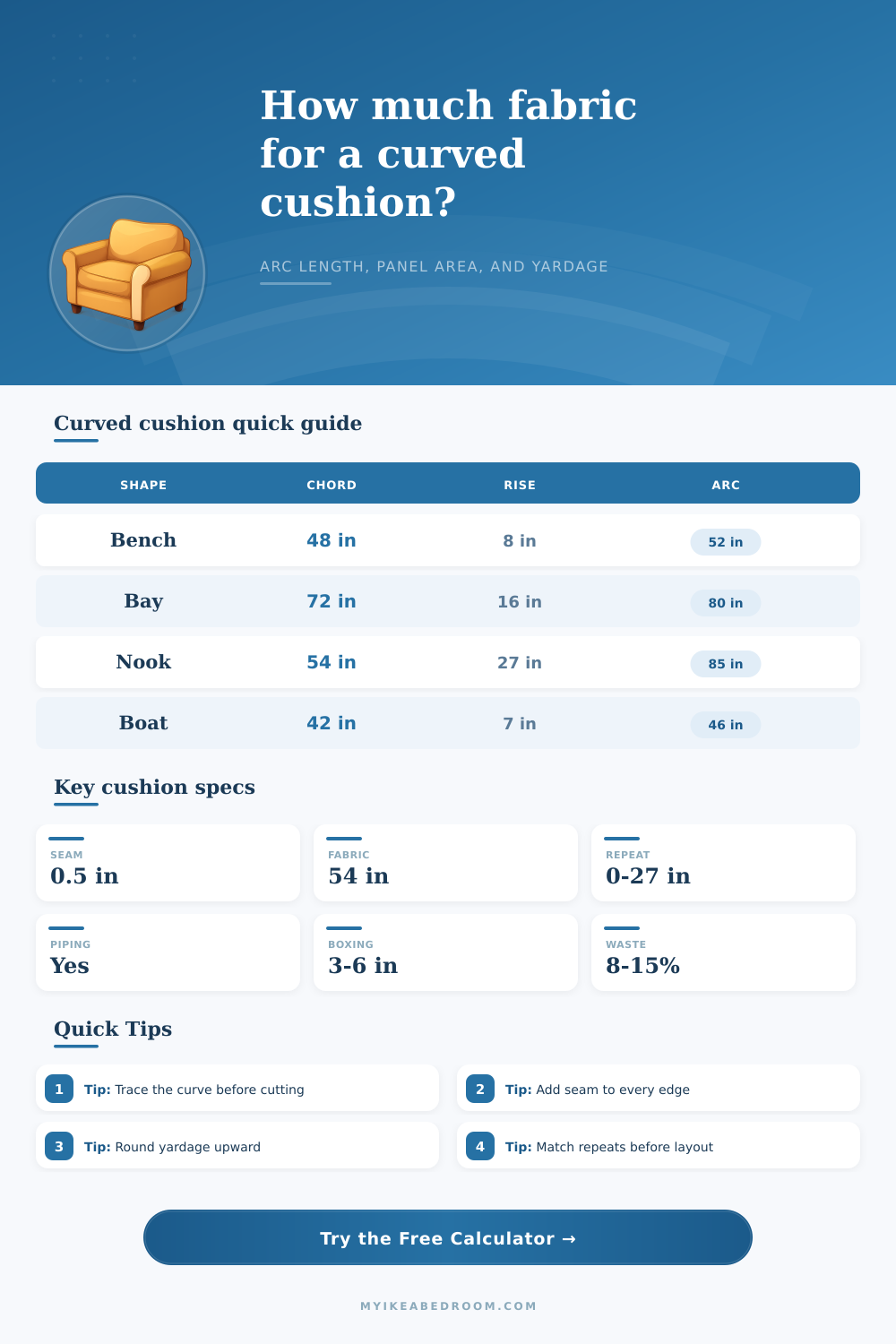
Choose the closest cushion shape, then adjust the chord, rise, fabric width, repeat, seam, boxing, and quantity for your actual pattern.
| Arc type | Best use | Area basis | Watch point |
|---|---|---|---|
| Circular segment | Bay window seats, curved benches | Radius and central angle from chord and rise | Very shallow rises make a large radius |
| Semicircle | Nook pads, half-round cushions | Half circle from chord as diameter | Rise is set to half the chord |
| Half ellipse | Wide ottomans and decorative pads | Half ellipse using chord and rise axes | Arc is shorter than a tall circle |
| Parabolic bow | Drawn templates with a center depth mark | Two-thirds of chord times rise | Needs several transfer points |
| Soft spline | Hand-shaped shallow cushions | Blended bow estimate | Trace paper is still the final pattern |
| Rise ratio | Curve feel | Typical cushion | Pattern note |
|---|---|---|---|
| 5% to 10% | Very shallow curve | Bench front or boat-style seat | Mark the midpoint carefully |
| 10% to 20% | Noticeable bow | Bay window cushion or banquette | Add enough boxing length |
| 20% to 35% | Deep curve | Reading nook or arched back pad | Check fabric direction |
| 50% | Semicircle | Half-round nook cushion | Chord becomes the diameter |
| Detail | Common range | Calculator input | Cutting effect |
|---|---|---|---|
| Seam allowance | 0.375 to 0.75 in | Seam allowance | Expands both panels and boxing width |
| Boxing width | 2 to 6 in | Finished boxing width | Controls strip fabric area |
| Piping | Top or both edges | Piping selector | Adds cord length around perimeter |
| Foam compression | 5% to 12% | Compression allowance | Suggests slightly thicker foam blank |
| Fabric width | Good for | Repeat behavior | Layout note |
|---|---|---|---|
| 45 in | Small pads and narrow benches | Repeats add length quickly | Expect more joins on large curves |
| 54 in | Most upholstery cushions | Works well for solids and small repeats | Often fits top and boxing efficiently |
| 60 in | Wide ottomans and long benches | Helps avoid piecing the panel | Check usable width after selvage |
| Directional nap | Velvet, corduroy, stripes | Use higher buffer | Keep every panel running one direction |
Curve: circular segment
Use when the wall or window line has a known chord and a measured center rise.
Curve: semicircle
Use when the cushion is a clean half circle and the chord is the diameter.
Curve: soft spline
Use for a hand-traced shallow arc where comfort matters more than a formal radius.
Curve: half ellipse
Use for wider, softer curves where the ends flatten into the straight edge.
Template first: Cut a paper or muslin template from the actual seat opening, then compare its chord and rise with the calculator before cutting upholstery fabric.
Repeat planning: For stripes, velvet nap, or a large motif, keep top, bottom, boxing, and piping strips oriented consistently before trusting the yardage total.
A cushion curve calculator is a tool that take specific measurements of a curved seat and outputs the number of length of fabric or the area of fabric that is required to create a cushion cover. When measuring a curved seat for a cover, the shape of that seat is both different from a rectangle and from an circle. Therefore, it is necessary to measure the distance of the seat from one end to the other (the chord width), as well as the distance from that straight measurement to the deepest point of the curve (the rise).
These two measurements will help the calculator to determine the amount of fabric necessary to cover the curved area. Beyond these two measurements, you must provide the amount of seam allowance that will be used for the top and bottom panels of the cushion and for the boxing strip (the decorative edging around the cushion) to the calculator. Seam allowance are added to the top and bottom panels to ensure that the panels will finish to the desired size of the cushion.
How to Use a Cushion Curve Calculator
Similarly, a seam allowance is added to the boxing strip so that the boxing strip will finish to the desired width. Should piping be used to decorate the top and bottom panels, the calculator will calculate the length of cord that is required for the piping. These seam allowances will increase the size of the pieces of fabric that will be cut.
In addition to providing the dimensions of the cushion and the amount of seam allowance that will be used, information regarding the pattern repeat and the width of the fabric is required. The pattern repeat is the distance between each identical motif in the fabric design. In the case that those design elements must align between the top panel of the cushion and the boxing strip, the calculator will increase the amount of fabric that is calculated to ensure that the pattern will land correct on the panels.
This prevents the individual from purchasing too much fabric. Finally, the calculator will include a waste percentage within the calculations for the same reasons that a waste percentage is added to the amount of fabric that is measured for the top and bottom panels: to account for mistakes in cutting the fabric and the direction of the fabric nap. The calculator will also consider the physical properties of the fabric.
One factor that should be considered is foam compression. When the fabric cover is placed upon the foam filling within the cushion cover, the fabric will compress the foam. Therefore, the calculator will add a percentage to the thickness of the foam to account for the compression of the foam by the fabric cover.
This ensures that the resulting cushion will not appear thin after it is used for long periods of time. Based off the factors that are provided to the cushion curve calculator, different results will be provided. Reference tables can be used to help an individual to decide upon the factors that will be entered into the calculator.
One table can illustrate the effect that the ratio of the rise to the chord width will have upon the resulting curve. Another table may indicate which arc types of curves are appropriate for ottomans that are to be wide in size, and which arc types of curves are appropriate for ottomans that are to be narrow in size. These reference tables can help ensure that the individual enters appropriate factors into the calculator.
It is important to understand the difference between the dimensions of the cushion cover that are finished versus the dimensions of the panels of fabric that will be cut. The length of the arc of the curve that the calculator calculates is the finished length of that arc, and is not the length of the cut portion of the arc. The length of the boxing strip that the calculator provides includes the seam allowance for that boxing strip.
Thus, the amount of fabric for the boxing strip does not need to be increased. Finally, the total amount of yardage of fabric that will be required will include the waste percentage and any adjustments for the pattern repeat. Thus, the total yardage of fabric that the calculator calculates is the amount of fabric that should of been ordered for the project.
Because the calculations that the calculator provides are based upon mathematics, the calculator is unable to account for the physical properties of each type of fabric. For instance, heavy velvets tend to have a strong nap, which means that each panel of fabric for the cushion must be cut in the same direction. Similarly, lightweight linen panels may shift during the process of tracing the template for the cushion, even though the linen does not have a nap.
Thus, the individual is required to use their own judgement as to whether the layout of the fabric indicated by the calculator will be successful in it’s sewing. One potential problem that can develop with the cushion cover that is created using these calculations is that the extra thickness of the foam may not be able to fit within the seat frame upon which the cushion will rest. Should the cushion be to be placed within a frame that allows for little extra thickness of the foam to be added, the individual may have to reduce the percentage of foam that is calculated to be required.
An alternative would be to use a firmer type of foam that will undergo less compression than soft foam fillings. The calculator cannot account for the size of the seat frame, therefore, so the individual will have to make these adjustments manually. Even with the calculations that the calculator performs, it may still be helpful to trace a template upon paper.
The calculators calculations are performed for a smooth curve, but the actual seat may have flats or dips in those curves. Thus, tracing a template upon paper will allow the individual to ensure the shape of the seat prior to cutting the fabric. Therefore, both the use of the template and the calculator can be beneficial to the individual.
If the calculator is to be used to calculate the amount of fabric for multiple cushions, the quantity field can be used. The quantity field will multiply the yardage calculations by the number of cushions that are to be created. Additionally, the quantity field will also apply the waste percentage to that total amount of yardage.
Thus, the quantity field can be beneficial when creating multiple identical cushions. Finally, using the quantity field also allows the calculator to account for the possibility that the individual may decide to rotate the pattern of the fabric that is to be used on each of the cushions. In conclusion, while the cushion curve calculator has removed the need for the individual to manually calculate the amount of fabric that will be required for a cushion cover of curved design, the calculator does not replace the individuals judgment.
The individual must decide upon the arc model that will best fit the design of the seat. The individual must also decide upon the amount of seam allowance that will be used for the project. Finally, the individual must decide whether the pattern repeat will require additional yardage of fabric.
The calculator will show the individual the cost of each of these decisions. Thus, by using such a calculator, the individual can focus upon the sewing of the cushion cover, since the calculator has allowed the individual to determine if they have enough fabric for the project.