Box Corner Cushion Calculator
Plan a boxed cushion cut list from finished width, depth, thickness, corner radius, boxing strip width, seam allowance, zipper placement, fabric width, pattern repeat, piping choice, quantity, and foam compression allowance.
Choose a common cushion type, then fine-tune the measurements and construction details for your exact cover.
| Part | Cut formula | Use for | Notes |
|---|---|---|---|
| Top panel | Width + 2 seams by depth + 2 seams | Main face | Corner radius stays on the seam line; add allowance outside it. |
| Bottom panel | Same as top panel | Underside face | Mark zipper direction before sewing boxing to the bottom panel. |
| Boxing strip | Perimeter + join allowance by strip width | Side wall | Join multiple strip pieces with seams placed away from corners. |
| Piping strip | Edge length plus join allowance | Corded edge | Bias strips bend best around rounded corners. |
| Finished thickness | Seam allowance | Typical cut width | Best use |
|---|---|---|---|
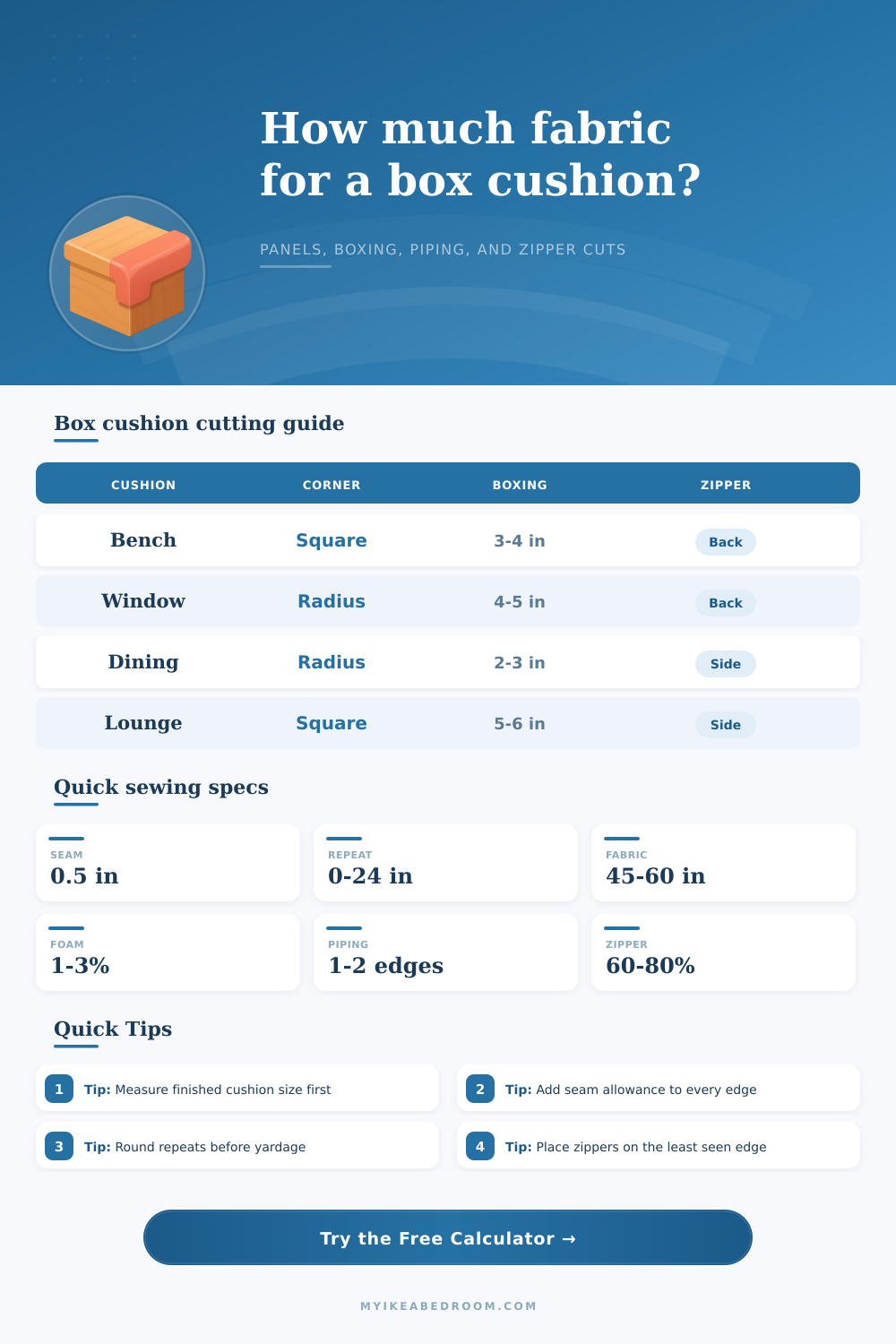
| 2 in | 0.5 in | 3 in | Dining chair pads and slim bench cushions |
| 3 in | 0.5 in | 4 in | Window seats, entry benches, and storage benches |
| 4 in | 0.5 in | 5 in | Bay seats, ottomans, and banquettes |
| 5 in | 0.5 in | 6 in | Outdoor lounge and daybed cushions |
| Placement | Estimated length | Best edge | Construction note |
|---|---|---|---|
| Back boxing edge | About 75% of width | Rear long edge | Good default for bench, bay, and window seat cushions. |
| One side edge | About 75% of depth | Least visible side | Helpful when the back edge is against a wall or frame. |
| Wraparound | About 45% of perimeter | Back plus corners | Easiest foam insertion for thick or firm cushions. |
| No zipper | 0 | Closed cover | Use only when the cover is not meant to be removed. |
| Fabric type | Repeat entry | Layout impact | Planning note |
|---|---|---|---|
| Plain solid | 0 in | Lowest yardage | Panels can be nested by cut size. |
| Small texture | 0-3 in | Small increase | Keep nap or grain direction consistent. |
| Medium print | 6-12 in | Moderate increase | Round the panel run to the next repeat. |
| Large motif | 18-27 in | Highest increase | Center motifs on top panels before cutting boxing. |
Simple layout: perimeter is width plus depth doubled.
Best for crisp bench pads, ottomans, and cushions with visible boxed edges.
Softer edge: radius shortens the straight boxing sections.
Best for dining pads, window seats, and cushions that slide into tight corners.
Cleaner top line: one perimeter of cord defines the upper face.
Use when the underside is rarely visible or the cushion sits in a recess.
Balanced finish: two perimeters frame both panel seams.
Use for ottomans, loose cushions, and pieces viewed from multiple angles.
Check the boxing width before cutting. If your entered boxing strip is much wider or narrower than thickness plus two seam allowances, adjust it before laying out fabric.
Keep the repeat direction consistent. For patterned fabric, center the top panel first, then cut boxing and piping from the remaining length in the same visual direction.
Box cushions is items that are used to provide comfort to individual while also maintaining the shape of benches or window seats. Box cushions are more structured than pillows; they are items that maintain their shape rather than slumping. The way that a box cushion is make will determine how the final box cushion will appear.
For instance, the way that the designer handles the corners of the box cushion and the sizing of the boxing strip will determine the way the box cushion will appear when it is completed. The dimensions of a box cushion once it is stuffed and zipped are referred to as the finished dimension of the box cushion. These dimensions will include the width, depth, and thickness of the foam of the box cushion.
How to Measure and Make a Box Cushion
The width will be the measurement of the box cushion from left to right. The depth will be the measurement of the box cushion from front to back. The thickness will be the height of the foam of the box cushion.
These three measurement are the fixed point of a box cushion design. Each measurement will need to incorporate the width of the seam allowance for the finished measurements to be correct once the box cushion is right side out. The width of the boxing strip will be the thickness of the foam plus two seam allowance.
This allowance for the seam will ensure that the foam will not sag or pull at any point. The corners of the box cushion will impact the mathematical measurement for its component. Corners that are to be square will require that the boxing strip be the length of the perimeter of the box cushion.
For corners that are to be rounded, the straight portion of the box cushion will need to be shortened, as well as the corners will need to be replaced with a curved portion of the same diameter as the rounded corners. The radius of the rounded corners will be measured on the finished seam line of the box cushion, not on the cutting line. This radius will be accounted for in the box cushion calculator to determine the length of the boxing strip.
The width of the fabric in yardage and the pattern repeat of the design will impact the yardage required to create the box cushion. A 54-inch bolt of fabric can usually contain one panel of fabric for box cushions with finished width of 50 inches or less. For box cushions that is wider than 50 inches, the panels will need to be laid side by side on the bolt of fabric.
For designs with large pattern motifs, more fabric may be required for each top panel so that each panel can be centered on the same part of the motif. The yardage calculator will add this length to the total yardage required to make the box cushion prior to applying the percentage for fabric waste. The placement of the zipper will impact the way that the box cushion is used.
If the box cushion is to be viewed from the front and the sides, a back-edge zipper will be used. A side zipper will be used for box cushions that will be placed against a wall. Wraparound zippers are generally used for thick outdoor cushion.
The length of the zipper will not be the full perimeter of the cushion. Instead, the length will be a percentage of the longest straight run of the box cushion design, as the zipper will need to end short of the corners of the box cushion. A percentage of 1-3% of the dimensions will be the compression allowance for the foam.
The calculator will add this percentage to each of the dimensions of the box cushion prior to calculating the size of the foam that should be cut. This extra fabric will ensure that the foam will compress into the box cushion to create a more snug fit for the foam within the cover. Too much of an allowance will strain the seams of the box cushion, while too little will cause the corners to “cave in” after the box cushion is used.
It is important to verify that the width of the boxing strip is correct after the measurements are set. If the boxing strip is too wide, the extra fabric may create soft folds along the side walls of the box cushion. If the strip is too narrow, the seam may sit on the face of the box cushion rather than being on the edge.
These issues can be fixed prior to cutting the fabric based off the measurements provided for the boxing strip. For piping, one perimeter will define the length of the top edge of the box cushion. Two perimeters of piping will frame the top and bottom edges of the box cushion.
Two perimeters of piping will allow for loose box cushions to be flipped face up. The length of piping will be calculated as the perimeter of piping multiplied by the number of edges selected, plus an allowance for the two ends of the piping to be seams in one end to the other. Most project design will not match the first sketch of the box cushion design.
For instance, a cushion that is to be placed within a window seat may have a rounded radius. A cushion that is to be placed within a dining room chair may have a side zipper to allow the cushion to be placed against the back of the chair rail. While the calculator will provide a starting point for the dimensions of the box cushion, the designer may benefit from creating a paper pattern of the cushion or creating a muslin pattern for the box cushion.
This step will allow the designer to avoid having to recut the fabric to fit the requirement of the area in which the box cushion will be placed. It is important to understand which dimension of a box cushion will be fixed and which will be adjustable. Dimensions that are to be fixed include the finished size of the box cushion, the seam allowance, and the thickness of the foam.
Adjustable dimensions may include the width of the boxing strip, the choice of piping, and the placement of the zipper. Once the designer has made decision regarding the adjustable dimensions, the mathematics involved in creating the box cushion becomes straightforward. The included calculator will handle the mathematics involved.