Roller Blind Size Calculator
Size roller blinds from recess width, recess height, mount type, fabric roll width, tube diameter, bracket deduction, control side, overlap allowance, bottom bar allowance, fabric thickness, and shade count.
Choose a common blind layout, then adjust the opening, overlap, tube, deduction, fabric, and control details for your window.
| Mount type | Width basis | Height basis | Best use |
|---|---|---|---|
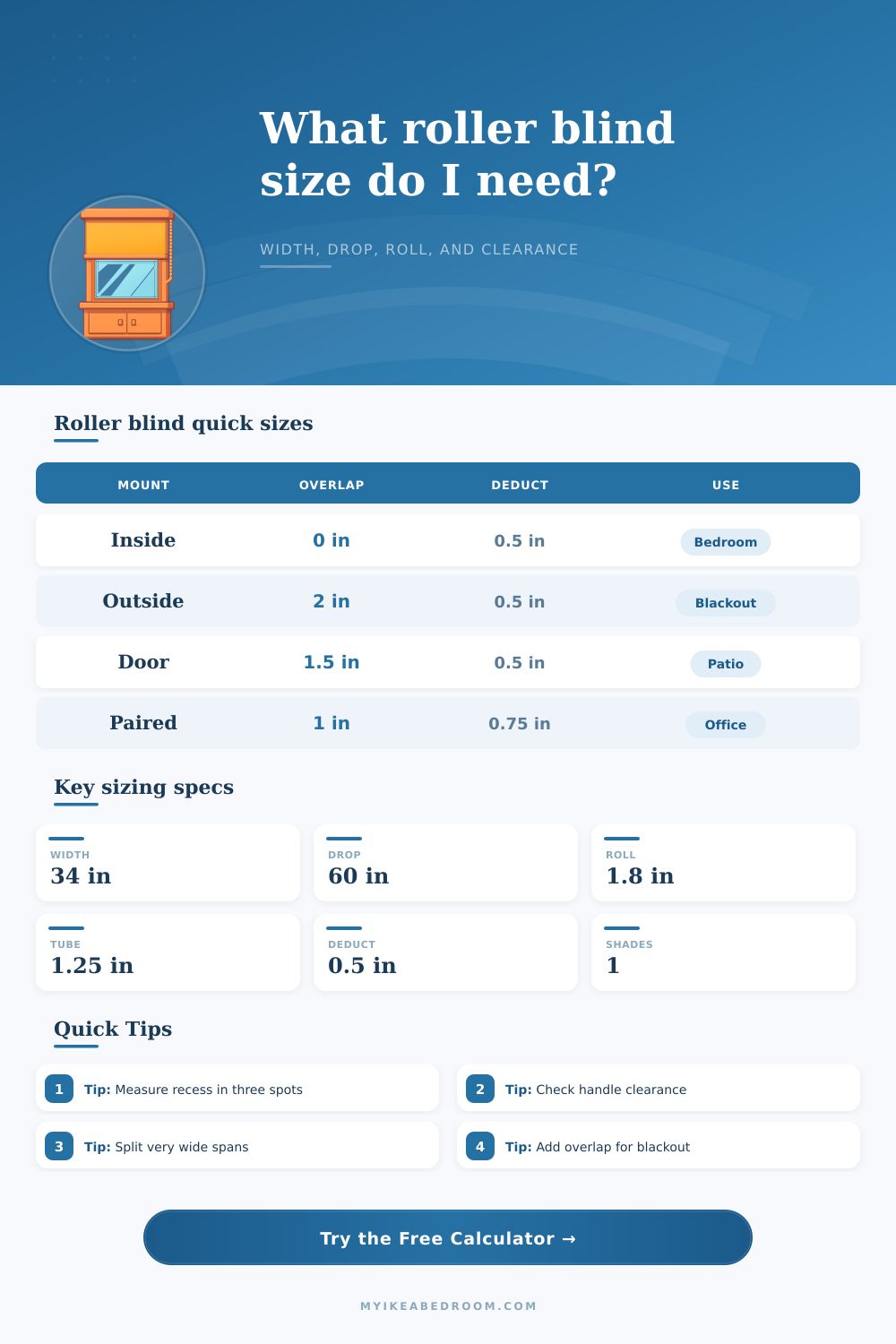
| Inside mount | Recess width minus bracket deduction | Recess height plus tube wraps and bottom bar | Clean fit inside a square, obstruction-free window recess. |
| Outside mount | Window width plus two side overlaps | Window height plus top and bottom overlap | Bedroom blackout or windows with shallow recess depth. |
| Ceiling mount | Covered span plus side overlaps | Drop from fixing line to sill or floor target | Alcoves, high windows, and broad wall-to-wall openings. |
| Door glass mount | Glass width plus narrow overlap | Glass height plus compact top and bottom allowance | Patio doors, sidelight glass, and swing doors with handles. |
| Paired mount | Opening split across shade count with center gaps | Same finished drop for each shade | Wide offices or shared bedrooms where one blind would be too wide. |
| Tube diameter | Typical blind width | Roll behavior | Planning note |
|---|---|---|---|
| 1.0 in tube | Up to about 36 in | Compact roll with less projection | Good for small bath, closet, and door glass shades. |
| 1.25 in tube | About 30 to 60 in | Balanced roll size and stiffness | Useful default for many bedroom and office roller blinds. |
| 1.5 in tube | About 48 to 84 in | Stiffer tube with larger roll diameter | Better for wide blackout fabric or taller drops. |
| 2.0 in tube | Very wide spans | Largest projection and better tube strength | Often paired with heavy fabric or commercial-style hardware. |
| Detail | Common range | Calculator field | Why it matters |
|---|---|---|---|
| Fabric side gap | 0.375 to 0.875 in total | Bracket deduction | Keeps the fabric clear of brackets, clutch, end plug, and control hardware. |
| Inside fitting gap | 0.125 to 0.25 in per side | Bracket clearance result | Leaves room for slightly out-of-square recesses. |
| Outside side overlap | 1.5 to 3 in per side | Overlap allowance | Improves privacy and blocks more light at the vertical edges. |
| Control clearance | 0.5 to 0.75 in | Control side | Allows chain, bead loop, motor head, or clutch to clear trim and handles. |
| Fabric type | Thickness range | Roll impact | Use in calculator |
|---|---|---|---|
| Sheer or screen fabric | 0.20 to 0.35 mm | Smallest roll for the same drop | Use the lower thickness values for airy privacy shades. |
| Light-filtering fabric | 0.30 to 0.45 mm | Moderate roll and easy operation | Good starting range for general bedroom daylight control. |
| Blackout fabric | 0.45 to 0.70 mm | Larger roll, especially on tall drops | Use the higher values when planning bracket projection. |
| Textured or backed fabric | 0.60 to 0.90 mm | Bulkiest roll and heavier tube load | Check roll diameter and split very wide openings if needed. |
Neatest recess fit
Finished width is deducted from the recess so the brackets can sit inside the frame.
Better edge coverage
Overlap is added to both sides and to the drop, which helps reduce daylight leaks.
Wide span control
Shade count splits a broad opening into narrower finished blind and fabric cut widths.
Handle-aware sizing
Uses compact overlap and reports clearance notes so the roll and control do not crowd hardware.
Use the tightest recess measurement: For inside mount, measure width at the top, middle, and bottom, then size from the smallest value before applying bracket deduction.
Check the rolled-up projection: The estimated roll diameter helps you spot conflicts with handles, trim, window locks, and shelves near the blind.
To size a roller blind corectly, you must understand that measuring a roller blind isnt a single number but involve several variable. When determining the measurement for a roller blind, you might think of measuring the glass of an window. However, this is an error.
You must measure for the brackets and the area that the blind’s fabric will cover the tube. Additionally, you must measure the recess widths, the recess height, and the fabric thick of the blind. The way you mount the blind will alter the measurements require for installation.
How to Measure a Roller Blind
For instance, if you opt for an inside mount, you will have to place the blind inside the window frame. Consequently, you will require precise measurement. Alternatively, if you opt for an outside mount, you will have to place the blind on the outside of the window frame trim.
An outside mount allow for an even overlap of the blind to prevent light from leaking from the blind’s sides. Furthermore, since an outside mount will cover more of the window area then an inside mount, you will have to order a roller blind with a greater width with an outside mount. Another variable to consider is the thickness of the fabric.
If you choose a blackout blind, the fabric will be thicker than a light-filtering blind. Additionally, the thickness will impact the blind’s roll diameter. A larger roll diameter will make the blind extend further from the wall.
Furthermore, if the blind extend too far from the wall, it might interfere with another object in the room, such as a window handle or shelf. You must consider the blind’s roll diameter before purchasing the blind. Another consideration is the blind tube’s diameter.
A small blind tube is suitable for narrow window. However, if the window is very wide, the small tube might not be strong enough to support the blind. In this case, a large blind tube can support the weight of the blind’s fabric.
However, the larger the blind tube’s diameter, the further the blind will extend from the wall. The last consideration is the bracket deduction. The brackets is essential to mount the blind.
You must leave some space in the blind’s fabric to avoid rubbing the blind against the blind’s hardware. Measure the width of the window in three different place. The frame of the window is not necessarily square.
When measuring the width of the window, use the narrowest measurement of the window frame to determine the width of the roller blind. If you use the widest measurement instead of the narrowest, your blind will not fit into the window recess. Additionally, measure any obstacle in the window, such as window locks, door handle, or curtain rods.
These objects will interfere with the blind if the blind is too wide or extend too far from the wall. When purchasing a blind, consider the fabric width of the blind. The finished blind width must account for the brackets and the bracket deduction.
If you do not include the bracket deduction in the finished blind’s width, the blind will extend beyond the mounting location on the wall. Finally, consider whether you need one large blind or several smaller blind. Using smaller blinds will make it more easier for you and your family to open and close the blind.
Additionally, using smaller blinds might allow you to find enough space in your window to mount the blinds.