Relaxed Roman Shade Calculator
Plan relaxed roman shade cut width, cut length, fabric yardage, lining yardage, center sag, bottom curve allowance, side returns, repeat adjustment, and ring row spacing from your window measurements.
Load a realistic soft shade setup, then adjust the window, mount, sag, curve, lining, repeat, and ring spacing to match your workroom plan.
| Mount type | Width basis | Built-in top allowance | Best use |
|---|---|---|---|
| Inside mount | Window opening plus hems | 3 in | Recessed shades where the fabric hangs inside the trim or frame. |
| Outside mount | Window width plus two side overlaps | 4 in | Better light coverage around trim with a relaxed lower edge. |
| Board mount with returns | Front width plus side return fabric | 5 in | Soft board-mounted shades that wrap back toward the wall. |
| Cafe relaxed shade | Short panel plus small hem allowance | 2.5 in | Half-height kitchen, bath, or door glass treatments. |
| Shade style | Center sag range | Bottom curve add | Visual result |
|---|---|---|---|
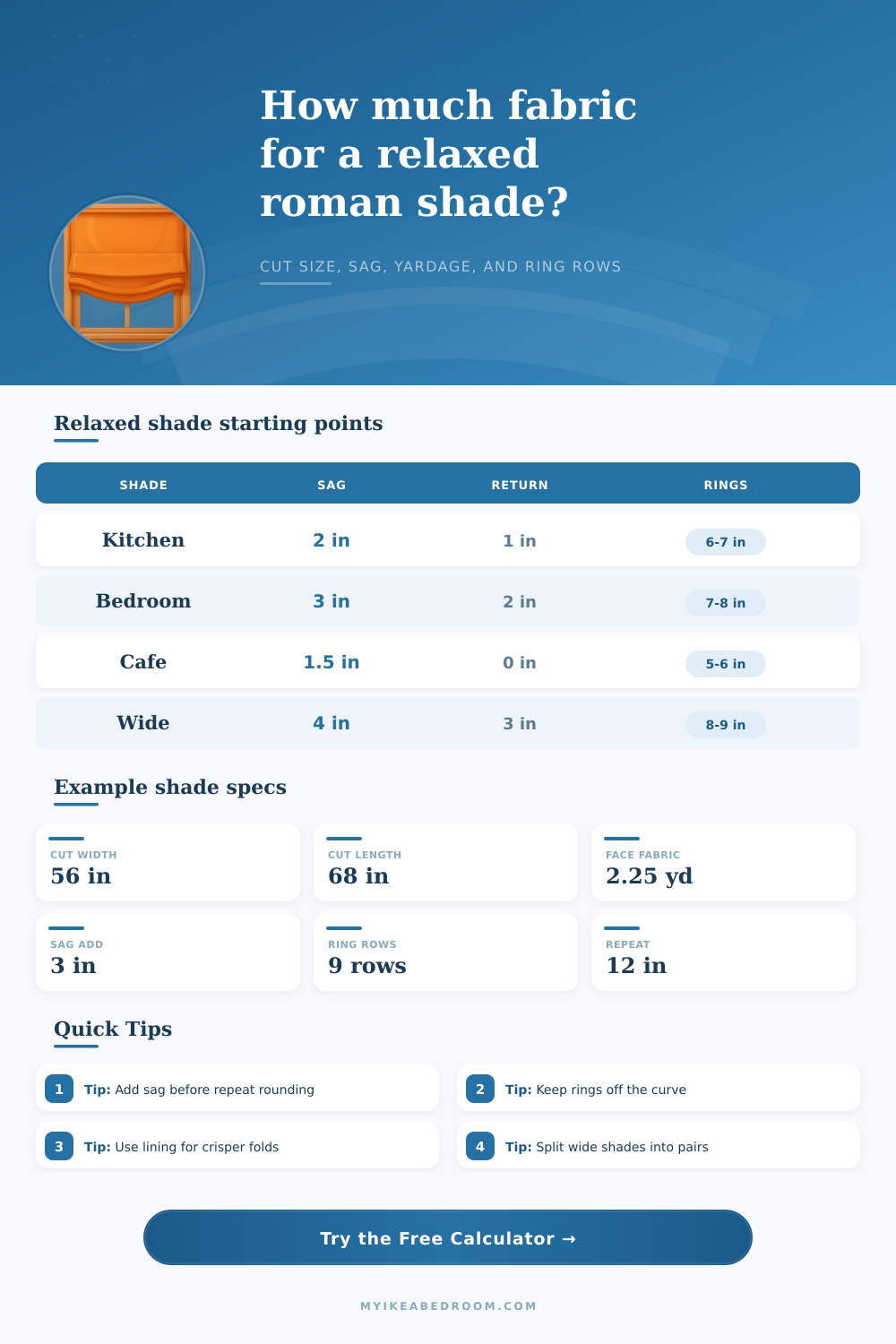
| Linen kitchen shade | 1.5 to 2.5 in | 1 to 1.5 in | Casual smile with a light, relaxed curve. |
| Bedroom relaxed roman | 2.5 to 3.5 in | 1.5 to 2 in | Softer drop that still stacks neatly when raised. |
| Wide casual shade | 3 to 5 in | 2 to 3 in | Deeper center dip so the shade does not look pulled tight. |
| Unlined sheer shade | 1 to 2 in | 0.5 to 1 in | Light curve without excess weight at the bottom. |
| Lining choice | Layer count | Cut length basis | Shade behavior |
|---|---|---|---|
| No lining | 0 lining layers | Face fabric only | Softest drape and least bulk, best for sheers and light linen. |
| Light sheer lining | 1 light layer | Raw cut length | Protects face fabric while keeping the relaxed drop fluid. |
| Privacy or blackout | 1 lining layer | Raw cut length | Adds body and opacity, with a slightly firmer lower curve. |
| Interlining plus lining | 2 support layers | Raw cut length twice | Fullest folds and more structure for decorative face fabrics. |
| Ring spacing | Finished height range | Typical row count | Planning note |
|---|---|---|---|
| 5 to 6 in | Short cafe shades | 5 to 7 rows | Good control on small relaxed panels and lightweight fabric. |
| 6.5 to 7.5 in | Kitchen and bedroom windows | 7 to 10 rows | Balanced lift spacing for most single-window relaxed romans. |
| 8 to 9 in | Tall or wide shades | 8 to 11 rows | Reduces hardware rows when the fabric has enough body. |
| 9 to 10 in | Very tall lined shades | 9 to 12 rows | Use with care so the relaxed bottom does not cup unevenly. |
Softest lower edge
Uses center sag and curve allowance so the shade forms a gentle smile instead of a flat bottom.
Straighter finish
Needs less sag fabric, but does not create the same casual center drop.
More side coverage
Side return fabric is useful when the shade projects from a mounting board.
Cleaner wide windows
Two narrower shades can avoid vertical joins and keep the relaxed curve controlled.
Keep ring rows above the curve: The row count is based on finished height with the sag zone protected, so rings do not pull the smile into a point.
Round repeat after allowances: Pattern repeat is applied after sag, curve, hems, and the mount allowance are included, which keeps printed motifs from landing short.
Relaxed roman shades are an type of window treatment that features a curved bottom edge and fabric that hangs in soft folds. A relaxed roman shade are not the same as a flat roman shade. A relaxed roman shade features a dip in the middle of the bottom edge of the shade.
The dip of the shade are created through the use of both a center sag and a bottom curve allowance. The center sag create the dip in the bottom of the shades fabric. The bottom curve allowance ensure that the bottom edge of the shade features a soft curve rather than a pointed edge.
How to Make and Measure Relaxed Roman Shades
If the manufacturer of the shade do not include the proper amount of both the center sag and the bottom curve allowance, the relaxed roman shade will appear even after it is hung onto the window. The type of fabric that is used for the relaxed roman shade will impact how the shade hang. For instance, fabrics like linen or linen blends is good fabrics for creating a relaxed roman shade since the linen fabrics holds a curve.
Cotton fabrics is also usable, but the cotton fabric should be relatively heavy to allow for the necessary amount of center sag. Sheer fabrics will require less center sag and a gentler bottom curve allowance since sheer fabrics can collapse if too much center sag are created. In addition to the type of fabric of the shade, the lining can also have an impact on the relaxed roman shade.
For instance, if the lining is used for privacy, the lining will add body to the fabric that allow the folds to remain even. However, if the lining is blackout lining, it will add some of the weight to the shade which will cause the bottom edge to hang lower. The type of mount for the relaxed roman shade will create change to the measurements for both the width and the top allowance of the relaxed roman shade.
For instance, if the mount for the relaxed roman shade is an inside mount, it will only require side hem. Outside mounts will create overlaps on the sides of the shade. Board mounts with returns will change the amount of fabric that is required for the sides of the shade.
Finally, if the relaxed roman shade is of the cafe style, it will only cover part of the windows glass and will have a smaller top allowance than a standard relaxed roman shade. The relaxed roman shade calculator is a tool that allows the individuals to calculate the amount of fabric and lining that will be required for the creation of the shade. The calculator will ask for the measurements of the window and the details of the fabric that will be used to create the relaxed roman shade.
Based on these inputs, the calculator will output the amount of yardage that is required for both the face and lining of the shade. Furthermore, the calculator will also account for any pattern repeat in the fabric. The calculator will also determine the number of rows of rings that will be needed to create the liftable portion of the shade.
The spacing of the rings will determine the evenness of the drape of the shade; if the rings is too far from one another, the shade may droop at the bottom of the shade. The rings should always be placed above the curve zone of the relaxed roman shade. If the rings are placed too low on the shade, they will create a downward pull of the fabric which will change the curve of the shade to a point.
The height of the rings from the top of the shade should be measured to the area where the center sag and the bottom curve allowance begins. This will ensure that the rings and hardware does not interfere with the relaxed portion of the shade. If the fabric features a large motif, such as a large floral or logomanufacturer design, the pattern repeat should be accounted for in the creation of the shade.
The length of the pattern repeat should be added after the length of the center sag and the bottom curve allowance of the shade. If the pattern repeat is not accounted for after the length of the center sag and the bottom curve allowance, the pattern may not align proper with the rest of the shade. By accounting for the pattern after the center sag and bottom curve allowance of the shade, the individual will not order more extra fabric than is required for the creation of the shade.
For large windows, it is often better to use two narrower relaxed roman shades instead of one wide shade. By using two narrower shades, the curve of the relaxed roman shade can remain controlled. Furthermore, using two narrow shades will prevent a long seam from being formed in the middle of the large window.
Many mistakes are made when creating a relaxed roman shade. For instance, it is common for the manufacturer to treat a relaxed roman shade as if it is a flat roman shade. Thus, they may often forget to add the amount of center sag and bottom curve allowance to the measurements of the fabric to allow for the pattern repeat.
In addition, many people will use the same amount of spacing between the rings on a relaxed roman shade as they will for a flat roman shade. However, a relaxed roman shade require extra room in the fabric for the curve and in the placement of the rings for the same reason. In addition to the fabric, the weight of the lining can impact the amount of drape that is created by the relaxed roman shade.
For instance, if the lining is blackout lining, it will add weight to the shade which will cause the curve of the shade to hang lower. Similarly, if the shade include an interlining, it will add thickness to the shade which will also impact the curve of the relaxed portion of the shade. In this instance, it is a good idea to order a small swatch of the interlining to determine how it will impact the curve of the shade before any fabric is cut.
Another factor that should be considered is the placement of the returns of a board-mounted shade. The amount of fabric that is used in the returns will impact the curve of the relaxed roman shade that is viewed from the side of the window. Too deep returns may result in the shade appearing lopsided from the side of the window.
Thus, it is a good idea to use modest returns to preserve the look of the shade when it is in its relaxed state. If a relaxed roman shade hangs in an uneven fashion after it is installed in the window, there are ways to adjust the shade to even out the hanging of the shade. The tension of the cords that hold the shade in place can be adjusted.
Furthermore, it may also be possible to add a small weight to one of the corners of the shade to even out the curve of the shade. The relaxed roman shade calculator allows individuals to determine the amount of fabric and lining that will be needed to create a relaxed roman shade. Furthermore, it will provide recommendations for the amount of yardage that will be needed for both the face and lining of the shade.
The calculator also accounts for any pattern repeat of the chosen fabric. Thus, the relaxed roman shade calculator provide the measurements that are necessary for the creation of the shade to hang correctly in the chosen window.