Lumens Per Square Foot Calculator
Measure room brightness from existing lumens, room size, purpose, ceiling height, wall reflectance, fixture spread, task zones, and dimming target.
Pick a common room target, then fine-tune dimensions, installed lumens, dimmer level, surface brightness, and lighting distribution.
Calculation breakdown
Enter room and lighting details to see the brightness recommendation.
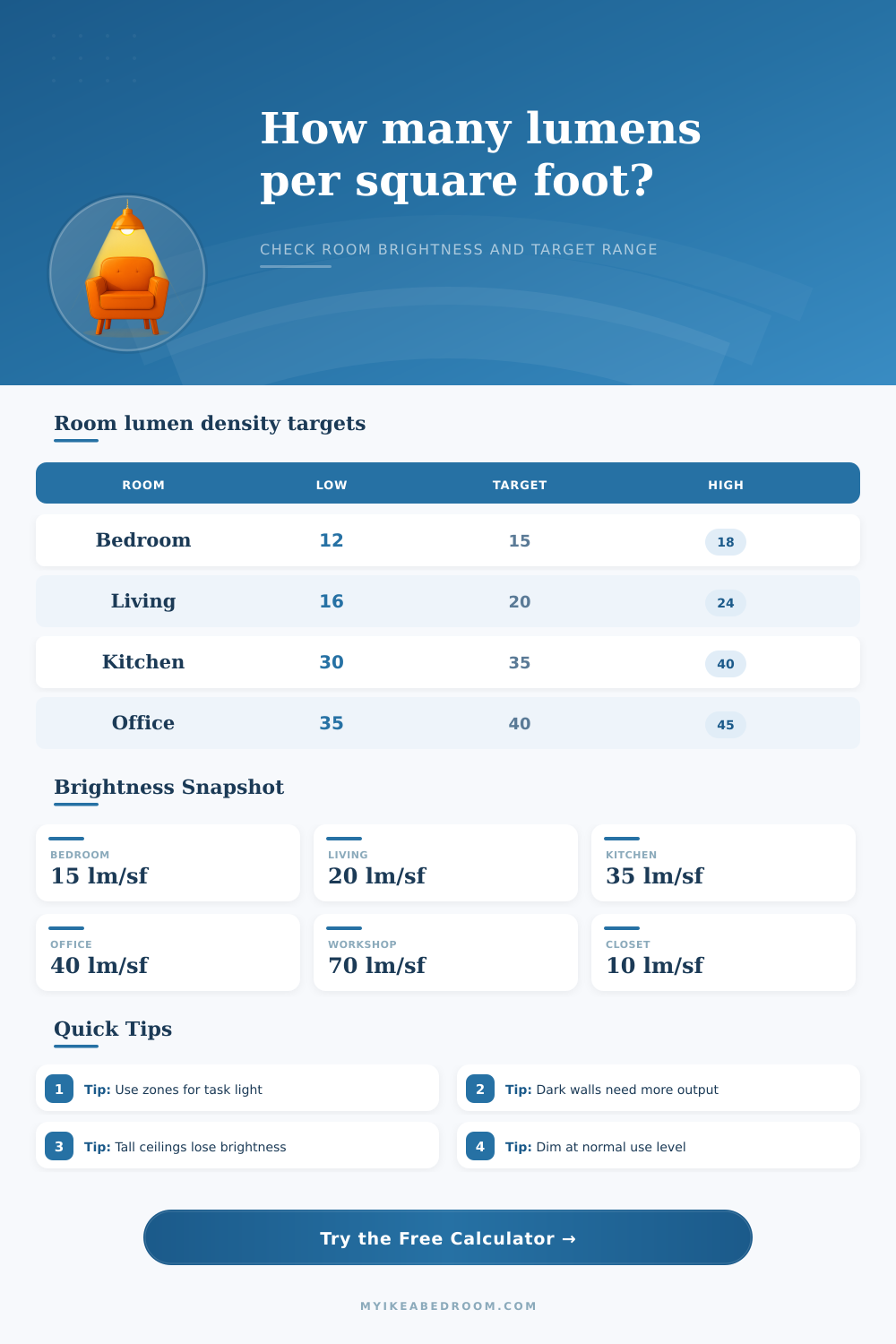
| Room purpose | Low range | Target | High range |
|---|---|---|---|
| Bedroom ambient | 12 lm/sf | 15 lm/sf | 18 lm/sf |
| Living room | 16 lm/sf | 20 lm/sf | 24 lm/sf |
| Kitchen general | 30 lm/sf | 35 lm/sf | 40 lm/sf |
| Closet | 8 lm/sf | 10 lm/sf | 12 lm/sf |
| Home office | 35 lm/sf | 40 lm/sf | 45 lm/sf |
| Workshop | 60 lm/sf | 70 lm/sf | 80 lm/sf |
| Dining room | 20 lm/sf | 25 lm/sf | 30 lm/sf |
| Bathroom vanity | 35 lm/sf | 45 lm/sf | 55 lm/sf |
| Condition | Multiplier | Use when | Calculator effect |
|---|---|---|---|
| Very light walls | 0.95x | White or pale surfaces with strong bounce | Slightly lowers target lumens |
| Light walls | 1.00x | Typical bedroom, living room, or office paint | Normal reference target |
| Medium walls | 1.08x | Mid-tone color or moderate wood surfaces | Adds lumens for absorbed light |
| Dark walls | 1.20x | Deep color, brick, dark panel, or matte finish | Raises target and score difficulty |
| 9 to 10 ft ceiling | 1.08x | Fixtures sit higher than standard rooms | Adds vertical loss allowance |
| 11 ft plus ceiling | 1.18x | Tall room, loft, or vaulted area | Adds more brightness reserve |
| Distribution | Base score | Best fit | Watch point |
|---|---|---|---|
| Single central fixture | 58 | Small rooms and closets | Edges and task areas may be dim |
| Balanced ceiling layout | 90 | Bedrooms, living rooms, kitchens | Fixture spacing still matters |
| Perimeter or wall wash | 74 | Accent walls and soft ambient glow | Center task zones may need help |
| Layered task plus ambient | 94 | Kitchens, offices, workshops | Balance task and ambient shares |
| Track or adjustable heads | 82 | Art walls, closets, flexible rooms | Aiming can create uneven patches |
| Wall sconces or uplights | 80 | Dining rooms, bedrooms, halls | Check ceiling and wall bounce |
| Task zone | Typical add-on | Useful in | Calculator note |
|---|---|---|---|
| Reading or bedside | 250 to 500 lm | Bedrooms and living rooms | Use focused lamps rather than raising the whole room |
| Desk or homework | 500 to 900 lm | Offices and kids rooms | Count as one task zone per seated workstation |
| Counter or prep | 700 to 1200 lm | Kitchens and laundry rooms | Task layer should land on the work surface |
| Workbench | 1200 to 1800 lm | Workshops and utility spaces | High-density work benefits from dedicated fixtures |
| Closet focus | 300 to 600 lm | Wardrobes and storage rooms | Distribution matters more than total density |
Best for closets, bedrooms, entries, and calm evening spaces where task lights can handle focused work.
Works for living rooms, dining rooms, and multipurpose rooms when the fixtures are spread evenly.
Fits kitchens, bathrooms, offices, and laundry areas where the room needs bright visual clarity.
Reserved for workshops, craft benches, and utility rooms with layered fixtures and good glare control.
Lumens per square foot can help a person to understand how much light is falling on the surfaces within the room. If a person feels that a room is either too dark or too bright, lumens per square foot can help to provide an exact numbers to those feelings. In order to calculate the amount of lumens per square foot that are required for a room, a person can enter the dimension of the room, the type of light fixtures that are within the room, and the purpose of the room.
The calculator will mathematically determine the number of lumens per square foot that will provide the best lighting for that specific room. The purpose of the room is one of the primary factors to consider when calculating the lumens per square foot requirements of a room. For example, if a person will primarily use a bedroom for resting, there will be fewer lumens per square foot requirements for that room than a kitchen that may require bright lighting to allow individuals to read recipes.
Find the right lumens per square foot for your room
Additional factors that impact the requirements of lumens per square foot are the color of the walls in the room. Dark walls will absorb more light than light walls, meaning that there will be a higher requirement for lumens per square foot in a room with dark walls compared with a room with light walls. The calculator accounts for the color of walls so that a person does not has to remember the reflectance values for each type of wall color.
The height of the ceiling within the room is another of the primary factors that will impact the number of lumens per square foot within a room. If the height of the ceiling is greater than 8 or 9 feet, it is possible that the light fixtures will not distribute enough light to the surfaces within the room. Therefore, if a person selects a height for the ceiling that is above 8 or 9 feet, the calculator will increase the number of lumens per square foot in the recommendation to ensure that individuals do not purchase too few light fixtures for the room of that height.
Additionally, the calculator can track the number of “dimming” levels that will be used within the room. For example, if individuals will only use the lights within the room at 70 or 80% brightness, the calculator will show the number of lumens per square foot at which the room will remain bright and visibly if those light levels are used. Another of the main factors to consider is the presence of “task zones” within the room.
Task zones are areas within the room that require more light than the rest of the area of the room. For instance, while a single light fixture can brighten the entirety of a room, additional fixtures may be required within task zones like desks or countertops within the kitchen. By entering the number of task zones into the calculator, a person can set each task zone to receive a specific number of lumens.
Furthermore, by adding a lamp to one of the task zones, the lighting within that area will be brightened without sacrificing the lighting of the remainder of the room. Many times, individuals will purchase additional lighting for the whole room instead of purchasing a lamp that will only brighten the task zone where it is needed. Fixtures can be distributed in various ways throughout the room.
For example, adding a fixture in the center of the room will not provide the same amount of light to the edges of the room as it will to the center of the area. Furthermore, distributing the light fixtures in a way that prevents any portion of the room from being excessively bright while other areas of the room are too dark will ensure that each portion of the room is well-lit. The room will earn the highest score from the calculator if the user distributes the light fixtures in a balanced and layered way, preventing any dark areas within the room.
The calculator will indicate if the distribution of the fixtures within the room may be problematic so that the individual can fix the lighting distribution prior to purchasing the fixtures. Finally, two additional factors that may influence the amount of lumens per square foot that are required for the room are the reflectance of the walls in the room and any headroom for dimming the lights. If the walls of the room are light colors, those colors will reflect the light into the area, increasing the amount of light within the space.
Therefore, if the walls are light colors, fewer lumens per square foot will be required in comparison to a space with dark walls. Furthermore, if individuals will dim the lights in the rooms to increase the life of the bulbs and reduce light pollution, the calculation will have to increase the number of lumens per square foot that are installed to ensure that the lights will still provide enough light to the area when they are dimmed. Common mistakes made by individuals include purchasing the correct amount of lumens per square foot for a room, but then finding that the lighting within the room is either too dark or too bright.
This is typically made possible by purchasing the recommended amount of lumens per square foot suggested by the calculator yet not considering other factors, such as fixture placement or the color of the walls in the room. By taking a few moments to consider each of these factors, the individual can purchase the recommended amount of light fixtures for the room. By using the lumens per square foot calculator prior to shopping for light fixtures, an individual can save themself the money that would typically be spent buying additional fixtures after they have purchased the first set of fixtures for the room.
While the lumens per square foot calculator can determine the amount of light that is required for the room, there are additional variables of the room that the calculator cannot account for. For example, the placement of furnitures within the room may change the lighting that is required for various portions of the room, such as a home office that may require different lighting for video calls than for completing paperwork. While the calculator will give an individual a recommended amount of light for the room, the individual should also walk through the room with the lights on to determine if the amount of lumens per square foot is within the target range for the room.
If the amount of lumens per square foot is within the target range for the room, and if the distribution of the light fixtures within the space is even, there may only be the need for small changes to the lighting of the room. The consideration of lumens per square foot will shift the individual’s focus for the lighting needs of the room away from the number and type of light fixtures that will be purchased, to the amount of light that will fall on the area that is required to be bright. If the calculation of the required amount of lumens per square foot for the entire room indicates that there is a need for additional light, there are various lighting choices that can be considered and evaluated.
For instance, it may be possible to increase the general lighting in the room, adjust the placement of the light fixtures in the room, or even increase the amount of light provided to task zones within the area. Each of these choices will have an effect on the cost of lighting the area. Therefore, the calculation of the amount of lumens per square foot for the area is the starting point for all lighting decisions for that area of the room.