Lux to Lumens Calculator
Convert metric illuminance targets into total rated lumens using room area, utilization factor, maintenance factor, ceiling height, surface reflectance, fixture count, beam spread, and task category.
Load a typical lux target, then fine tune the room shape, reflectance, utilization factor, fixture count, and beam angle for your layout.
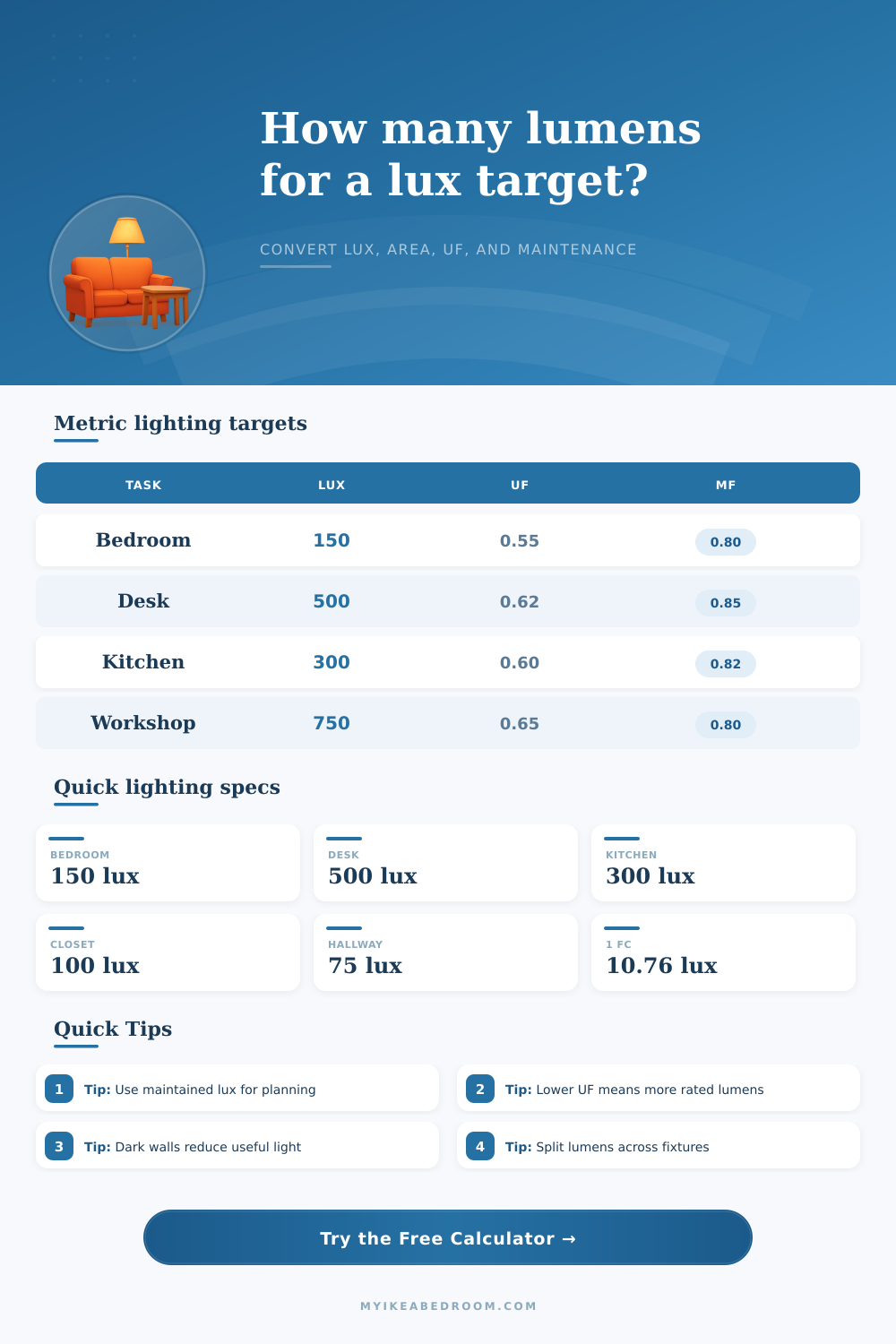
Utilization matters: The simple conversion is lux times square meters, but real layouts need UF and MF because not every rated lumen reaches the task plane after reflection, fixture optics, dirt, and aging.
Check coverage separately: A room can have enough total lumens but poor uniformity. Beam spread and fixture count help show whether the light is likely to overlap evenly.
Lighting design involve a measurement of light and create comfort in human environments. There is often a large distance between the lux value that is targeted and the actual light that fall on a persons working area. The lighting design calculator help to minimize this distance between target and actual light levels.
It calculates the total amount of lumens that a space need to provide for the target lux value, taking into account the effect that real-room conditions will have upon the light that is distributed into the space. Real-room conditions include the way that light is lost due to dirty fixture or aging fixtures, as well as the geometry of the space itself. Lux is a measurement of light density.
What a Lighting Design Calculator Does
Lux isnt a measurement of the total amount of light that exist in a space. One lux is equal to one lumen per square meter of area. The size of the area that is to be illuminated will always be impacted by the total light levels for a space.
The lighting design calculator account for this concept in determining the total lumens requirement for a space. If the target lux value is increased, the total lumens will increase accordingly. The fixtures will actually output the portion of the light that the utilization factor is applied to the target lux value to account for into the working area of a space.
This portion of the light is lost due to the reflection of light off of the fixture itself, the geometry of the space, and the amount of light that is reflected off of the surface of that area. A low utilization factor mean that most of the light that the fixtures create is being lost before it can reach the workspace. The maintenance factor calculation works in the opposite direction of most human intuitions.
The maintenance factor do not add to the total lumens of a fixture; it subtracts from that total. The maintenance factor accounts for the loss of light output from dirty lenses, yellowing diffusers, and the reduction of light output from LED fixtures after thousands of hour of operation. The lighting design calculator multiplies the utilization and maintenance factors together to determine the total number of lumens that are require to provide the target lux value.
The maintenance factor is applied to the calculation to determine the total light output. The total light output from all the fixtures is multiplied by a surface-reflectance modifier. The purpose of this modifier is to reflect the difference in brightness between various surfaces in a space.
Light reflects off of bright walls and ceilings, but dark surfaces absorb it. The ceiling height of a space is often referred to in lighting calculations. As is the height of the task plane.
These two measurements is used to calculate the light distribution of the fixtures that will be installed in the area. The light that spread from the fixtures will diminish with distance. The lighting design calculator can calculate the footprint of the beam of light from the fixtures based on the angle and height of the fixtures.
Based on this calculation, the area that the light will illuminate within the space can be compared to the total area of the space. The coverage efficiency score is a number that can be used to determine whether or not the placement of the lighting fixtures will provide an even distribution of light to the area. A high efficiency score indicate that most of the light from the fixtures will land on the task area.
A low efficiency score indicate the need for more fixtures or a change in the beam angle of the fixtures. The reference tables are used to help establish a target lux value. The tables reflect the lux levels that are required for various lighting task in a space.
These lux values are not rigid standards to which all spaces must adhere. For instance, most residential spaces do not require the same lux levels for different tasks in the home. A bedroom does not require the same lux value for sleeping as it does for reading.
A kitchen work area will require higher lux values than a residential living area. These values are established in the tables to provide designers with insight into whether their target lux value is conservative or ambitious in comparison to other residential spaces. It is common for designers to make mistakes.
Often, lighting designers treat the lighting design calculator as a one-time calculation to be perform once the selection of fixtures for a space. Instead, the calculation should be performed as a means of determining the types of lighting fixtures that is required to fulfill the target lux values. If the total lumens of the available lighting fixtures is less than the lumen total that the lighting design calculator calculates, the designer will have to acquire additional lighting fixtures for the installation site.
An understanding of the factors that contribute to the total light output of the fixtures is essential for lighting designers. The designer must have an understanding of the way that the light will be lost due to the utilization factor, the maintenance factor, and the reflectance of the surfaces within the space. Furthermore, the designer is also responsible for understanding the impact that the beam spread will have on the amount of evenness of the lighting within the space.
A narrow beam will illuminate a small area brightly, but the remainder of the area will be dark. A wide beam will provide even lighting to an area, but each fixture will emit less light into the space. The coverage efficiency score helps to indicate whether or not the evenness of light will be maintained with the fixtures that are to be implemented into the space.
If the coverage efficiency score is low, then the lighting designer can determine whether more lighting fixtures are needed, or if the beam angle of the fixtures can be increased. The concept of surface reflectance is one that lighting designers often miss. Many spaces have dark walls, whereas others have bright and white colored ceilings and walls.
These differing reflectances will impact the amount of light that is reflected back into the space. A change of the surface reflectance settings from light to dark will change the total amount of lumens that will be required to provide the target lux value. The lighting design calculator will output a total amount of lumens to the designer.
This total lumens value is the total amount of light that all the lighting fixtures that will be installed in the space will emit. This total lumens value is not to be directly ordered from the lighting manufacturers, however. There will be additional considerations of the actual light output that each type of fixture will emit.
This total lumen value is used to create a baseline value for the lighting fixtures that are to be implemented in the space. From this starting point, there will be additional comparisons of each fixture type’s light output. Based on these comparisons, the designer can make an informed decision about the type of lighting fixtures that will be purchased for the installation site.
The lighting design calculator accounts for all the variables in lighting design. It can take into account the impact of each factor on the total amount of lumens that will be required for the space. Thus, the calculator removes guesswork from the lighting design process; all that is required from the designer is the geometry of the space and the target lux values for the area.