Ceiling Slope Calculator
Calculate ceiling angle, pitch ratio, low-to-high height difference, and usable clearance zones for attic bedrooms, vaulted rooms, shed ceilings, closets, stairwells, and knee-wall layouts.
Pick a room shape, then fine tune rise, run, span, wall heights, ceiling type, fixture clearance, and insulation thickness.
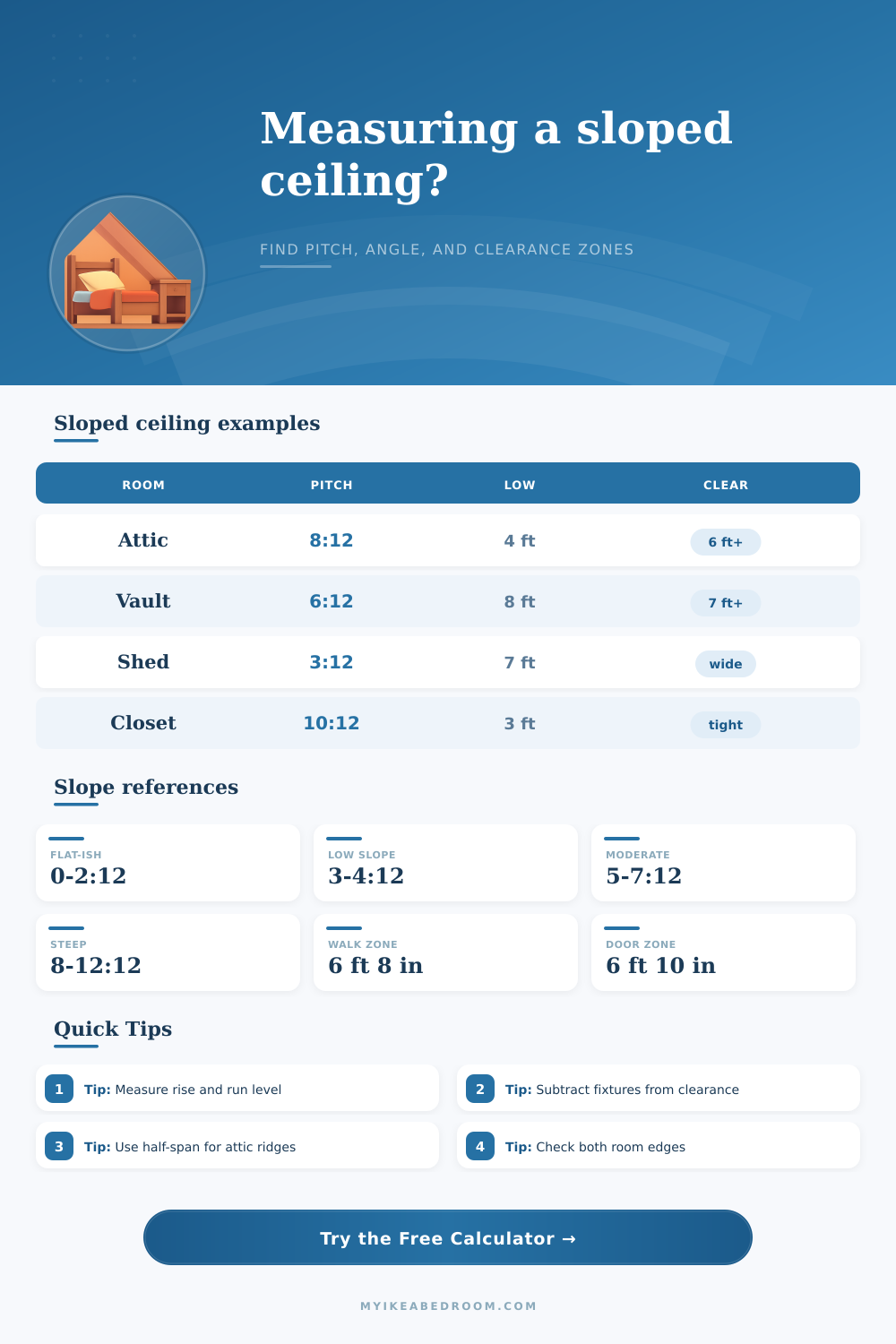
| Pitch | Angle | Height gain over 10 ft | Room planning note |
|---|---|---|---|
| 2:12 | 9.5° | 1.67 ft | Gentle ceiling, long clearance zone |
| 4:12 | 18.4° | 3.33 ft | Noticeable slope, furniture still flexible |
| 6:12 | 26.6° | 5.00 ft | Common vault or attic pitch |
| 8:12 | 33.7° | 6.67 ft | Steeper attic, clearance changes quickly |
| 12:12 | 45.0° | 10.00 ft | Very steep, strong knee-wall effect |
| Ceiling type | Span input | High point | Calculator treatment |
|---|---|---|---|
| Attic or gable | Full room width | Ridge at center | Uses half the span as the sloped run |
| Vaulted ceiling | Low wall to ridge | Ridge or tall wall | Uses entered span as the sloped run |
| Shed ceiling | Low wall to high wall | One tall side | Calculates one continuous plane |
| Stairwell ceiling | Horizontal stair run | Top landing side | Shows grade and headroom sensitivity |
| Sloped closet | Back to front depth | Door or front wall | Highlights usable storage depth |
| Clearance line | Imperial | Metric | Useful planning zone |
|---|---|---|---|
| Low storage | 4 ft | 1.22 m | Drawers, bins, shelves, low wardrobes |
| Desk / seated | 5 ft 6 in | 1.68 m | Desk, dresser, nightstand, seated tasks |
| Walkable | 6 ft 8 in | 2.03 m | Main walking path and bed-side approach |
| Door swing | 6 ft 10 in | 2.08 m | Doors, tall panels, wardrobes, tall storage |
| Room scenario | Typical pitch | Low wall | Planning focus |
|---|---|---|---|
| Attic bedroom | 7:12 to 10:12 | 3 ft to 5 ft | Center walking zone and bed placement |
| Vaulted primary room | 4:12 to 7:12 | 8 ft+ | Fixture drops and fan clearance |
| Shed ceiling room | 2:12 to 5:12 | 7 ft to 9 ft | Tall storage on the high wall |
| Sloped closet | 8:12 to 12:12 | 2 ft to 4 ft | Rod height, shelf depth, drawer access |
0°
Calculated from the active pitch mode.
0 ft
Clearance zone if the same low wall used a 4:12 pitch.
0 ft
Clearance zone if the same low wall used a 6:12 pitch.
0 ft
Clearance zone if the same low wall used a 10:12 pitch.
Measure horizontally, not along the ceiling: Run and span should be level distances. If you measure along the sloped face, use the calculator's slope length only as a check, not as the run input.
Clearance is reduced by anything below the finish plane: Fixtures, track rails, beams, thick finishes, and insulation build-down can turn a visually open area into a tighter usable zone.
The angle of the ceiling within a room can determines how the room will function. The angle of the ceiling will determine whether the room feels openly or as if it is cramped. Additionally, the angle of the ceiling will dictate where the bed within the room is to be placed, as well as whether the dresser within the room can open without hitting an drywall of the room.
Therefore, the ceiling angle within a room must be measured prior to the completion of the room. The pitch of the ceiling will determine the amount of headroom that is within the area that is to be used as a living space. Steep ceilings will allow headroom only in the center of the room, reserving the side of the room for storage purposes.
Measure the Ceiling Angle and Headroom
In contrast, ceilings that has a gentle pitch will allow headroom throughout the entire space, but reduce the amount of storage that can be incorporated into the room. Each of these different types of ceiling pitches will affect the way in which an individual moves within their rooms. The calculator can be used to mathematically calculate the ceiling angle for a room once each of the measurements for that room are enter into the calculator.
The rise and the run for the sloped ceiling will allow for the angle of the ceiling to be calculated, as will the span of the room. The height of the low wall of the room and the height of the high wall will allow for the angle of the slope to be calculated. Each of these measurements will allow for the calculation of each of these variables.
Each of these measurements is taken before subtracting the height that the installation of insulation and light fixtures within the ceiling will take. These calculations are provided as a means of providing an estimate of the parameters of the ceiling for planning purposes, as they are not intend to provide an exact figure. In addition to focusing upon the angle of the ceiling that is to be built, it is additionally important for those who intend to read the parameters of the ceiling to also consider the amount of usable clearance that will exist within the ceiling area.
While the steep attic that may exist in the ceiling may allow for a dramatic angle to the ceiling, the steep attic may only provide limited headroom in the middle of the room. In contrast, a shed ceiling that is of a more moderate pitch may allow for the majority of the area within the room to be usable for those who live within the house. Each of these variables, such as ceiling clearance and the thickness of the insulation within the room are important variables to consider prior to the building of the ceiling.
For instance, if the room is to contain six inches of recessed lighting fixtures and several inch of rigid insulation, the ceiling will not allow for the ceiling height to be as calculated. The calculator can adjust the calculations within to account for these variables. Various types of ceilings will change the way in which the calculations for the angle of the ceiling are performed.
For instance, attics that contain a center ridge will only have half of the span of the room to be used in calculating the rise and the run of the ceiling. Additionally, shed ceilings will have a different height to the ceiling then attics that contain a center ridge. Finally, stairwells may require that the ceiling be clear of the steps that are to be constructed within the room, which will alter the low point of the ceiling.
Reference tables are provided for the different ceiling slopes and their angles. Each of these tables allow for individuals to compare the angle of the ceiling within their house to attic ceilings and bedrooms, for instance. Such tables indicate, for instance, that pitches of 6:12 will result in angles of 26 degrees, and will result in five feet of height change within a ten-foot run of the ceiling.
Additionally, pitches that are steeper than 6:12 will move the usable zone towards the center of the house, while the 6:12 pitch will allow for both the center of the room and the edge of the room to remain usable. Many individuals may make mistakes when attempting to calculate the angle of the ceiling. For instance, one mistake may be to measure the run of the slope of the sloped ceiling of the house rather than measuring the horizontal run of that ceiling.
Additionally, individuals may not account for the ceiling height that will be required for doors or storage within the house. These variables is listed within the calculator to allow individuals to understand the needs of the house based off the calculated ceiling. In addition to these calculations, there are other considerations within the house that are outside the calculations provided by this tool.
For instance, structural beams may extend into the ceiling slope at heights that are outside of those calculations. Ducts for HVAC systems may extend into the ceiling at heights that are lower then the calculated heights. Finally, windows may require headroom above the window sash to allow the window to open.
Each of these considerations may interact with the calculations provided by the tool. If the parameters that are entered into the calculator are adjusted, the parameters that are provided within the calculator will change. For instance, moving the low wall of the house up by one foot will increase the usable area of the ceiling, as long as the pitch of the ceiling is moderate.
Additionally, increasing the steepness of the slope of the ceiling will decrease the usable area within the house. Thus, prior to the framing of the ceiling in the house, individuals should of run the calculations for the ceiling to determine any changes to those parameter. The goal of the tool is to allow individuals to create a ceiling that is not entirely without slope, but which provides a balance between the desired slope for the room of the house and the need for usability within the room.
The tool allows individuals to find this balance prior to the installation of drywall within the room. Once the angle of the ceiling is determined, individuals can begin to place feature like the bed, the dresser, and the light fixtures in areas that will work within the newly-calculated ceiling.