Carpet Roll Calculator
Plan carpet roll length, roll sections, seam count, fill direction, pattern repeat, hallway and closet cuts, stair cuts, waste allowance, and leftover offcut length.
Choose a room, hallway, closet, or stair layout to load realistic roll width, available roll length, fill direction, repeat, seams, cuts, and waste.
0 ft
Sections run along the room length.
0 ft
Sections run along the room width.
0 seams
Computed room seams versus target.
0 ft left
Positive means the available roll is enough.
| Roll width | Room width covered without seam | Typical use | Planner note |
|---|---|---|---|
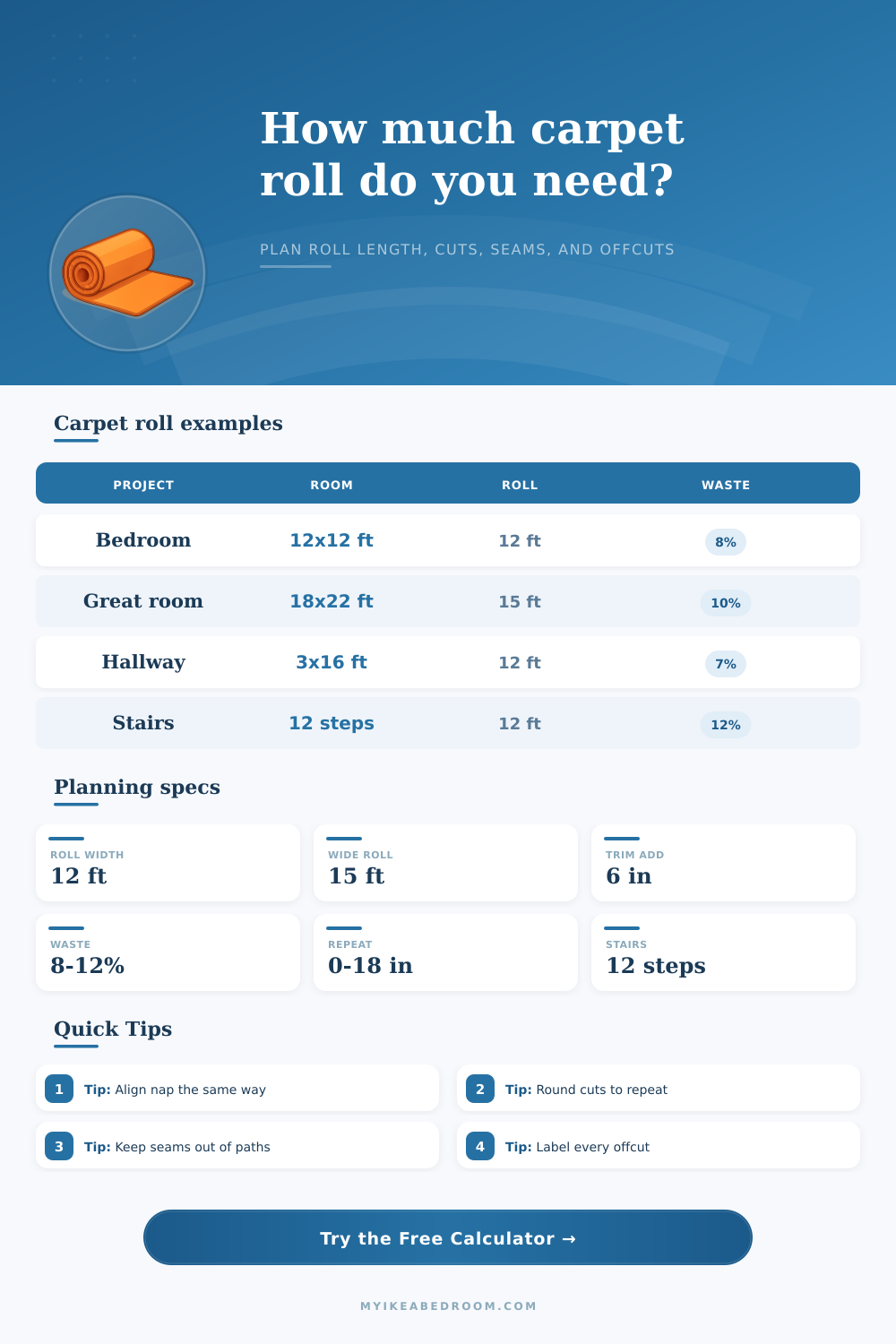
| 12 ft | Up to about 12 ft before trim | Bedrooms, offices, halls | Most rooms over 12 ft wide need a second section or rotation. |
| 13 ft 6 in | Up to about 13.5 ft before trim | Medium bedrooms and dens | Can remove one seam in some square rooms. |
| 15 ft | Up to about 15 ft before trim | Great rooms and primary suites | Often trades heavier handling for fewer seams. |
| Custom runner | Usually narrower than room carpet | Stairs and corridors | Use stair width and path length as separate cut planning. |
| Repeat type | Repeat input | Extra length behavior | Best use in calculator |
|---|---|---|---|
| Plain texture | 0 in | No repeat round-up | Use standard trim and waste only. |
| Small pattern | 3 to 6 in | Each section rounds up slightly | Good for closets and short halls. |
| Medium repeat | 9 to 12 in | Visible seams need alignment | Add waste and check seam locations. |
| Large repeat | 18 in or more | Offcuts grow quickly | Use the actual repeat from the carpet label. |
| Cut type | Inputs used | Roll length method | Seam note |
|---|---|---|---|
| Hallway strip | Hall length and hall width | One or more strips rounded to repeat | Long corridors show crooked seams quickly. |
| Closet piece | Closet count, width, and depth | Repeated short sections from offcuts | Closets can absorb useful leftover length. |
| Stair cut | Stair count, width, tread plus riser | Step path length multiplied by count | Keep pile direction consistent from top to bottom. |
| Landing | Enter as hallway or main room area | Plan as its own rectangular section | Match direction at the transition. |
| Layout condition | Suggested waste | Why it changes | Inputs to adjust |
|---|---|---|---|
| Open rectangular room | 5% to 8% | Few cuts and simple direction | Room dimensions and trim allowance |
| Bedroom with closets | 8% to 12% | Closet pieces and doorway returns | Closet count, depth, and width |
| Hall and stairs | 10% to 15% | Long narrow cuts and step wrapping | Hall width, stair count, stair path |
| Large pattern repeat | 12% to 18% | Sections round up to line up motifs | Pattern repeat and fill direction |
Plan roll sections before cutting: Use the calculated section count and longest section to mark each cut in order, especially when a pattern repeat is entered.
Use offcuts deliberately: Closets, small landings, and short stair pieces are good places to assign leftover roll length without changing the main room seam direction.
When planning for a carpet installation, there are a few different factor that must be considered in order to ensure that you purchase the correct amount of carpet for the job. The total amount of carpet that is needed for a room is often different than the area of the floor in that room. By only calculating the area of the floor, it is possible that there will not be enough carpet to complete the installation job.
Therefore, you should of use a calculator to determine the total amount of carpet that is required for the installation job. The first factor that you must consider in the calculation is the width of the carpet rolls. Rolls of carpet that is twelve feet in width are common in that they are the standard size for many bedrooms and offices.
How to Work Out How Much Carpet You Need
These rolls are often large enough to cover the area of a single room without having to create a seam in the middle of the room. Alternatively, rolls of carpet that are fifteen foot in width can cover more of the floor in the same area. However, the fifteen foot rolls are more difficult to move and more likely scuff the walls of the area that is to be carpeted.
Additionally, the fifteen foot rolls can be beneficial in that they may be able to avoid creating a seam in the carpet in areas like walking paths. You can enter each of these carpet roll widths into the carpet area calculator to determine how the width of the carpet roll may impact the number of seams in the carpet. Another factor that impacts the amount of carpet that is required is the pattern of the carpet.
Carpet rolls often come with a pattern in which the design of the carpet repeats at regular intervals. For instance, if the carpet has a twelve inch pattern repeat, you must round up the carpet to the next full pattern repeat for each section of the carpet. Plain carpets or carpet that features a textured pattern does not have such a pattern repeat, and so are easier to calculate.
The carpet area calculator often includes a field for entering the pattern repeat of the carpet, or the amount of carpet that will be required to account for those repeating patterns. Additionally, factors like hallways and closets can also impact the amount of carpet that is required. Typically, hallways are of a different width then the remainder of the rooms in a house.
Additionally, carpet for hallways may be of a different direction than the main carpet for the remainder of the rooms. Therefore, you may have to cut a strip of carpet from one of the main rolls of carpet to cover the hallway. Additionally, the remainder of the carpet that is leftover after the main installation of the carpet may cover closets.
However, the carpet area calculator allows for the length of the hallway and the number of closets to be entered, which will calculate the total length of carpet that will be required for the area. Additionally, the stairs in a home can impact the amount of carpet that is required. Each stair has a tread and riser that must be carpeted.
Therefore, carpet cuts for the stairs must account for the wrapping of the carpet around the stairs. Each of the stairs also must have the same direction of carpet pile as the remainder of the carpet in the area. Carpet area calculator accounts for the length of carpet required for the stairs by creating a section for the stair cuts in the calculation of the carpet needs.
Another factor in the carpet calculation is the waste that can occur in carpet installation. In a simple installation, five percent of carpet waste can be allowed for potential errors in installation. However, if the installation includes stairs, closets, or carpet of a specific pattern, twelve percent of carpet waste is recommended.
The need to trim the carpet to the area to be carpeted, and errors in carpet installation, create the waste in carpet cutting and installation. The carpet area calculator accounts for carpet waste by applying a percentage to the raw length of the carpet roll. The direction in which you lay the carpet in the area can also have an impact upon the carpet installation plan.
You can lay carpet in the length or the width of the area that is to be carpeted. By choosing one or the other, it is possible to minimize the number of seams in the carpet, but the carpet of one direction may be longer than carpet laid in the other direction. Carpet area calculators typically account for both laying directions to allow for a comparison in carpet length and number of seams.
Finally, the offcuts of carpet is an consideration in carpet installation plans. Offcuts are the pieces of carpet that are left over after the carpet is installed in the main area of the house or apartment. These offcuts are potentially useful in repairing carpeting elsewhere in the home, or can be used to carpet small areas like closets.
Carpet area calculators indicate the length of carpet that will remain after installation of carpet in the main area. By using the carpet area calculator to determine the amount of carpet that will be required for the main area, the hallways, the closets, the stairs, and to account for carpet waste, carpet installer can develop a plan for carpet installation that accounts for all variables. Youll find that teh process works best when you consider everything.
It is important to recieve accurate measurements, because its better to have too much than not enough. This will make the process much more comfortabley.