Carpet Yardage Calculator
Estimate carpet square yards, roll linear yards, seams, pattern-repeat trim, closet and alcove add-ons, stair carpet, seam allowance, and waste yardage for bedrooms, hallways, basements, and stairs.
Load a realistic room setup, then adjust the roll width, seam direction, add-ons, stairs, pattern repeat, seam allowance, and waste percent to match the actual carpet label and floor plan.
Strips run along the entered room length. This is often cleaner in bedrooms because seams can follow the longer sight line.
0 seams, 0 lin yd
Strips run along the entered room width. This can reduce roll yardage in long narrow rooms, halls, and some basement layouts.
0 seams, 0 lin yd
The auto setting compares both room orientations, then uses the lower linear-yard result for the main room before add-ons.
Lengthwise
| Roll width | Square yards per linear yard | Best fit use | Planning note |
|---|---|---|---|
| 12 ft | 4.00 sq yd per lin yd | Most bedrooms and stairs | Most common broadloom width; seams needed when room width exceeds 12 ft. |
| 13.5 ft | 4.50 sq yd per lin yd | Medium bedrooms | May remove one seam in rooms just over 12 ft wide. |
| 15 ft | 5.00 sq yd per lin yd | Large rooms and basements | Often reduces seams but can increase offcut if the room is narrow. |
| Custom | Roll width divided by 3 | Remnants or special goods | Use the finished usable roll width from the carpet specification. |
| Waste setting | Use when | Typical projects | What it covers |
|---|---|---|---|
| 5% to 8% | Open rectangular areas | Simple rooms, straight hallways | Minor trimming, wall variation, and small offcuts. |
| 10% | Standard room carpet | Bedrooms, offices, living rooms | Closet thresholds, fitting cuts, and attic-stock style leftover. |
| 12% to 15% | More cutting or pattern alignment | Stairs, landings, alcoves, patterned carpet | Repeat matching, angled cuts, stair turns, and seam trimming. |
| 18% to 20% | Complex floor plans | Multiple alcoves, odd walls, heavy pattern work | Large offcuts and extra alignment room. |
| Carpet type | Repeat input | Seam allowance | Planning note |
|---|---|---|---|
| Solid plush or texture | 0 in | 1 to 2 in | Roll cuts mainly need trim allowance at walls and seams. |
| Small geometric repeat | 3 to 6 in | 1.5 to 2 in | Each strip may round up to the next visible repeat. |
| Large pattern repeat | 12 to 24 in | 2 to 3 in | Confirm whether repeat runs lengthwise, crosswise, or both. |
| Berber or loop texture | 0 to 6 in | 1 to 2 in | Use directional nap consistently from room to room. |
| Add-on | How this calculator treats it | Good measuring method | Common allowance |
|---|---|---|---|
| Closet or alcove | Count times average length times width | Measure inside clear floor, not just door width. | Add before waste percent. |
| Straight stairs | Stair count times width times tread plus riser | Measure one full tread and riser path. | Use 10% to 12% waste. |
| Landing | Landing length times landing width | Measure the full rectangle at the turn. | Include seam trim at doorways. |
| Runner-style stairs | Use runner width as stair width | Enter the exposed carpet width only. | Add pattern repeat if bordered. |
Measure at the widest points. Use the longest wall-to-wall length and the widest wall-to-wall width, then add closets and alcoves separately. Carpet is cut from rectangular roll goods, so narrow missing corners rarely reduce the roll length as much as they seem to on paper.
Check pattern direction before choosing seams. A lower linear-yard result is useful only if the carpet nap, stripe, or pattern repeat can face the same direction across the room, stairs, landing, and doorway transitions.
Calculating the amount of carpets that is necessary for a project is a necessary task for any individual who desire to ensure that they have enough carpet to cover the area that is to be carpeted but dont want to purchase too much carpet for the project. The cost of carpet rolls is high, and the individual will want to account for all of the factors that may lead to carpet waste. One way of performing this calculation is by the use of a carpet yardage calculator.
Carpet yardage calculator allow the individual to input the measurements of the areas that will be carpeted as well as various other factors related to the carpet and the laying of the carpet. The carpet yardage calculator will output the amount of carpet (in yards) that will be required to complete the project. Carpet yardage calculator requires that the individual enter several different sets of measurements into the calculator to determine the amount of carpet that will be required for the project.
How to Work Out How Much Carpet You Need
The individual need to measure the areas that will be carpeted, such as closets, landings, and stairs. Closets, landings, and other areas that may not be carpeted in other parts of the house can require additional carpet. Additionally, stairs often require the individual to measure the depth of the treads of the stairs and the depths of the risers of the stairs and enter into the calculator the depth of all of the steps of the staircase.
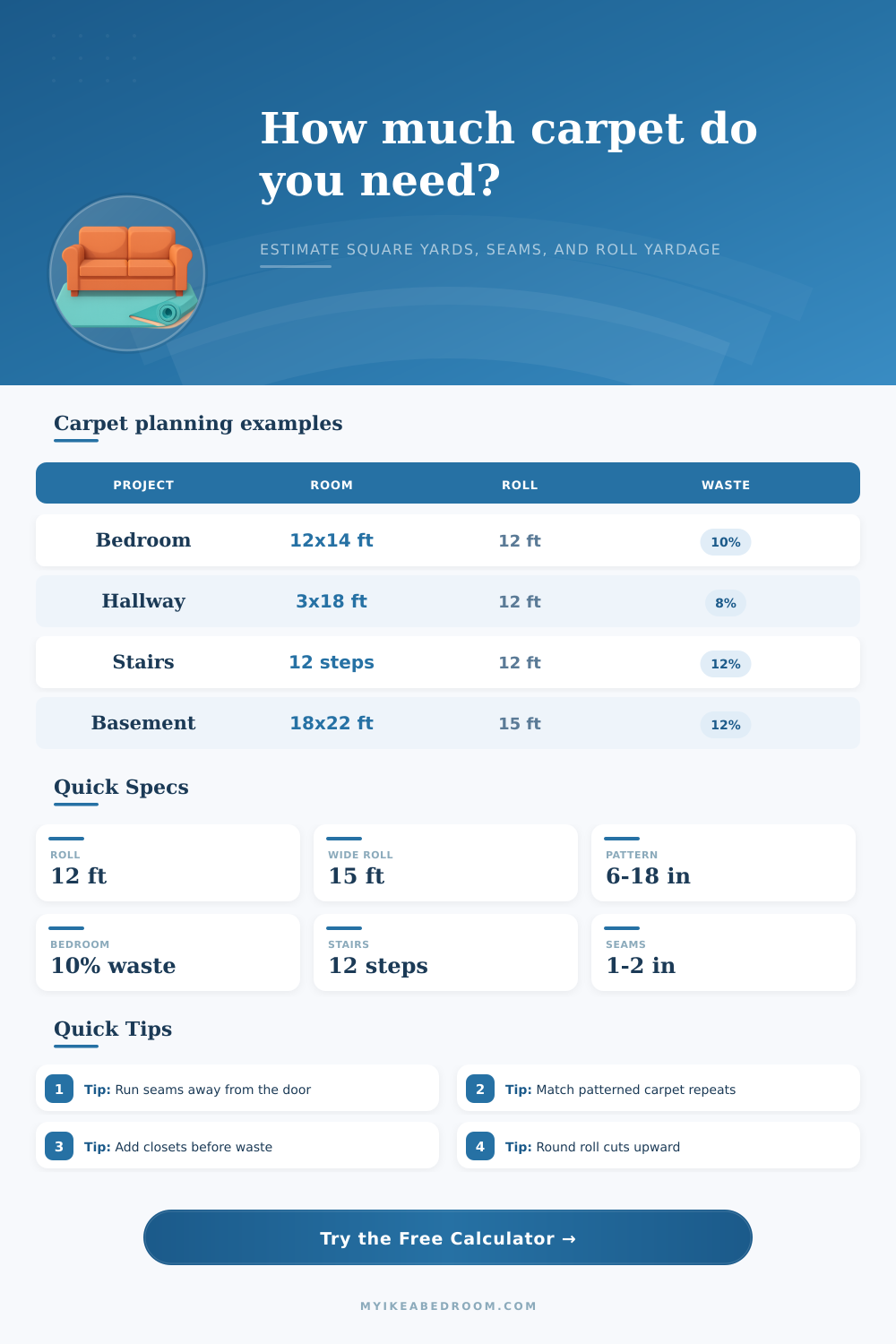
Carpet rolls may come in various sizes, such as 12-foot rolls, 13.5-foot rolls, and 15-foot rolls. The width of the carpet roll can impact how many seam will be in the carpet and how much carpet waste will result from cutting the carpet to lay it on the floor. Carpet yardage calculator can determine how many linear yard of carpet will be required to lay the carpet based on the roll width and the area to be carpeted.
If the carpet contains a visible pattern, the carpet may have to be cut to allow the carpet patterns to line up along the seams of the carpet. Each carpet pattern may have a specific measurement to the area of the carpet that repeat itself. The individual will need to enter this measurement into the carpet yardage calculator.
If the carpet to be purchased is a solid carpet that does not contain any visible carpet patterns, the individual will enter a zero into the calculation for the pattern repeat. In addition to the pattern and the roll width of the carpet, the carpet yardage calculator will also ask for the number of seams of the carpet. Carpet seams must be allowed for the carpet installer to make a clean seam between one piece of carpet to another piece of carpet.
If the carpet that will be purchased does not have any seams, the individual will enter a zero for the seam allowance. Another factor that will be asked of the individual when using a carpet yardage calculator is the percentage of carpet waste that will be created during installation of the carpet. A percentage of waste of five percent may be sufficient for a carpet installation in a square room that does not contain any carpet patterns.
A carpet waste percentage of ten percent is likely to be used in areas like bedrooms in which doorways may need to be cut in the carpet. Additional waste may result from the laying of stairs. Carpet with carpet patterns may require some of the carpet to be wasted during installation.
A carpet yardage calculator will allow the individual to enter a percentage of carpet waste that will be created during installation of the carpet. Another factor for the carpet yardage calculator is the nap of the carpet. Carpet will have a nap in specific directions within the area that will be carpeted.
If the carpet is to be laid against the nap in some areas and with the nap in other areas, the carpet may appear to have a different shade in those areas. Carpet installers may prefer that the seams in the carpet be laid away from the main doorway of the area. Carpet that contains carpet patterns may have the carpet pattern repeat in and out of the carpet.
Carpet patterns may be measured in specific directions, and these patterns may be selected before the carpet installers decide in which direction the carpet seams should be laid. In addition to the area that will be carpeted, the carpet yardage calculator will ask for specific measurements of the stairs in the area. Carpet installers calculate the straight run of the stairs in the area by multiplying the number of steps of the stairs times the width of the stairs in that area.
Additionally, the carpet installers may have to measure the landings in the area. If the stairs turn in the area, carpet installers may have to measure the turn in the stairs in that area as well. Carpet waste percentages will be higher for the stairs than it is for a bedroom due to the waste of carpet that will be created with every step in the area.
Carpet installers will have to make allowances for carpet waste with each step in the staircase. Additionally, carpet installers have to make allowances for cutting the carpet in the landings for the stairs. Closets and alcoves may have to be measured in the carpet area in which the carpet will be laid.
The carpet may have to be cut to accommodate the tight spaces that are closets. Carpet installers will have to measure the inside dimensions of each of the closet in the area that will be carpeted. Each of these closets will be treated as a rectangle in the carpet yardage calculator.
Carpet installers will ask that the individual input the length and the width of each of the closets to which carpet will be laid. Carpet measurements will be made for these closets as an additional area to which carpet will be laid. This allows the carpet yardage calculator to account for the carpet that will be needed for each of these areas.
By measuring the closets and alcoves in the carpet area, the carpet yardage calculator will ensure that there is enough carpet for those areas without requiring carpet to be purchased for those tight spaces. The carpet yardage calculator may help the individual to make decisions regarding the carpet to be purchased. Carpet roll width, carpet pattern repeat measurements, and carpet waste percentages the individual can select.
Each of the settings for these measurements can impact the amount of carpet that will be required for installation in the carpet area. For instance, the individual may choose a carpet roll that is wider than others to reduce the number of seams in the carpet; however, using a wider carpet roll may lead to an increase in the amount of carpet waste. A higher percentage of carpet waste could allow for the carpet to contain the carpet patterns that the individual prefers.
The carpet areas in which carpet will be laid are rarely perfect rectangles. Carpet installers will likely cut the carpet that is purchased for laying in the carpet area to account for irregularities in the dimensions and angles of the rooms that are to be carpeted. Carpet yardage calculator will ask for the carpet waste percentage for the entire carpet installation to account for this irregular carpet area.
The percentage of carpet waste will be the individuals decision, as carpet will need to be purchased in amounts that will allow the carpet installer to complete the carpet installation without running short of carpet or ordering too much carpet. Carpet yardage calculator will determine the amount of carpet that will be required in square yardage, linear yardage, and the number of seams to be cut in the carpet. Carpet yardage calculator will allow the individual to convey the necesary information for carpet purchase to the carpet supplier.