12x12 Tile Calculator
Estimate fixed 12 in × 12 in tile count, box count, grout-adjusted coverage, layout waste, border rows, opening cutouts, finished thickness, and installed tile weight for floors, walls, hearths, and square-grid projects.
Load a common 12x12 project, then replace the dimensions, openings, box count, layout, and tile weight with your measurements.
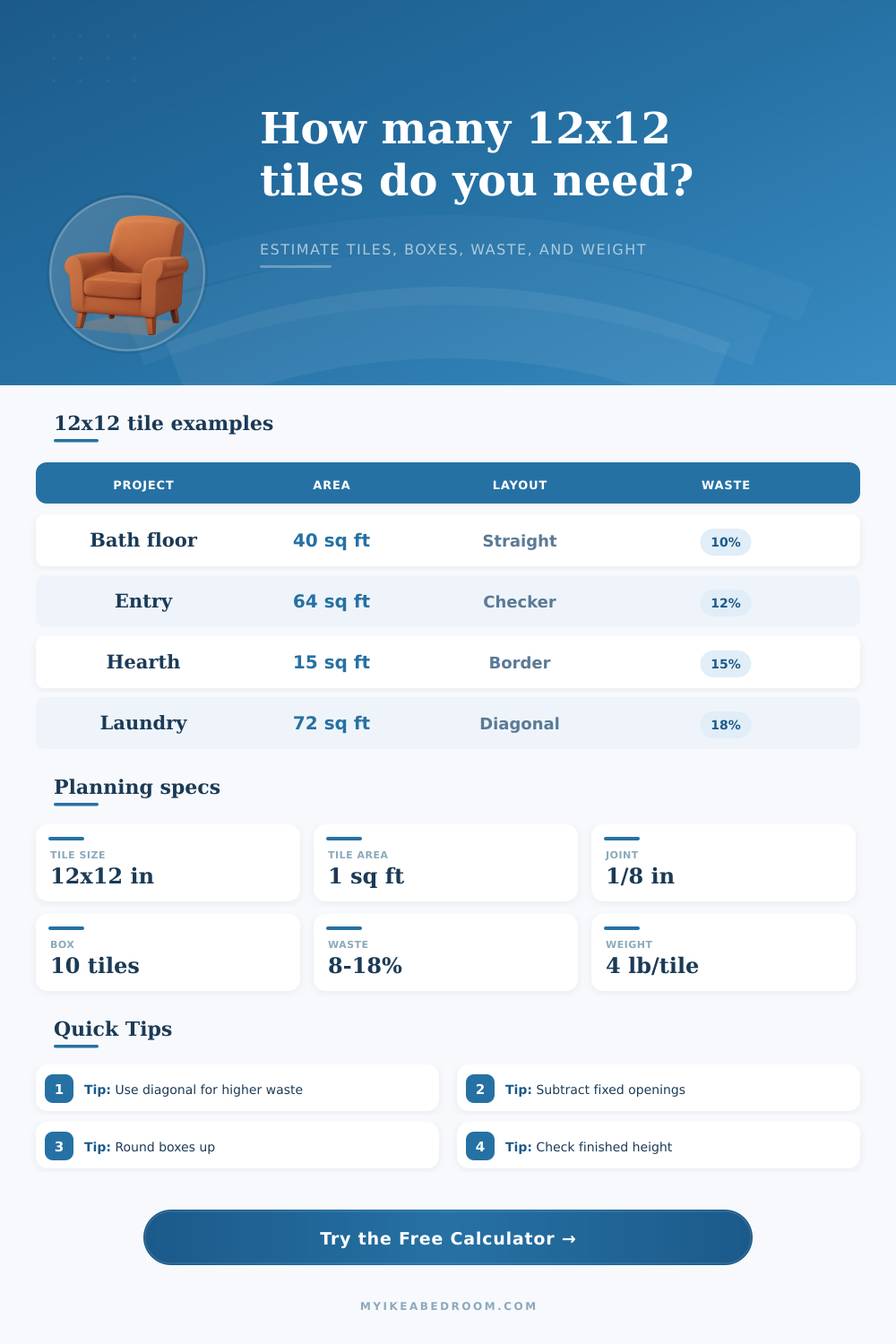
10% waste
Best for simple rectangles, walls, and low-cut square rooms.
12% waste
Same square grid, but color balance can require extra full tiles.
15% waste
Perimeter rows add planned cuts and corner-piece decisions.
18% waste
Angled perimeter cuts usually need the largest 12x12 allowance.
| Grout joint | Planning module | Module area | Tiles for 100 sq ft |
|---|---|---|---|
| 1/16 in | 12.0625 in square | 1.010 sq ft | 100 tiles before waste |
| 1/8 in | 12.125 in square | 1.021 sq ft | 98 tiles before waste |
| 3/16 in | 12.1875 in square | 1.032 sq ft | 97 tiles before waste |
| 1/4 in | 12.25 in square | 1.042 sq ft | 96 tiles before waste |
| Project condition | Suggested waste | Reason | Best layout input |
|---|---|---|---|
| Open rectangle | 5% to 8% | Few edge cuts and no interruptions | Straight grid |
| Typical small room | 10% | Doorways, vents, and normal edge cuts | Straight grid |
| Checkerboard | 12% | Color count and alternating pattern balance | Checkerboard |
| Border or hearth | 15% | Extra perimeter cuts and corner alignment | Border field |
| Diagonal room | 18% to 20% | Large triangular cuts along walls | Diagonal layout |
| Tiles per box | Face coverage | Boxes for 80 tiles | Typical use |
|---|---|---|---|
| 6 tiles | 6 sq ft | 14 boxes | Heavy stone-look porcelain cartons |
| 8 tiles | 8 sq ft | 10 boxes | Midweight floor tile cartons |
| 10 tiles | 10 sq ft | 8 boxes | Common ceramic 12x12 cartons |
| 12 tiles | 12 sq ft | 7 boxes | Light ceramic wall or floor tile |
| Tile type | Typical thickness | Typical weight | Calculator input |
|---|---|---|---|
| Light ceramic wall tile | 1/4 in to 5/16 in | 2.5 to 3.5 lb each | Use actual lb per tile if known |
| Ceramic floor tile | 5/16 in to 3/8 in | 3.5 to 4.8 lb each | Standard ceramic density |
| Porcelain floor tile | 3/8 in to 1/2 in | 4.5 to 6.5 lb each | Porcelain density |
| Dense quarry tile | 1/2 in or thicker | 6 lb or more each | Dense tile density |
Keep 12x12 math fixed: Treat each tile as one square foot for face coverage, then allow grout joint, layout, border rows, and waste to adjust the final box count.
Separate openings from waste: Subtract known untiled areas first. Use waste for broken pieces, diagonal cuts, border corners, and color matching, not for large voids.
A 12×12 tile is a unit of floor covering that covers one square foot of surface area. However, a 12×12 tile dont always cover one square foot of area due to the space that the grout joints take up. The grout joint is the space between two 12×12 tiles.
The width of the grout joint increase the area that a 12×12 tile covers. For instance, if the width of the joint is 1/8 inch, then the length of the 12×12 tile is 12.125 inches. The area that one 12×12 tile covers is greater than one square foot.
How Many 12×12 Tiles Do You Need
Fewer 12×12 tiles is required to cover a specific number of square feet than would be calculated if the area that the tiles cover was only one square foot each. A tile calculator takes into account the width of the joints between 12×12 tiles so that a person does not have to manually calculate the area that will be covered by each individual 12×12 tile. The layout of the 12×12 tiles can change the number of 12×12 tiles that a person must purchase.
For example, a straight grid layout for the 12×12 tiles use fewer 12×12 tiles than a diagonal layout of the same 12×12 tiles. A straight grid layout produces minimal waste when the person lays down the 12×12 tiles in the area to be covered. A diagonal layout of the 12×12 tiles creates more waste than a straight grid layout because the triangular shape of the cuts of the 12×12 tiles along each wall require more waste to be removed from the tiles.
A checkerboard layout of the 12×12 tiles requires more 12×12 tiles than both the straight grid and the diagonal layout because the extra full 12×12 tiles is required to complete the checkerboard pattern. A border treatment of the area to be covered requires more 12×12 tiles than the straight grid layout. The border treatment of the area requires many cuts along the perimeter of the covered area.
A tile calculator accounts for the number of 12×12 tiles that will be wasted due to different layout choices for the tiles. A waste calculation of 10 percent is a small number of extra 12×12 tiles that will be purchased. An 18 percent waste allowance is a larger number of extra 12×12 tiles that will be bought for the project.
The number of openings in the area to be covered by the 12×12 tiles is another feature that can affect the number of 12×12 tiles that are required. An opening is an area where a person will not place a 12×12 tile. Openings in the area to be tiled may include vents, windows, or appliances.
You must subtract the area covered by the openings from the total area in square feet of the area to be tiled. The waste of 12×12 tiles is for instances where a 12×12 tile may become broken during the installation of the 12×12 tiles. The area covered by the openings does not count as waste during installation.
The number of openings and the size of each opening can be entered into a tile calculator to accurately calculate the area of the openings in the area to be tiled. The weight of the 12×12 tiles is another feature of the 12×12 tiles that many individuals consider when calculating how many 12×12 tiles will be needed. The weight of a ceramic 12×12 tile is approximately four pounds.
The weight of a porcelain 12×12 tile is six pounds or more. The weight of the 12×12 tiles can impact the number of boxes of 12×12 tiles that an individual is able to carry. The weight of the 12×12 tiles may also require that the person reinforce the subfloor of the area to be tiled.
A tile calculator can estimate the weight of the number of 12×12 tiles that will be purchased for a project. Most tile retailers sells 12×12 tiles in boxes that are complete with a specific number of 12×12 tiles. The retailers do not sell partial boxes of 12×12 tiles.
A tile calculator will round the total number of 12×12 tiles that are required to cover the area to be tiled up to the next highest whole box of 12×12 tiles. Rounding the total number of 12×12 tiles up to the next highest whole box allows for extra 12×12 tiles to be purchased. The extra 12×12 tiles can be used in case one of the 12×12 tiles becomes chipped.
Because buying extra 12×12 tiles is less costly than purchasing additional boxes of 12×12 tiles later, buying extra boxes of 12×12 tiles at the time of purchase is beneficial to the individual who is placing the order for the 12×12 floor tiles. In order to use a tile calculator correctly, the person must measure the dimensions of the area to be tiled accurate. Areas that are to be tiled may appear to be rectangular in shape.
However, the area may contain an angled wall or a closet whose dimensions must also be included in the total number of square feet of the area. If the measurements of the area to be tiled are incorrectly entered into a calculator, the order for the number of 12×12 tiles will be incorrect. The person must enter the real dimensions of the area to be tiled into a calculator in order to ensure that there is enough 12×12 tiles for the job.
Finally, the person should consider the dye lot of the 12×12 tiles before purchasing the 12×12 tiles. A dye lot is the batch of 12×12 tiles that is produced during the same time period. The color of the 12×12 tiles in a batch may not be the same as the color of the 12×12 tiles in another batch of 12×12 tiles created at the same time.
In order to ensure that the color of the 12×12 tiles is the same throughout the entire area that will be covered in 12×12 tiles, the person should purchase all of the 12×12 tiles at once from the same dye lot. Using a tile calculator to order the number of 12×12 tiles will help the individual purchase the necessary number of 12×12 tiles from the same dye lot.