Wall Tile Calculator
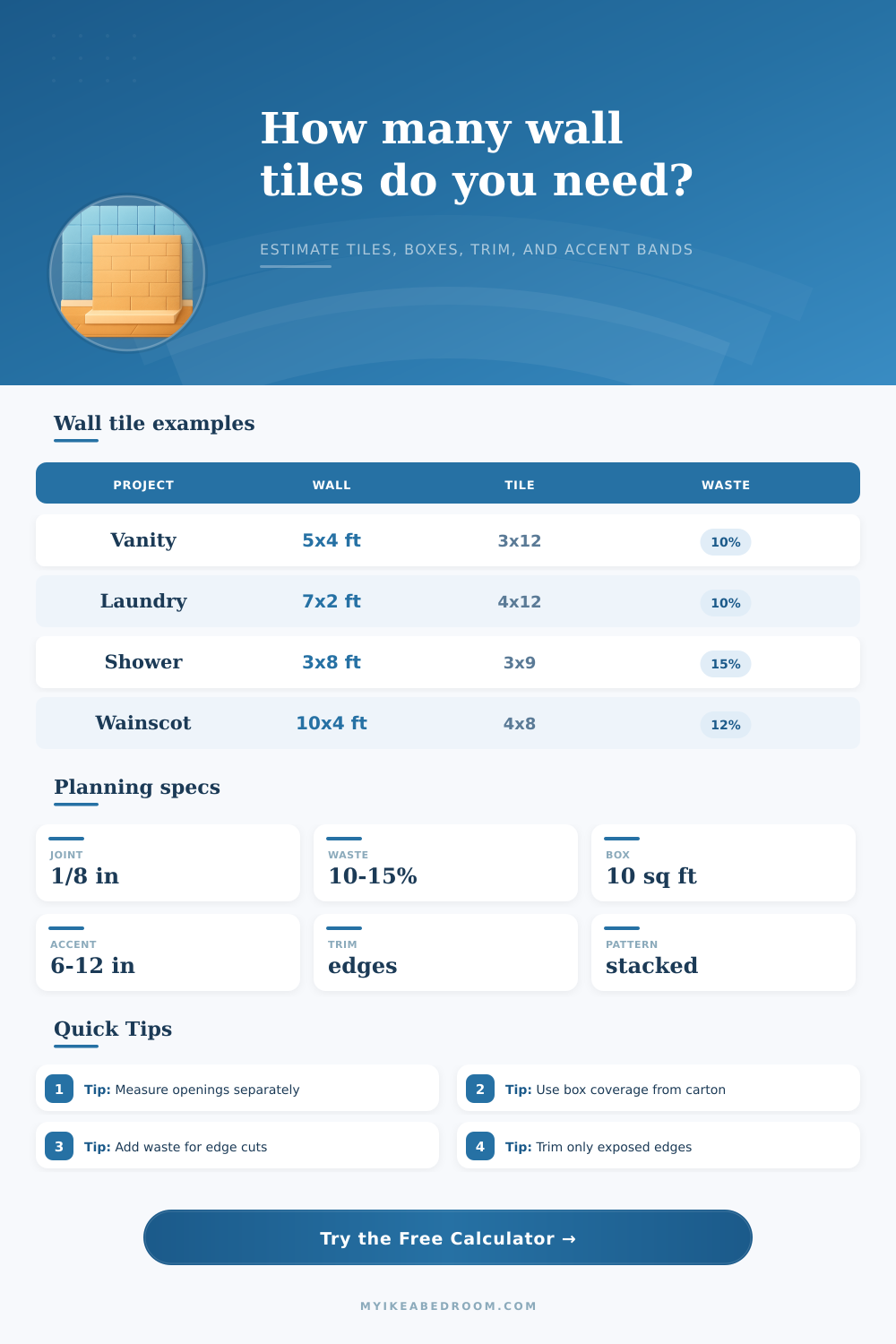
Estimate stacked wall tile quantities for bathrooms, laundry rooms, fireplaces, wainscot panels, shower accent walls, and feature walls with openings, grout joints, trim edges, accent bands, box coverage, and waste.
Choose a common wall tile scenario, then replace the wall, opening, tile, trim, accent band, and box coverage inputs with your measurements.
--
Straight rows with the tile long side running across the wall.
--
Rotates the tile so columns read taller and edge cuts change.
--
Adds a modest waste factor for shifted courses and end cuts.
--
Counts the band height separately so feature strips are visible.
| Tile size | Area each | Typical wall use | Stack note |
|---|---|---|---|
| 2 in x 8 in | 0.111 sq ft | Vanity walls and narrow bands | Good for clean horizontal rows |
| 3 in x 12 in | 0.250 sq ft | Bathroom, laundry, and shower accents | Strong vertical or horizontal look |
| 4 in x 8 in | 0.222 sq ft | Wainscot and powder room walls | Balanced module for short walls |
| 4 in x 12 in | 0.333 sq ft | Fireplace and feature walls | Fewer pieces, larger edge cuts |
| 6 in x 24 in | 1.000 sq ft | Large format accent panels | Check flatness before stacking |
| Wall condition | Suggested waste | Why it changes | Calculator setting |
|---|---|---|---|
| Open rectangular wall | 5% to 10% | Few cuts and predictable edges | 5% or 10% |
| Multiple walls | 10% to 12% | Corners and returns create offcuts | 10% or 12% |
| Window or niche cuts | 12% to 15% | Openings interrupt courses | 12% or 15% |
| Accent band layout | 15% to 18% | Feature strips need planned cuts | 15% or 18% |
| Small tile with many edges | 18% to 20% | More pieces are affected by trimming | 18% or 20% |
| Feature | Measure this | Calculator input | Result impact |
|---|---|---|---|
| Window inside wall | Width and height of untiled rectangle | Opening count and average size | Reduces net area and tile count |
| Mirror or vanity gap | Area not covered by tile | Opening size | Credits only the covered field |
| Outside vertical edge | Visible left or right border | Trim edge length per wall | Adds to total trim length |
| Top cap edge | Finished upper edge of wainscot | Trim edge length per wall | Adds to trim length result |
| Band height | Common use | Tile count behavior | Planning note |
|---|---|---|---|
| 3 in to 4 in | Thin liner or pencil accent | Low accent tile count | Good when trim already frames the field |
| 6 in to 8 in | Shower or vanity feature strip | Moderate accent tile count | Align with fixtures when possible |
| 10 in to 12 in | Wide decorative band | Higher accent tile count | Needs more waste near corners |
| Full wall height | Feature wall instead of a band | Matches the total tile field | Set band height equal to wall height |
Separate openings: Measure each window, niche, mirror, or appliance gap as a rectangle, then use the average size when several openings are similar.
Check carton coverage: Box coverage may be based on tile face area, so keep the grout joint, waste, and pattern settings in the calculator.
A wall tile calculator will allow you to calculate the amount of tile you need for your bathroom wall. You use a wall tile calculator because the tool will show you the specific amount of tile you will need (tile count), the number of box of tile you will need (box count), and the length of trim necessary to complete the bathroom project (trim length). By using a wall tile calculator, you will ensure that you have enough tile for the job, and you wont buy too much tile that would waste your money.
To use the wall tile calculator, you will need to enter the dimension of the bathroom walls, the dimensions of the tiles you wish to use, the width of the grout joint between the tiles, and the number of openings (such as windows) in the bathroom walls. The dimensions of the walls will determine the area that the tile will cover. The area will have to be reduced by the area of any openings (windows, doors) because the tile will not be placed over these openings.
How to Use a Wall Tile Calculator
The dimensions of the tiles and the width of the grout joint will create the area of the tile that will be used to calculate how many tiles is needed for the bathroom project. Using wider grout joints will take up some of the area of the tiles, thus reducing the amount of individual tile that will be needed to cover the area of the bathroom walls. Furthermore, different tile patterns will use different amount of tile.
For example, a straight stack pattern will use fewer tiles than an offset pattern. The straight stack pattern is the most efficient use of the available number of tiles because there are no wasted tiles. Offset patterns lose some of their tiles because each row of tiles will have a piece of tile missing from the end of each row.
Finally, a percentage of waste can be entered into the calculator. This accounts for the fact that some of the tiles may break during the tiling process or that some of the individual tiles will need to be cut to fit the edges of the area to be tiled. The percentage of waste can be between 5% and 20% for most bathroom projects.
If the walls have many corners and niches, a higher percentage of waste should be chosen. A higher percentage of waste is always a plus because if one of the tiles breaks during installation, there will be extra tiles to replace it. If there is not enough waste percentage accounted for in the calculation, its possible that there will not be enough tiles to complete the bathroom wall project; in this case, an additional trip to the store will be required to purchase additional tiles.
The calculator will calculate the accent bands and trim edges separately. An accent band is a row of tiles that will be of a different color from the remainder of the tiles for that bathroom area. The calculator will calculate the accent band separate from the main calculation of the tiles needed to cover the remainder of the area because the accent band will not interfere with the main calculation.
Trim is used along the exposed edge of the area to be tiled. The wall tile calculator will calculate the linear feet of the exposed edges so that the appropriate amount of trim can be purchased. Any edges that will be covered by other bathroom fixtures (like cabinets) will not require trim to be purchased for those edges.
The wall tile calculator will display the total linear feet of trim so that the number of pieces of trim will be determined from this calculation. Reference tables will assist in entering the proper information into the wall tile calculator. The reference tables will display the dimensions of the common sizes of bathroom tiles.
Furthermore, the tables will allow the percentage of waste to be selected for different types of walls (tiles with many corners, niches, etc.). For instance, larger bathroom tiles will result in more waste during installation (when cutting the tiles to fit the corners of the bathroom walls). This information will help the individual entering the information into the wall tile calculator to select the proper dimensions and waste percentage for their bathroom.
These tables are not strict rules but provide examples of the possible amounts of waste for the individual to select from. The condition of the walls in the bathroom may also impact the amount of tiles that will be needed for the project. If the walls are not perfectly flat, it may be necessary to purchase additional tiles for cutting to fit the shape of the walls.
The wall tile calculator will assume that the area to be tiled will be flat and straight. Therefore, if the walls of the bathroom may be wavy or out of plumb, it is better to use a higher percentage of waste to allow for additional tiles to be purchased in case of a lack of sufficient tiles to cover the area. Another consideration of the calculation of the amount of tile that will be needed is to compare the number of boxes of tile that are manufactured by the company to the coverage number that appears on the carton of the tile.
The number of tiles that come in each box may include the area covered by the grout joint or it may only be the area covered by the tiles. Regardless, the number that appears on the carton should be used for the calculation of the number of boxes of tile needed. By running the numbers through the wall tile calculator, the individual can plan the bathroom wall tiling project.
The wall tile calculator will permit the individual to view how the size of the tiles will leave a very small amount of tile at the top of the walls. Furthermore, the accent bands can be viewed to see if they will be in a full row of tiles. Planning the layout of the tiles by the wall tile calculator will be more efficient than planning the layout of the tiles by cutting individual tiles with a saw.
After all of the calculations have been entered into the wall tile calculator, the wall tile calculator will display three main numbers: the total number of tiles, the total number of boxes of tiles, and the length of trim necessary to complete the project. The total number of tiles will allow the individual to find the right pieces of tiles for purchase. The total box count will allow the individual to determine the number of boxes to load into a vehicle.
Finally, the trim length will allow the individual to purchase the correct amount of trim for the bathroom wall project.