Shower Tile Calculator
Estimate shower wall tile, pan mosaic sheets, niche returns, bench and curb tile, waterproofing overlap, finished trim length, grout, thinset, and waste from one shower-specific planning form.
Choose a common shower layout, then adjust the wall, niche, bench, curb, pan, tile, grout, and trim measurements.
10% buffer
Lowest waste when walls are plumb and tile rows stay straight.
11% buffer
Offset rows add end cuts at corners, niches, and curbs.
12% buffer
Tall tiles can create more cuts at pan, ceiling, and bench lines.
18% buffer
Angled layout needs the largest buffer around niches and glass edges.
| Layout | Typical tiled surfaces | Common pan size | Planning note |
|---|---|---|---|
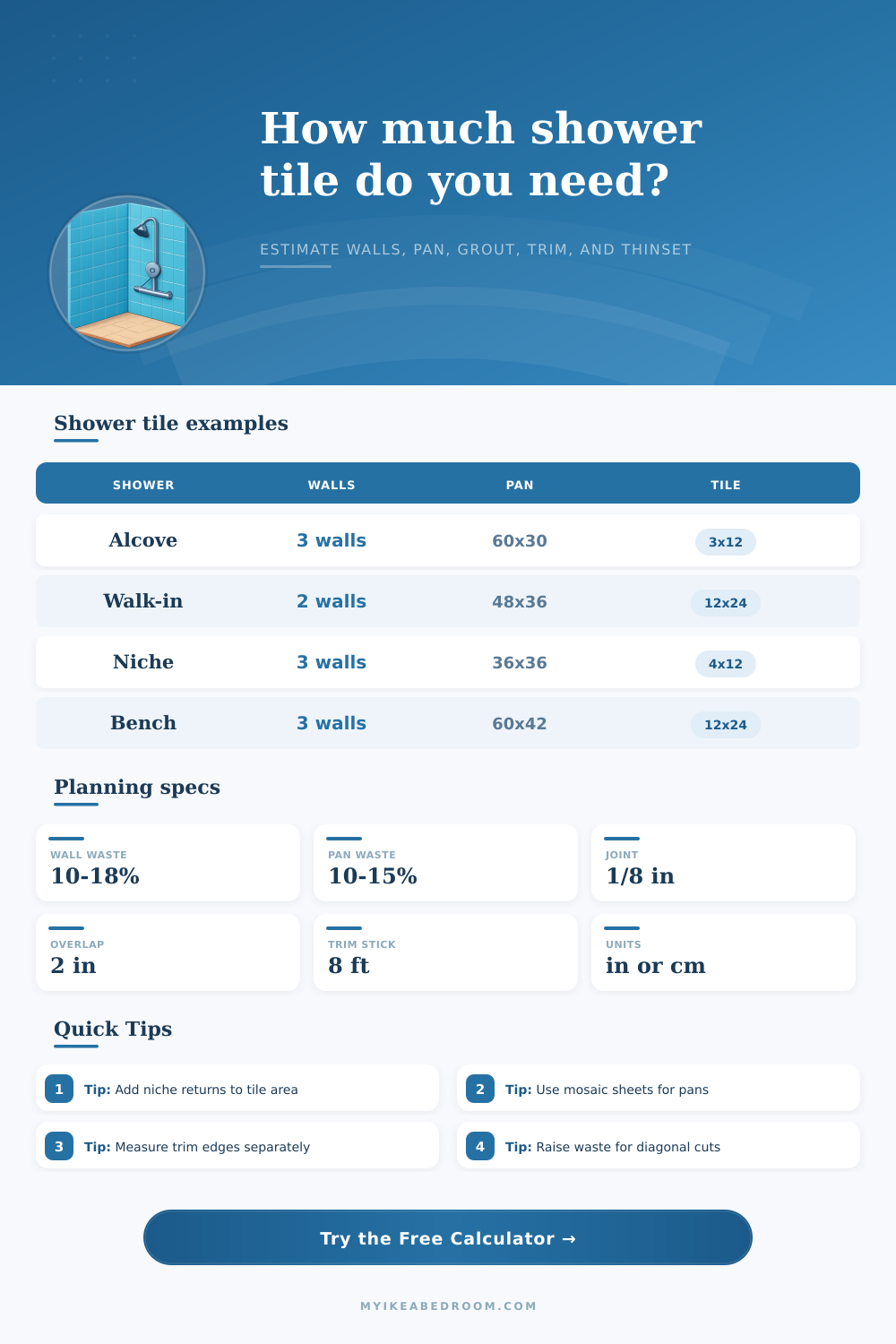
| Alcove tub surround | Back wall plus two side walls | 60 in × 30 in tub footprint | Set pan length to zero when the tub deck is not tiled. |
| Walk-in shower | One back wall and one return wall | 48 in × 36 in | Measure glass-side trim separately from tiled corners. |
| Three-wall shower | Back wall plus left and right walls | 36 in × 36 in to 60 in × 36 in | Most accurate when each side height is measured independently. |
| Bench shower | Walls, pan, bench top, front, and returns | 60 in × 42 in | Bench surfaces often push waste into the 15% range. |
| Tile format | Nominal size | Typical joint | Shower use |
|---|---|---|---|
| Subway wall tile | 3 in × 12 in | 1/16 to 1/8 in | Walls, niches, and vertical stacks |
| Large wall tile | 12 in × 24 in | 1/8 to 3/16 in | Flat walls with fewer grout lines |
| Hex mosaic sheet | 12 in × 12 in sheet | Mounted spacing | Sloped shower pans and niches |
| Penny mosaic sheet | 12 in × 12 in sheet | Mounted spacing | High-grip pans with more grout volume |
| Feature | What the calculator adds | What to measure | Result impact |
|---|---|---|---|
| Niche | Back, two sides, top, and sill surfaces | Opening width, height, return depth, and count | Subtracts the wall opening, then adds the inside tile area. |
| Bench | Top, front face, and two side returns | Width, depth, and face height | Increases wall tile count and thinset area. |
| Curb | Top plus inside and outside faces | Length, top width, and face height | Adds tile area and usually adds trim or edge finishing. |
| Trim edges | Entered edges plus niche perimeter | Glass side, outside edges, and exposed niche edges | Calculates total length and trim piece count. |
| Material | Planning factor | Calculator basis | Use note |
|---|---|---|---|
| Wall grout | Joint width and tile grid | Estimated line length x joint x depth | Large tile needs less grout than small tile. |
| Pan grout | Higher mosaic joint density | Sheet area with mosaic multiplier | Mosaic pans can use noticeably more grout. |
| Thinset, standard trowel | About 85 sq ft per 50 lb bag | All tile area plus a small waterproofing allowance | Use for many ceramic wall tiles. |
| Thinset, large notch | About 45 sq ft per 50 lb bag | All tile area plus a small waterproofing allowance | Use for large-format tile when required by the tile. |
Separate field tile from features: Measure the three wall fields first, then add niches, bench faces, curb faces, and trim edges so small shower details do not disappear inside one rough wall number.
Use a larger waste buffer for wet cuts: Herringbone, diagonal tile, mosaic pan edges, benches, and niches can consume extra tile even when the visible square footage seems modest.
A shower tile calculator is a tool that help you to determine the amount of material that you will have to purchase in order to complete your shower renovation project. A shower tile calculator takes your provided measurements of your intended shower and mathematical calculates the amount of tiles, grout and thinset that will be required to complete the installation. Using a shower tile calculator prior to beginning your renovation is helpful due to the fact that showers remain wet after installation, and their corners and edge are often complicated in appearance.
Without the use of a shower tile calculator, it is possible that you will not be aware whether you will need to purchase one extra box of tile or you will need to purchase three more boxes of tile. To use a shower tile calculator, you will have to provide a variety of different measurement to the calculator. You will have to provide dimensions of the three main wall within the shower, as well as the size of the shower pan if you will be tiling the floor of the shower.
How to Use a Shower Tile Calculator
Additionally, you will have to provide the dimensions of any built-in features within the shower, such as niches or benches. These feature will add to or remove from the total area of the tiles that you are to install within the shower, so it is important that they be accounted for when using the tool. Finally, you will have to account for the fact that not all tiles will be able to be installed in perfect even squares; there will have to be a waste factor for the number of tiles that will be cut during installation.
For instance, a ten percent waste factor may be sufficient for tiles that are to be laid in a simple stacked pattern, but a higher waste factor may be required for a more complex (such as diagonal) pattern. The size of the tiles that you are to use in the installation will mathematicaly impact the calculations of the tile calculator. For instance, if you use larger tiles in the installation, there will be fewer individual pieces of tile that are to be installed.
However, if you use smaller tiles, there will be an increase in the length of the grout lines between the individual tiles. Additionally, the amount of grout that will be required for the installation will mathematicaly change according to the size of the tiles that are to be utilized within the project. Similar to the size of the tiles, the pattern that the tiles are to be arranged within the tiles will impact the calculations of the calculator.
For instance, a running bond or bricklay pattern can lead to the need for more cut in the tiles at the corners of the showers and other features within those showers. Additionally, other patterns, such as herringbone or diagonal pattern can create triangular pieces of tile that cannot be used for any other portion of the installation. Therefore, a higher waste percentage will be required for these types of installations than percentages like ten percent.
For instance, a waste percentage of eighteen percent is higher then a waste percentage of ten percent. In addition to accounting for each of the walls and the size of the tiles, a shower tile calculator also accounts for any built-in features, such as niches or benches. For instance, while a niche may reduce the area of the main walls that must be tiled, the inside of the niche will have to be tiled separately.
Additionally, any area of the bench that is to be tiled, such as the top, front, and side faces of the tile will have to be accounted for in the calculations of the calculator. Thus, the calculator will account for each of these feature once the dimensions of the features are entered into the tool. Another measurement of importance to the calculator is the trim length of the tiles.
Tiles that are placed against glass doors, at the outside corners of the basin, or along the top of the curb will have trim pieces cut from them. Thus, the calculator will calculate the length of these trim pieces according to the length of each individual trim piece. The result of this calculation will provide the number of sticks of trim that will have to be purchased when buying the tiles for the bathroom installation.
Another consideration for the calculator is the amount of grout and thinset that will be required for the installation of the tiles. The amount of grout is calculated in relation to the area of the tiles, the size of the tiles, and the width of the joints between the individual tiles. Additionally, additional considerations will be made for the area of the shower pan (and any tiles that are used for mosaic sheets) since these areas will require more grout than the remaining area of the tiles.
The amount of thinset that will be required can be calculated in relation to the size of the area to be tiled, the size of the tiles, and the notch size of the thinset (which is related to the thickness of the tiles). By using a shower tile calculator, you are able to view the way that each variable impact the cost of the project. For instance, if you increase the percentage of waste for the area to be tiled, the calculator will indicate the additional number of tiles that will be required to complete the project.
Similarly, if you add an additional niche to the bathroom, the calculator will account for the additional number of tiles that are required for the inside of the niche. Such interactions between variables are not easily accounted for using a notepad and writing out calculations for the number of tiles required. Many individuals will make mistakes when measuring their showers for tiling.
For instance, they may ignore the area of the returns within niches or the face of the curb. Additionally, they may use the same percentage of waste for all types of designs or patterns. Thus, although the calculator will not prevent these mistakes, it will make the consequence of those mistakes visible to the individual prior to ordering the materials required for the renovation of the bathroom.
The accuracy of a shower tile calculator relies upon the accuracy of the measurements that are entered into the tool. The calculations will require that you measure the height of each of the walls from the top of the pan to the top of the tiles (not from the finished floor). Additionally, you will have to confirm the dimensions of the pan to correspond to the area that will actualy be tiled.
Any adjustments to the measurements of the tiles will help to avoid any potential problems when the tiles arrive for installation. A shower tile calculator organizes each of the lengths, widths, and other measurements that you provide to create quantities that can be used to purchase the materials for your project.