Seasonal Wood Movement Calculator
Plan winter-to-summer wood expansion for solid tabletops, drawer fronts, cabinet doors, floating panels, shelves, and counters before you drill slots or set clearances.
Pick a furniture scenario to load realistic species, width, humidity, finish, construction, and clearance values, then tune the inputs to your room.
Calculation breakdown
Flat sawn wide top
Highest movement. Plan larger slots and avoid rigid cross-grain fastening.
Quarter sawn panel
Lower movement. Useful for raised panels, fronts, and visible seasonal gaps.
Floating construction
Best tolerance. Allow the panel to move inside grooves with even side clearance.
Fixed cross grain
Highest risk. Movement has nowhere to go, so splitting or cupping becomes likely.
| Species | Tangential shrinkage | Radial shrinkage | Seasonal planning note |
|---|---|---|---|
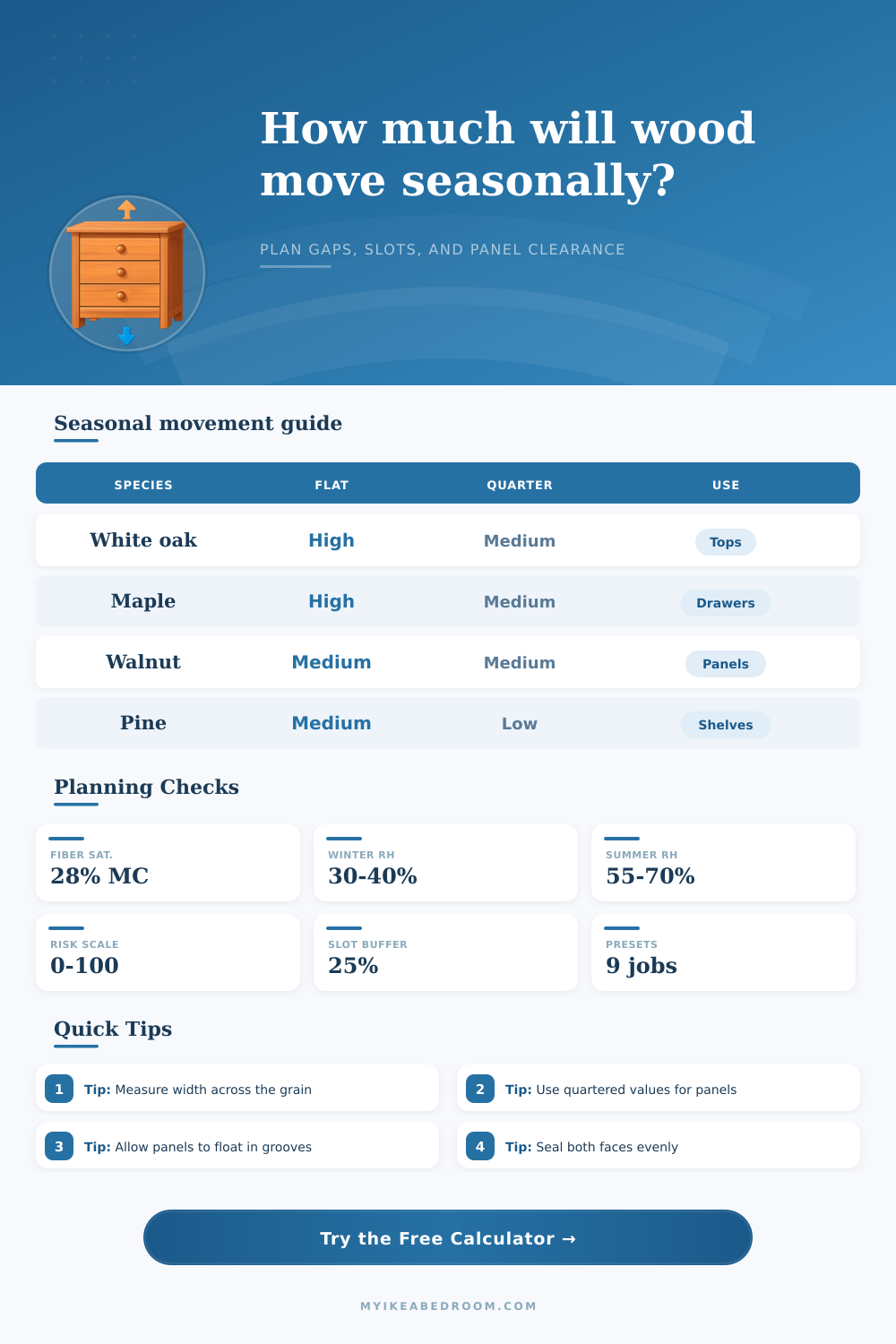
| White oak | 10.5% | 5.6% | Strong but active; watch wide tabletops and breadboard ends. |
| Hard maple | 9.9% | 4.8% | Drawer fronts and doors need predictable reveals. |
| Black walnut | 7.8% | 5.5% | Moderate seasonal swing; floating panels still need room. |
| Eastern white pine | 7.4% | 4.8% | Softer shelves move less than oak but dents and cups easily. |
| Beech | 11.9% | 5.5% | Large movement; keep counters and slabs well relieved. |
| Cherry | 7.1% | 3.7% | Stable for cabinet doors when panels are not glued tight. |
| White ash | 7.8% | 4.9% | Bench seats and wide rails need elongated fastener holes. |
| Western red cedar | 5.0% | 2.4% | Low movement; still allow expansion in wide closet panels. |
| Relative humidity | Approx. EMC | Typical season | Planning use |
|---|---|---|---|
| 25% | 5.0% | Dry heated winter | Check shrinkage and open reveals. |
| 35% | 6.8% | Controlled winter room | Good assembly target for heated homes. |
| 50% | 9.2% | Balanced indoor room | Middle-of-year furniture reference. |
| 65% | 12.0% | Humid summer room | Plan expansion clearance and slot travel. |
| 80% | 16.0% | Damp space | Use caution for solid doors and counters. |
| Choice | Factor | Effect | Best use |
|---|---|---|---|
| Bare or unfinished | 1.00 | Fastest moisture response | Shop samples or unfinished backs. |
| Oil or wax | 0.90 | Small moderation | Furniture that still breathes quickly. |
| Film finish both faces | 0.72 | Moderates seasonal rate | Tables, shelves, and drawer fronts. |
| Sealed all faces | 0.58 | Slower, more balanced response | Doors, panels, and counters. |
| Veneered balanced panel | 0.45 | Lowest solid-like swing | Stable panels when core is balanced. |
| Project type | Common free gap | Slot direction | Watch point |
|---|---|---|---|
| Tabletop clips | Movement plus 20% | Across the grain | Center screw can anchor; outer slots should float. |
| Drawer front | Reveal plus movement | Horizontal on wide fronts | Keep reveals even at both humid and dry seasons. |
| Floating panel | Half movement each side | Panel floats in groove | Avoid glue on full panel edges. |
| Breadboard end | Movement at outer pins | Elongated toward edges | Pin center tight and outer pins in slots. |
| Cross-grain cleat | Full movement travel | Perpendicular to grain | Rigid glue lines raise risk quickly. |
Wood moves during various seasons due to the fact that the wood is continuously trading moisture with the air that surrounds the wood. A tabletop may be sitting in perfect alignment with the frame in which it is to be installed in the January season, but by July it may cause the tabletop to binding against the frame or split the joint where the two pieces of wood are meant to join together. Within the same tabletop, the boards may shrink during the dry winter months, leading to a gap in the board where the wood split, a gap that the woodworker did not intentionally make.
Wood movement is due to the changing width of the wood across the grain of the wood in response to changes in humidity within the surrounding air. The humidity within most homes fluctuate between the low thirties and the low sixties throughout the year, and these fluctuations contribute to the wood movement. It is essential for the woodworker to understand how the wood will move with the changing seasons prior to begin to cut and fasten the wood in place; without an understanding of how the wood will move, the woodworker may create a tabletop or other piece of wood that remains flat during the years rather than a piece of furniture that continually fights against the natural movement of the wood.
How Wood Moves with the Seasons
The calculator asks the woodworker for several inputs to calculate the amount that the wood will move during the year. The woodworker must enter the species of the wood that will be used, the width of the wood across the grain, the humidity within the winter months, and the humidity within the summer months into the calculator. Additionally, the woodworker must also enter the type of construction of the piece of wood that will be created.
Each of these variables contribute to the calculation of the movement of the wood. The output of the calculator is the expansion of the wood, the amount of clearance that the wood should be allowed, and the travel of the slots into which the wood will be fastened. Additionally, the calculator also provides a risk score for the project that the woodworker intends to create with the wood; the risk score informs the woodworker of the likelihood that the project will encounter problems.
Another input that the calculator asks of the woodworker is the grain orientation of the wood. Wood that is flat sawn will experience more movement than wood that is quarter sawn due to the grain of the wood. As such, a woodworker typically uses quarter sawn wood in the creation of raised panels or tabletops where it is essential for the wood to remain flat during the year.
This input allows the woodworker to adjust for the different types of boards that may be used in the project. The choice of grain profile can reduce the movement of the wood by nearly half. Thus, reducing the movement of the wood will reduce the amount of clearance that is required of the wood and the length of the slots into which the wood will be fastened.
An additional input that may be used within the calculator is the type of finish that will be applied to the wood. A finish will not prevent the wood from moving, but it will change the rate at which the wood moves. If a finish that coats both faces of the board is used, the movement of the wood will be slowed.
A finish that is applied only to the top of the board will cause the wood to move at a faster rate than a wood that is finished on both sides of the board. This input in the calculator allows for the woodworker to account for the fact that the wood will move at a certain rate with the seasons. The woodworker may need to compare the recommendations of the calculator to the plan for the amount of clearance that will be provided.
If there is not enough clearance to allow for the wood movement, the woodworker can make alterations to the project. The woodworker can increase the slot length for the project, reduce the width of the panels, change the type of wood that is to be used in the project, or change the construction of the project. Each of these alterations will have a certain impact upon the project.
For instance, increasing the slot length may result in the piece of furniture looking sloppy if the slots are to become visible; reducing the width of the panels may result in the piece of furniture not having the proportions that the woodworker desires. Additionally, altering the species of the wood will change the color, the hardness, and the movement of the wood. The risk score helps to inform the woodworker of the impact that each of these choices will have upon the project.
One of the most common mistakes in creating a piece of wood is in the anchoring of a wide panel. If the wide panel is anchored at more than one point across the grain of the wood, the wood will either cup or crack due to these created points of stress. This risk can be avoided by only using a single center screw or wooden button to hold the panel in place.
The calculator of the wood movement recognizes this risk if the woodworker selects a construction type for the project that is to be fixed across the grain of the wood. The fewer number of points at which the wood is to be fixed to another piece of wood, the more freedom that the panel will have to expand and contract with the different seasons. The timing of when the wood is to be acclimated to the workshop environment is another aspect of the creation of a piece of furniture.
The woodworker should measure the moisture content of the wood after the wood has been sitting in the workshop for one or two weeks; the moisture content that is measured after two weeks will be more accurate than the moisture content of the wood that is measured after only one week. By measuring the moisture content of the wood after it has been allowed to acclimate to the workshop environment and inputting that measurement into the calculator, the woodworker can determine whether the wood will expand or shrink from that starting point in response to the seasonal humidity changes. The reference tables located on the calculator contain the typical shrinkage values of the different types of wood, as well as the humidity values that are typically experienced within the home and the moisture content that the wood will have when it reaches equilibrium with that humidity.
These tables allow the woodworker to quickly ascertain the information required by the calculator. Additionally, the tables can help to show the woodworker the reason that movement caused by seasonal humidity changes is more pronounced in some climates than in others. The small details of a project often determine whether the project’s piece of wood will survive the first year.
For instance, the outer pins of breadboards will be allowed to sit within the slots of the adjacent panel while the woodworker will fasten the center pin of the breadboard to the slot within the panel. Panels that are floated within frame-and-panel doors will have grooves of a depth that is greater than half of the movement of the panels so that the panels do not become lodged within the slots of the doors. Finally, the wooden buttons and metal clips that are used to attach the panels to the doors will need to be able to travel in the direction in which the wood expands.
These small details may be better understood after becoming familiar with the amount of movement that the wood will experience within the completed project. The goal of the woodworker is not to prevent the wood from moving, but to provide the wood with the amount of movement that is required to prevent damage to the piece of furniture that is created from that wood. If the calculator provides a low risk score and if the amount of clearance that is provided to the wood is greater than the expansion that is calculated for that wood, the wood will remain flat throughout the years.
Additionally, providing an amount of clearance to the wood that is greater than the amount that will expand will ensure that the piece will remain flat and functional throughout the seasons. Furthermore, measuring the amount that the wood expands prior to cutting it will ensure that the piece of furniture that is created will remain functional throughout the seasons.