Contact Paper Calculator
Estimate contact paper area, roll count, roll length, cuts per roll, seam overlap, edge wrap, pattern repeat allowance, and waste for shelves, drawers, doors, backs, and panels.
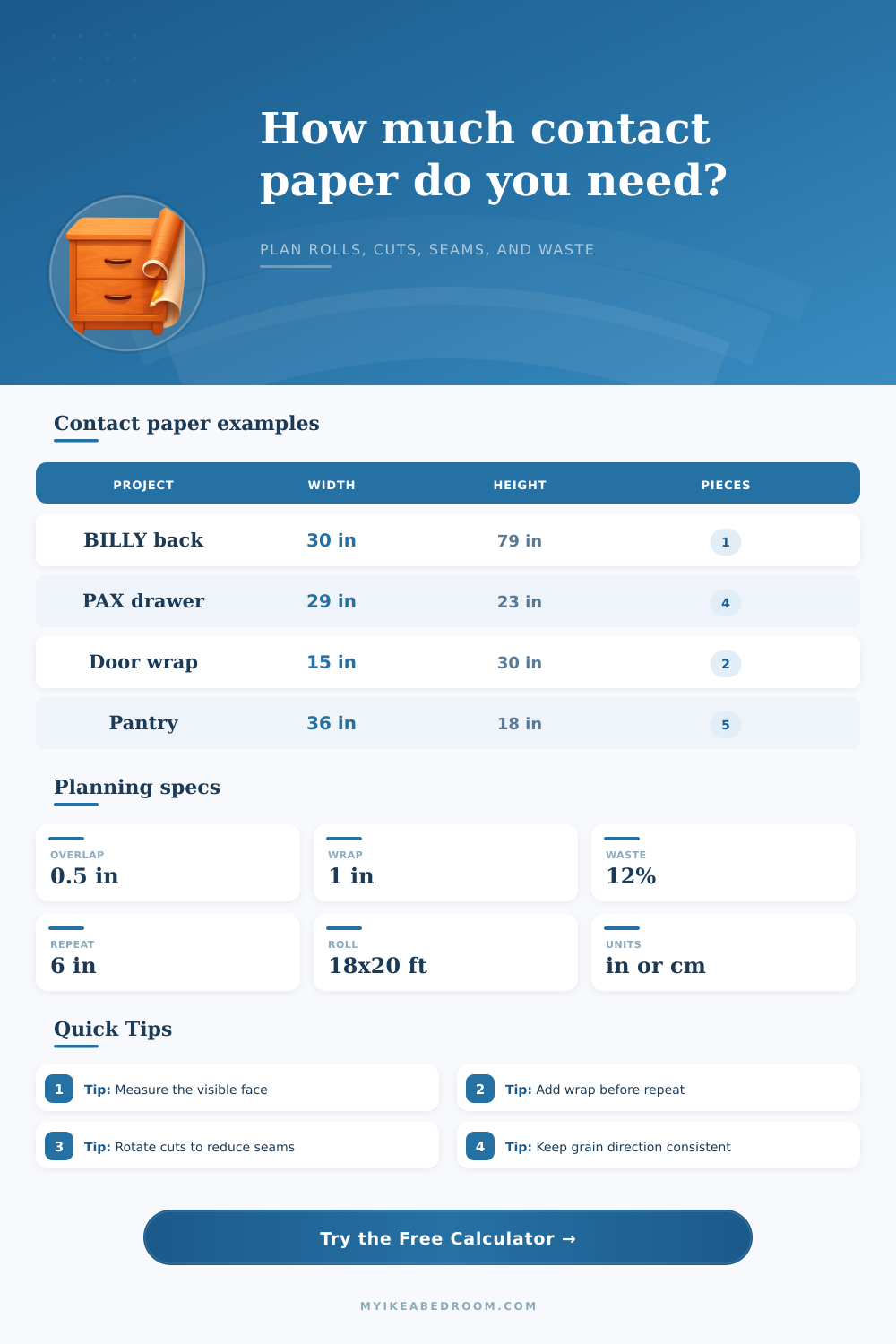
Start with a familiar furniture or cabinet surface, then replace the dimensions with the measured visible face before cutting.
0 cuts per roll
Enter dimensions to compare.
0 cuts per roll
Enter dimensions to compare.
0 total seams
Seams appear when the roll is narrower than the cut face.
0% roll waste
Includes offcut, repeat, wrap, and selected buffer.
| Surface | Measure as | Typical wrap | Planning note |
|---|---|---|---|
| Bookcase backing | Visible width x height | 0 to 0.5 in | Plan vertical grain or pattern direction before cutting tall panels. |
| Drawer bottom | Inside clear width x depth | 0.5 to 1 in | All-side wrap helps hide minor gaps around drawer corners. |
| Cabinet door face | Flat front face | 1 to 1.5 in | Extra wrap gives enough film to turn cleanly around edges. |
| Countertop test panel | Top face plus front lip | 1.5 to 2 in | Large smooth runs often need more trimming allowance. |
| Roll width | Best fit | Likely seams | Use when |
|---|---|---|---|
| 12 in / 30 cm | Narrow drawer sides | Doors and backs | Small pieces matter more than wide coverage. |
| 18 in / 46 cm | Shelves and fronts | Wide drawers | Most medium furniture pieces fit with one or two strips. |
| 24 in / 61 cm | Drawer bottoms | Tall panels | Reducing seams is more important than small offcuts. |
| 30 in / 76 cm | Back panels | Countertops | Large visible panels need fewer side-by-side seams. |
| Pattern type | Repeat input | Waste buffer | Seam note |
|---|---|---|---|
| Plain matte or clear | 0 in / 0 cm | 5-10% | Cut starts can be staggered to save material. |
| Fine texture or speckle | 2-4 in / 5-10 cm | 10-12% | Most seams blend if edges overlap evenly. |
| Wood grain or stripe | 6-12 in / 15-30 cm | 12-15% | Keep grain direction consistent across repeated pieces. |
| Marble or large motif | 12-24 in / 30-61 cm | 15-20% | Matching fronts may use extra length per piece. |
| Material | Typical thickness | Repeat risk | Best surface |
|---|---|---|---|
| Matte vinyl adhesive | 3-4 mil | Low | Bookshelves, drawers, simple panels |
| Gloss vinyl adhesive | 3-5 mil | Medium | Smooth cabinet doors and drawer fronts |
| Wood grain textured | 5-8 mil | High | Visible furniture faces with one grain direction |
| Marble pattern film | 4-7 mil | High | Countertop samples, panels, and broad surfaces |
| Transparent protective film | 2-4 mil | Low | Scratch protection and shelf tops |
| Removable low-tack film | 3-5 mil | Medium | Temporary fronts, rental-friendly panels |
Wrap changes the cut, not the finished face: Enter the visible surface size first, then add edge wrap only for the sides that will turn around an edge or lip.
Pattern repeat comes after wrap: For wood, marble, grid, or stripe contact paper, the calculator rounds the wrapped cut length up to the next repeat mark before adding waste.
Contact paper is a material used to cover a variety of surfaces, such as the backs of bookcases and the bottoms of kitchen drawers. Contact paper allow an individual to give a surface to an object a clean finish without using paint or new materials to the object. Because contact paper can be difficult to estimate, individuals can use a contact paper calculator to determine how many rolls of contact paper an individual will have to purchase for a specific project.
A contact paper calculator takes the dimensions of the surface to be covered, the size of the roll of contact paper that will be used, and the details of the contact paper pattern to calculate how many rolls of contact paper will be needed for a project. The contact paper calculator accounts for the way that contact paper rolls has to be overlapped with each other when placed on a surface to ensure that the raw contact paper doesnt become visible. The first measurement that an individual will have to provide to a contact paper calculator is the size of the surface that will be covered by the contact paper.
How to Use a Contact Paper Calculator
This size is the visible area of the surface after the contact paper is installed. The size of the raw wood board from which the contact paper will be installed isnt the measurement that will be entered into the calculator. The contact paper calculator requires that this visible area is measured in order to ensure that the contact paper calculator provides accurate measurements for the number of rolls of contact paper that will be needed to cover the surface.
After the contact paper calculator takes the surface size from the individual, it will calculate the edge wrap. Edge wrap is the length of contact paper that will be folded around the edge of the object that will be treated with contact paper. Edge wrap may be applied to only one side of cabinet doors, but it may be applied to all four sides of drawer bottoms.
These dimensions is important in that they determine how much contact paper will be required to cover the object to be treated. Another factor in the calculation of the amount of contact paper that will be needed for a project are the measurements of the pattern of the contact paper. Patterned contact paper comes in a variety of colors, textures, and designs.
These different designs will require that the length of contact paper be rounded up to the next full design element, or pattern repeat. This type of contact paper will make the purchase of contact paper a little more expensive than plain contact paper due to the need to have extra contact paper to even out the different design elements. Plain contact paper does not have a design element to even out, so plain contact paper will require less contact paper than patterned contact paper.
Another factor in the contact paper calculator is the size of the contact paper roll. Contact paper rolls may be of different widths and lengths. Contact paper in narrow rolls will require more strips of contact paper to cover a large object than contact paper of a larger width.
A strip of contact paper will create an extra seam in the object being treated with contact paper; therefore, the contact paper calculator will calculate the contact paper requirement for a project that will have fewer seams. Another setting within the contact paper calculator is the waste percentage. The contact paper calculator comes with preset waste percentages between 5% and 20% waste.
Contact paper with a plain matte finish will have less waste than contact paper with a large design motif or complicated edge wraps. Contact paper that wastes less will be required for projects with plain contact paper, as compared to projects with contact paper of a large design motif. Another detail within the contact paper calculator is the calculation of seam overlap.
Contact paper rolls of a specific width will have seams that overlap with other strips of contact paper when the contact paper is placed on a surface that is wider than the width of the contact paper roll. Contact paper calculators calculate the number of seams that will be created with the contact paper based on the size of the object to be covered and the width of the contact paper. Contact paper calculators may include reference tables of the sizes of various objects.
For instance, contact paper calculators often have reference tables for the size of bookcase backing, drawer bottom, cabinet door, and countertop test panel. For bookcase backings, the contact paper calculator will measure the width and height of the visible area of the bookcase. Backings on bookcases require little edge wrap.
For drawer bottoms, edge wrap on all four sides of the drawer will be required. Cabinet doors require edge wrap on only one side. Counter tops for contact paper test panels will require a higher waste percentage of contact paper because the large smooth counters will reveal any errors in the trimming the contact paper with the contact paper cutter.
Some of the most common mistakes when using contact paper calculators are to measure the raw wood on which the contact paper will be applied instead of the visible area of the object after contact paper is applied. Another common mistake is to forget to add edge wrap to an object before contact paper calculates the contact paper pattern repeat. Yet another mistake is for individuals to choose a low waste percentage for contact paper with a large contact paper motif.
This contact paper will require extra length of contact paper in order for the large contact paper motifs to be even with one another. Contact paper calculators may help an individual avoid these mistakes, but the individual is still in charge of choosing which contact paper to use for which project. The type of contact paper that will be used for a project can impact the ease of contact paper installation.
Matte vinyl contact paper will hide bubbles and dust more better than contact paper with a glossy finish. Contact paper with wood grain motifs will show misalignments between strips of contact paper. Marble contact paper motifs may require extra length of contact paper such that the veins within the contact paper show up even with one another.
Contact paper that is transparent will be thin in thickness and may require more precision with contact paper cutting. Contact paper that is removable can easily be repositioned to allow for even placement, but may require smaller edge wraps than contact paper that is not removable. To ensure that the contact paper calculator provides accurate estimations of the amount of contact paper that is required for a project, individuals should think about contact paper projects in a stage-by-stage process.
First, each visible surface that will be treated with contact paper needs to be measured and the edge wrap requirements determined for each object. Next, the contact paper roll that will be used needs to be selected to minimize either the number of seams or the amount of offcut contact paper. Contact paper calculators ask for the waste percentage to be selected for the project; this percentage should account for the complexity of the contact paper design and how precisely the contact paper will be cut.
After the contact paper calculator’s measurements have been entered, the contact paper calculator can calculate the amount of contact paper that will be required for a project. Finally, the individual can determine whether the contact paper calculator’s estimate of the amount of contact paper that will be required to complete a project will be within the budget that is allotted for contact paper purchase. By using the contact paper calculator in the stages described in this response, contact paper calculators will remove the guesswork of an individual who must purchase contact paper for their home project.