Shelf Liner Calculator
Plan shelf and drawer liner from shelf width, depth, counts, roll width, roll length, overlap, edge wrap, waste, pattern repeat, and cut direction.
Load a bookcase, wardrobe, kitchen cabinet, pantry, dresser, or vanity layout, then adjust the measured clear dimensions before cutting.
0 pieces per roll
Width is placed across the roll.
0 pieces per roll
Depth is placed across the roll.
0
No repeat matching added to each cut.
0
Each piece rounds up to the repeat length.
| Furniture area | Typical clear size | Count to plan | Liner note |
|---|---|---|---|
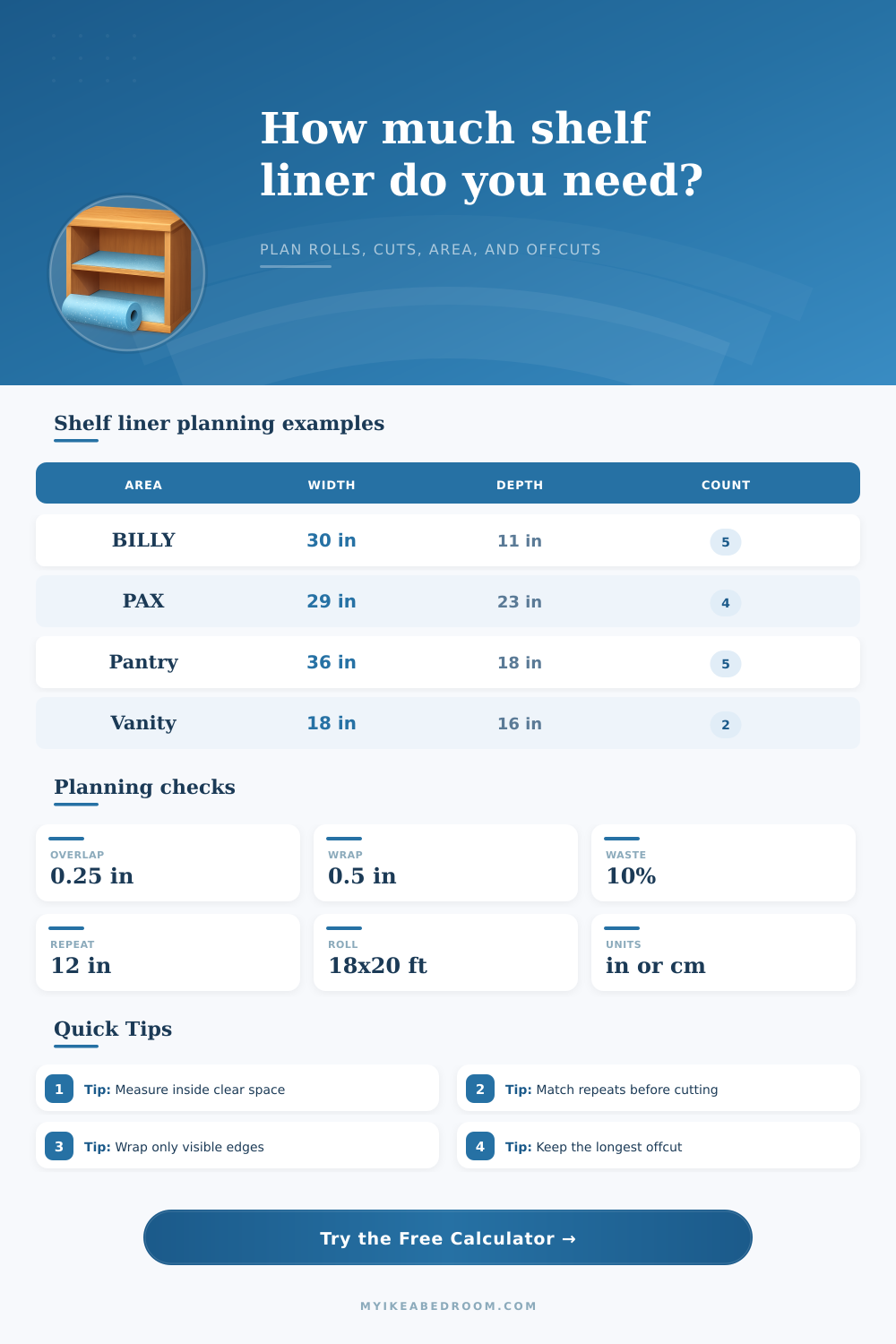
| BILLY style bookcase shelf | 30 x 11 in / 76 x 28 cm | 5 shelves | Usually one strip from an 18 inch roll. |
| PAX style drawer tray | 29 x 23 in / 74 x 58 cm | 4 drawers | Wide drawers may need seams or rotated cuts. |
| Kitchen wall cabinet shelf | 30 x 12 in / 76 x 30 cm | 3 shelves | Front wrap helps hide the liner edge. |
| Bathroom vanity drawer | 18 x 16 in / 46 x 41 cm | 2 drawers | Measure around plumbing notches separately. |
| Roll width | Best fit | Possible seams | Planning note |
|---|---|---|---|
| 12 in / 30 cm | Shallow bookcase shelves | Deep drawers | Good for narrow pieces with little offcut. |
| 18 in / 46 cm | Cabinet shelves and small drawers | Deep pantry shelves | Works for many shelves if depth is across roll width. |
| 20 in / 51 cm | Dresser drawers and pantry shelves | Wide wardrobe trays | Often reduces seams on medium drawers. |
| 24 in / 61 cm | Wide drawers and deep shelves | Very wide shelves | May leave wider offcuts on shallow shelves. |
| Liner type | Repeat input | Waste buffer | When to use |
|---|---|---|---|
| Plain clear or white liner | 0 in / 0 cm | 5-10% | When cuts can start anywhere on the roll. |
| Small texture or dot repeat | 2-4 in / 5-10 cm | 10% | When seams are forgiving but fronts should align. |
| Tile, stripe, or grid repeat | 6-12 in / 15-30 cm | 15% | When visible fronts should land on the same motif. |
| Large decorative pattern | 12-24 in / 30-61 cm | 15-20% | When every drawer front needs a matching start point. |
| Setting | Typical value | Metric value | Effect on plan |
|---|---|---|---|
| No seam overlap | 0 in | 0 cm | Use for single-strip shelves or taped seams. |
| Light seam overlap | 0.25 in | 0.6 cm | Prevents small gaps when two strips meet. |
| Front edge wrap | 0.5 in | 1.3 cm | Adds a small return over the visible front edge. |
| Full tray wrap | 0.5-1 in | 1.3-2.5 cm | Adds material around all drawer bottom edges. |
Clear inside size: Measure the usable shelf or drawer bottom, not the outside furniture width. Subtract rails, rounded backs, hinge bumps, and any notches before entering the final rectangle.
Pattern and seams: If the liner has stripes, grids, or a large motif, enter the repeat before cutting. The calculator rounds each cut up so matching fronts do not steal material unexpectedly.
A shelf liner are a material that is placed on the bottom of a shelf or a drawer to protect the surface of that shelf or drawer. Individuals can begin the project of placing shelf liners on there shelves and drawers by measuring the shelves and purchase a roll of shelf liner from a hardware store. However, many people find that the measurements of the shelves that they measure does not correlate to the amount of shelf liner that they will need to purchase to cover each shelf.
The reason for this discrepancy is due to the fact that individuals may have forgotten to account for the depth of the shelves, the way that the shelf liner will wrap around the edge of the shelf, or even the way that the shelf liner tile on the shelf. In order to account for these factors in an accurate way, the individual must utilize a calculator to determine the amount of shelf liner that is require to cover each shelf or drawer. The calculator will require that the individual enters several different measurement of the project that is to be performed.
How to Calculate How Much Shelf Liner You Need
For instance, the individual will need to enter the clear inside dimension of each shelf or drawer. In addition, the individual will need to enter the width of each roll of shelf liner that will be utilized to cover the shelves, as well as the total number of shelves that need to be covered with shelf liner. Each of these measurements must be entered into the calculator in order for the calculator to determine the amount of shelf liner that is require for the entire project.
In addition to entering each of these measurements, the individual will also need to decide how to orient the cuts of the shelf liner that will be purchased. For example, the width of each shelf may need to match the width of the roll of shelf liner. However, another determination that will need to be made is whether the roll of shelf liner is deep enough to cover the depth of each shelf; if not, the individual will need to purchase shelf liner in two separate rolls and the individual will need to arrange the two pieces of shelf liner in a seam along the depth of the shelf.
Calculators can compare each of these different possible orientations of the shelf liner to determine which arrangement will require the least amount of shelf liner to cover each shelf. Another factor that will influence the amount of shelf liner that is required for the project is the depth of the shelves. For instance, shelves will require an overhang of shelf liner when the shelf liner is placed upon the shelf; an overhang of quarter-inch will prevent a gap from appearing between two pieces of shelf liner.
An overhang along the edges of the shelf of half an inch will prevent the raw cut of the shelf liner from being visible along the edge of the shelf. Each of these depths are included in the calculator in addition to the measurements of each shelf to ensure that the total amount of shelf liner that will be needed is accuratley calculate. Another factor that will influence the amount of shelf liner that will be required is the fact that some shelf liners include a specific pattern.
Plain shelf liner does not include a pattern that must be accounted for; the shelf liner can be cut on the roll anywhere. However, patterned shelf liner will require that the individual round each cut of shelf liner up to the next pattern repeat along the shelf liner roll; otherwise, the patterns of the shelf liner wont be even along the edge of each drawer. In addition to accounting for shelf liner that is patterned, the calculator will round each cut of shelf liner to the pattern repeat in order to minimize waste of the shelf liner.
One additional factor that will impact the amount of shelf liner that will be required to complete the project is the amount of waste that is created during the placement of the shelf liner into each shelf. Waste results from shelf liner that is cut too short to cover the shelf, shelf liner that is ruined in the cutting of the shelf liner, as well as shelf liner in small pieces that are created when placing the shelf liner into the bottom of the shelf. Ten percent waste is typically allowed for most shelf liner projects; however, there may be a need for a higher percentage of waste if the project incorporates patterned shelf liner.
The percentage of waste is accounted for in the calculator of the amount of shelf liner that will be needed. Because drawer liners must wrap around the sides of the drawers, more shelf liner is required to line the drawers than to line the shelves. An edge wrap along all four sides of a drawer will protect the edges of the drawer and ensure that the drawer liner will not move within the drawer.
Pantry shelves, for example, may also require a return along the back edge of the shelf to prevent the shelf liner from creeping forward over time. Finally, the calculator will calculate for the individual the amount of shelf liner that will remain after the placement of the shelf liner into each shelf. Most calculators keep track of the length of the longest piece of shelf liner that will remain after placement into the shelves.
By calculating for the individual the length of the remaining shelf liner, the individual can ensure that that remaining shelf liner can be used to cover another small drawer or shelf. By using this calculator to account for each of the dimensions of the shelves, the depth of each shelf, the need for edge wrap, the need for pattern repeat, and the allowance for waste, the individual will have an accurrate calculation of the amount of shelf liner that is required to complete there project.