Doyle Board Foot Calculator
Estimate Doyle log scale from small-end diameter, log length, bark deduction, trim allowance, sweep or defect percent, log count, species density, and moisture state.
Load a common sawlog scenario, then adjust the diameter, length, deductions, count, species, and moisture state for your actual log.
Small-end measurement: Doyle scale is driven by the small-end diameter. A one-inch bark or measurement change can move a small log several board feet because the formula squares the diameter after the four-inch deduction.
Net scale: Use gross scale to compare log size, then use net scale for realistic yield planning. Sweep, rot, metal checks, shake, and heavy knots should be deducted before estimating usable lumber weight.
The Doyle board foot calculator is a tool that help people calculate how many board foot of lumber a log will contain. A person will need a Doyle board foot calculator because calculating the amount of lumber that a log will contain is a difficult task. Furthermore, providing an incorrect estimate of the amount of lumber that can be harvested from a log will have significant consequence for the individual logging or lumber mill.
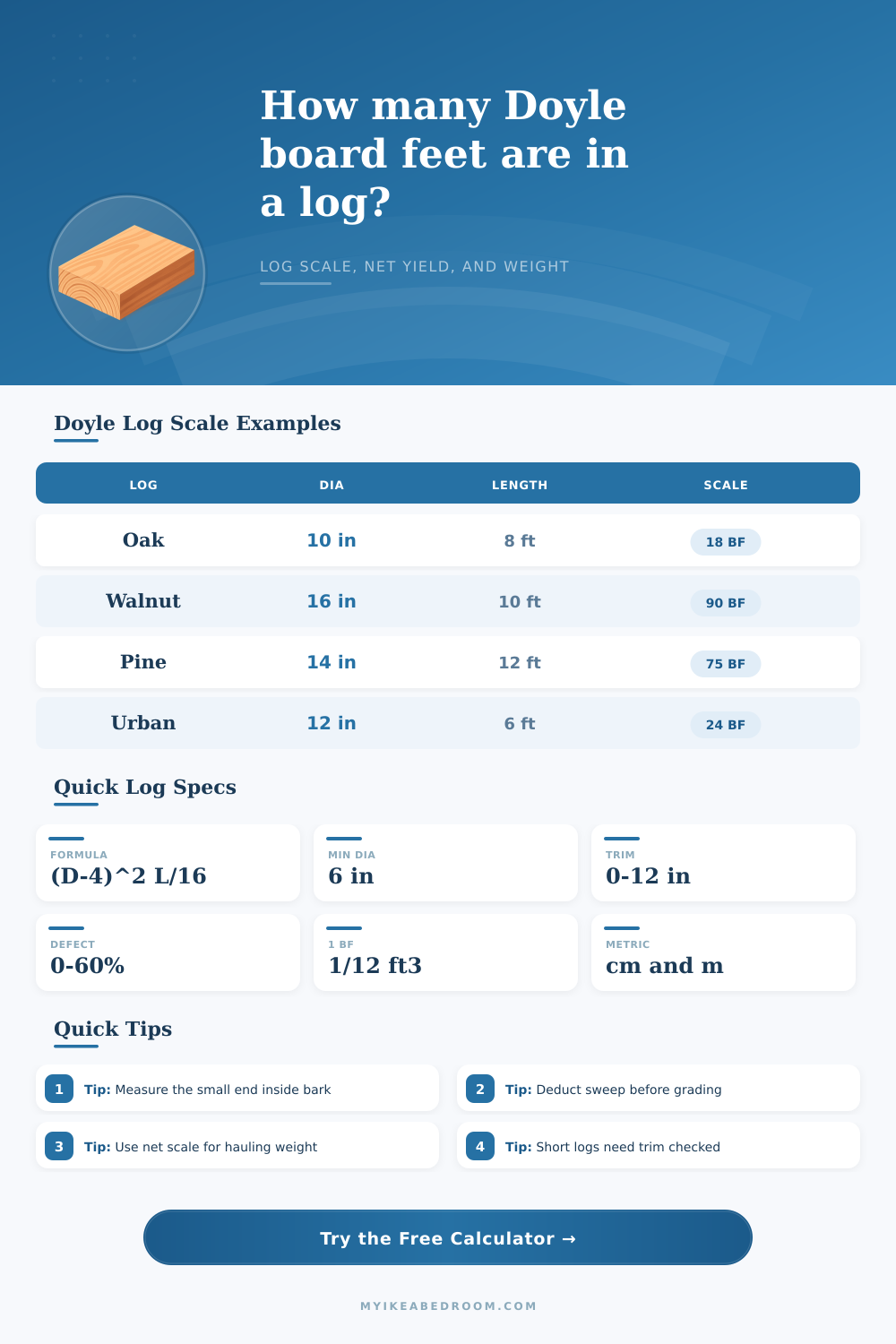
The Doyle rule is a specific formula that is used to calculate the amount of board feet that a log will contain. To use the Doyle rule, a person must subtract four inch from the diameter of the log at the small end of the log. The result of that subtraction is square.
How to Use the Doyle Board Foot Calculator
The calculator then multiply that squared number by the length of the log in feet. Finally, dividing that result by sixteen will provide the number of board feet of lumber that the log will contain. The four inch deduction from the diameter is used to account for the lumber that is lost when logs are processed into slabs and edgings.
Furthermore, because the Doyle rule subtracts from the diameter, logs that contain small diameters will be penalized more heavy than logs with large diameters. Another important measurement to enter into the Doyle board foot calculator is the diameter of the log. The Doyle board foot calculator is design to use the inside bark diameter of the log.
If the individual measures the diameter of the outside of the logs bark, they will need to account for the bark deduction of that log before entering the diameter into the calculator. The error in measuring the diameter of the log will have a more significant impact on logs with smaller diameters. This is due to the squaring of the diameter of the log.
For instance, introducing a half inch error into a ten inch log will have a greater impact on the board foot calculation than the same half inch error into an eighteen inch log. Another measurement that must be entered into the Doyle board foot calculator is the length of the log. The Doyle board foot calculator will automatically deduct a trim allowance from the length of the log.
Trim is the length of the log that is left on the log when it is being harvested to allow the mill to square the ends of the log. If a person does not account for trim when entering logs into the Doyle board foot calculator, they will provide an overestimate of the amount of lumber that the log will contain. The Doyle board foot calculator will not calculate the amount of defect in the logs dimension.
The defect of the log is the rot, metal, knot, and sweep within the log. The Doyle board foot calculator cannot see these. An individual will have to enter the percentage of the defect into the Doyle board foot calculator.
The calculator will take that percentage and apply it to the gross scale to determine the net scale of the log. The net scale is the amount of lumber that will be usable from the log. Another important factor for determining the weight of the logs is the species density of the log and its moisture state.
The Doyle board foot calculator will multiply the amount of net board feet of lumber that the log will contain by the weight of the species of the log. Finally, the calculator will apply a multiplier to that value to account for the moisture in the logs. Freshly cut logs will contain more water than logs that have been air dried.
Therefore, the moisture in the logs will impact the total weight of the logs that is being transported. The reference tables included with the Doyle board foot calculator may assist an individual in understanding the calculations of the Doyle rule. These reference tables will display the change of the scale of logs of different diameter.
Furthermore, these reference tables will display the change of the net yield of logs of different defect levels. Although individuals dont have to memorize these reference tables, they will help people understand how the Doyle rule calculate the board feet of logs. Furthermore, individuals can use the reference tables to recognize that logs with small diameters will experience more loss of volume due to the Doyle rule penalty.
Additionally, people will also recognize that the moisture content of logs will increase the weight of the logs. Using the Doyle board foot calculator will allow an individual to make different comparison of the logs. For instance, the diameter of the logs can be changed to recognize the change of the scale of the logs.
Additionally, the percentage of defect of the logs can be changed to recognize the change in the net yield of logs. Furthermore, the moisture state of the logs can be changed to recognize the change in the weight of the logs. By using the Doyle board foot calculator and comparing the result of the logs within the calculator to the actual amount of lumber that is harvested from the logs, an individual will improve their ability to estimate the diameter, length, and defect of logs.