Plywood Weight Calculator
Estimate per-sheet weight, total stack load, remaining cut weight, and handling category from sheet size, thickness, core density, count, moisture, cutouts, and laminate or veneer layers.
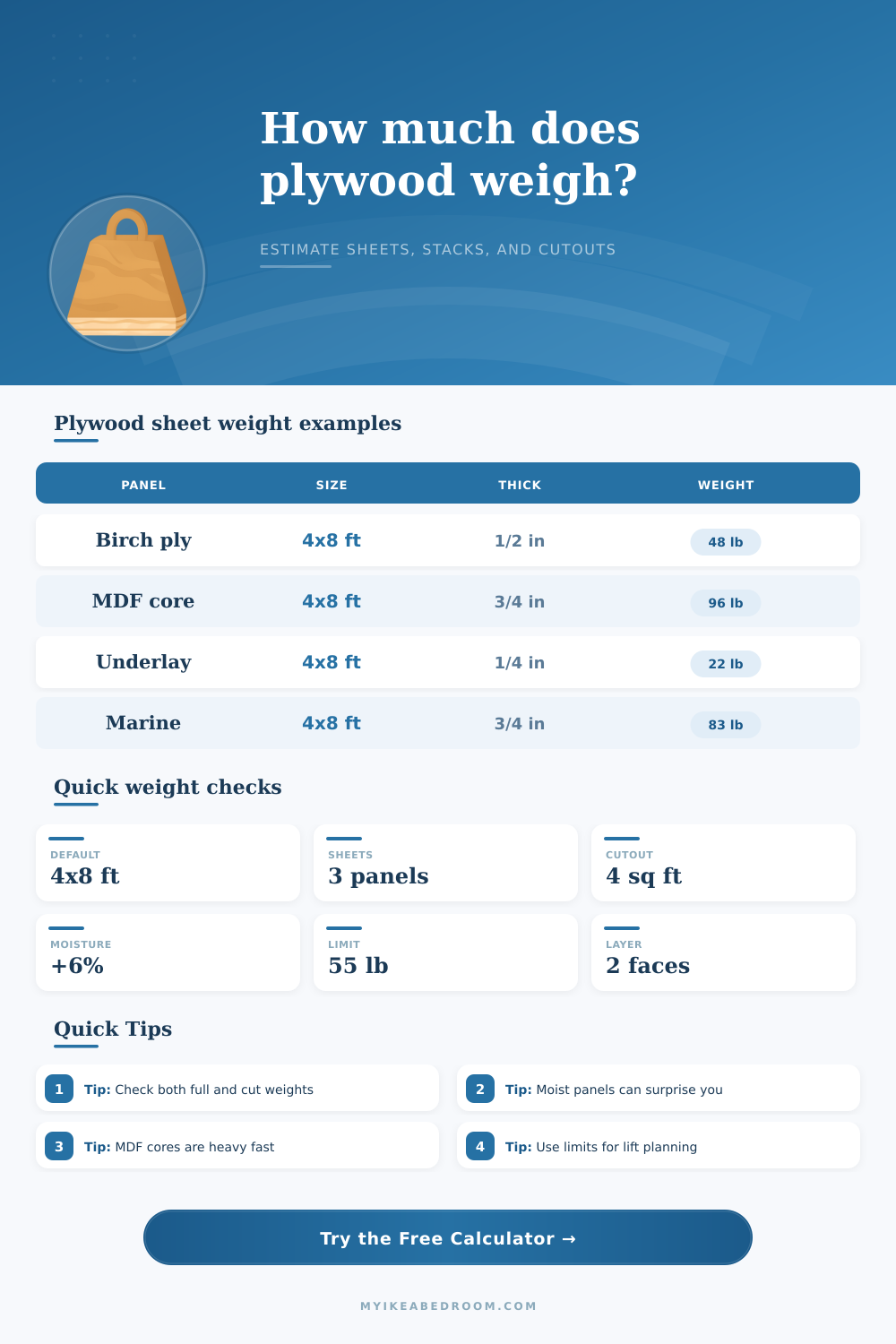
Load a common panel setup, then adjust size, thickness, core type, sheet count, cutouts, moisture, and handling limit.
Cutouts: For doors, sink openings, and access panels, subtract only the material removed from each sheet. Narrow kerfs usually do not change handling weight enough to matter.
Handling limits: Compare the net sheet weight to the limit for the hardest move, not the easiest one. Stairs, turns, and vertical loading make the same sheet feel heavier.
Plywood weight are a factor that many peoples find to be surprising about plywood. Plywood weight can change significant from one type of plywood to the next. A sheet of plywood may appear manageable to those who attempt to lift the plywood.
However, the weight of plywood can become challenging to handle. Plywood weight is a factor that will affect the physical effort that must be applied to move plywood of vary types, and the schedule that is create to complete the move. Plywood weight can change with the density of the plywoods core.
What Affects Plywood Weight
Different mills can manufacture plywood that contain different types of wood species in they plywood cores, different types of glue, and have different amount of pressure applied to the plywood during the manufacturing process. For instance, a sheet of lauan underlayment will typically weigh less than a sheet of particleboard core plywood. The core density of plywood will have a major impact on the total weight of the plywood; thus, plywood with a higher density will weigh more than plywood with a lower density.
The moisture content of plywood will impact the weight of the plywood. Plywood contain wood fibers that can absorbs water. As a result, the weight of plywood increase with the amount of water that the wood fibers absorb.
A stack of plywood that is stored in a damp environment for several week will contain a significently higher total weight than a stack of plywood that is stored in a dry environment. You can enter the moisture adjustment factor into the calculator that will estimate plywood weight; this adjustment will account for the weight of the water that is contained within the plywood. Plywood may contain cutouts that will impact the total weight of the plywood.
Plywood that has a large cutout will weigh less than plywood that dont have any cutouts of the same size. The area of the cutout can be entered into the plywood weight calculator to obtain a more accurat weight of the plywood. The way in which plywood is handled will impact how the individual feels the weight of the plywood.
For instance, moving plywood that is flat to the floor may require more effort than moving plywood up the stairs. A multiplier can be entered into the plywood weight calculator to compare the weight of the plywood to the individuals lifting limit. The type of layers applied to the face of plywood will add to the weight of plywood.
High-pressure laminate will add to the weight of plywood in one of its faces, while veneer will add to the weight of plywoods faces. Each of these face layers will add to the total weight of plywood in small amount per square foot of plywood; however, the total weight becomes large when the weight per square foot is multiplied by the total area of the sheet of plywood. A reference table can be used to determine the total weight of plywood with different types of face layers applied to its faces, without performing the multiplication calculation of the weight of the layers.
Plywood thickness will impact the total weight of plywood. Many individual are unaware of the difference between the nominal thickness and the actual thickness of plywood. Plywood may be sold as three-quarter inch thickness, but the actual thickness of the plywood may be slightly less.
Though the difference in thickness between nominal and actual thickness is small, the difference in volume will create a change in weight of the plywood. Thus, it is best to use the actual thickness of the plywood in the weight calculation to ensure that the calculated weight is accuratley. The orientation in which plywood is held will create an impact upon the weight of the plywood.
For instance, if the plywood is held vertically, the weight of the plywood will be distributed along the long axis of the body. If the plywood is held flat, the weight will be distributed across the forearms of the individual. Each of these methods of holding plywood may be more beneficial to some individuals than others, depending off the move that must be performed with the plywood.
The height to which plywood is stacked will impact the way that plywood must be moved. A tall stack of plywood will require few individual lift of the plywood to move the entire stack. However, the sheets located at the bottom of a stack will have to support the weight of the sheets that are positioned above the bottom sheets.
The total weight of the plywood sheets above the bottom sheets can cause the bottom sheets to flex and potentially crack. It may be easier to move the plywood if the total weight of the plywood sheets was distributed across fewer plywood sheet; the weight of plywood sheets can be safely distributed to reduce the chance of plywood damage. The goal of calculating the weight of plywood is to determine the total weight of the plywood prior to beginning to move it.
By calculating the weight of plywood, an individual can create a plan for moving the plywood that will be manageable according to the strength and limitations of the individual. By knowing the total weight of the plywood that must be moved, the move will not become a struggle for those who must perform the move. You should of calculated the weight first.