Pocket-hole joinery planner
Pocket Hole Screw Length Calculator
Choose a pocket-hole screw length from board thickness, screw angle, pilot depth, material hardness, head style, clamp gap, glue, and edge distance.
| Screw length | Penetration | Remaining | Score | Fit note |
|---|---|---|---|---|
| Run the calculator to compare screw lengths. | ||||
| Pocketed workpiece | Mating board | Typical screw | Common furniture use |
|---|---|---|---|
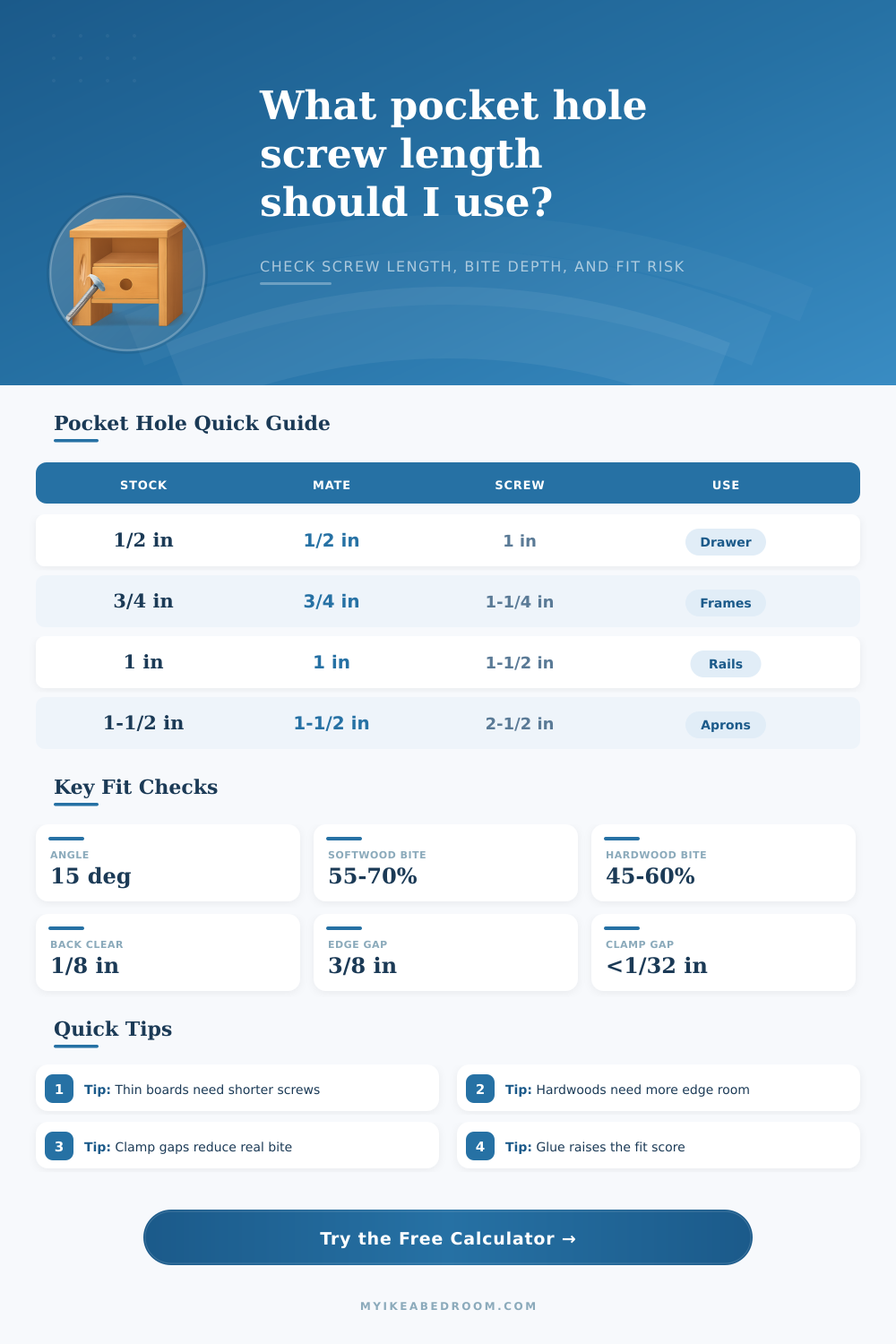
| 1/2 in | 1/2 in to 5/8 in | 1 in | Drawer boxes, light casework |
| 3/4 in | 3/4 in | 1-1/4 in | Cabinet face frames, cleats, rails |
| 3/4 in | 1 in to 1-1/4 in | 1-1/2 in | Thicker tabletops and frame rails |
| 1-1/2 in | 1-1/2 in | 2-1/2 in | Bench aprons, bed rails, 2x frames |
| Material | Target bite | Back clearance | Risk to watch |
|---|---|---|---|
| Softwood or plywood | 55% to 70% of mating board | At least 3/32 in | Pullout if bite is shallow |
| Hardwood | 45% to 60% of mating board | At least 1/8 in | Splitting near edges |
| MDF or particleboard | 40% to 55% of mating board | At least 5/32 in | Crumbly fibers and blowout |
| End-grain heavy joint | 60% to 75% if thickness allows | At least 1/8 in | Screw-only joints can loosen |
| Angle from normal | Normal bite factor | Lateral shift per inch | Good use |
|---|---|---|---|
| 10 deg | 0.985 | 0.176 in | Thicker rails with generous edge room |
| 15 deg | 0.966 | 0.268 in | Most cabinet and furniture pocket holes |
| 20 deg | 0.940 | 0.364 in | Angled pockets and miter work |
| 25 deg | 0.906 | 0.466 in | Use only with wider mating stock |
| Head style | Allowance | Seat behavior | Fit note |
|---|---|---|---|
| Pocket washer head | 0.08 in | Seats flat in pocket shoulder | Default for pocket-hole joinery |
| Pan head | 0.06 in | Sits slightly proud in some pockets | Check jig and bit match |
| Trim head | 0.04 in | Small bearing surface | Useful for narrow rails |
| Large washer head | 0.10 in | More head thickness in pocket | May need a touch more length |
Check the exit path: A longer screw is not always stronger. Keep enough back-side thickness so the tip cannot print through the finished face.
Clamp before driving: Even a small joint gap steals screw length from the mating board and can lower the fit score on thin stock.
Choosing the correct pocket hole screw length is importance for a few different reasons. The correct pocket hole screw length will prevent the screw from poking through the finished face of the wood. Choosing a screw that is too long will make the screw exit the wood.
Choosing a screw that is too short will make the joint wobbly and weak. The strength of a pocket hole joint rely upon how much the screw bites into the second piece of wood. Several variables will affect how strong that joint will be.
How to Choose the Right Pocket Hole Screw Length
Most pocket hole jigs will allow the screw to exit at an angle of approximately fifteen degrees. Because the screw will exit at this angle, some of the length of the screw will be used up before the screw can begin to bite into the second board. A longer screw is not always a better screw, as some of the length will be used up using this diagonal path of the screw.
You can use a calculator to determine the proper length of the pocket hole screw based off the thickness of the boards being jointed, the pilot depth of the jig, and the clamp gap between the boards. The thickness of the boards will play a primary role in the length of the screw that will be required to properly join the two boards. However, the thickness of the boards alone will not necessarily determine the length of the pocket hole screw that should be used.
Hardwood will hold the threads of the screw more tightly than plywood will hold the threads of a pocket hole screw. Because hardwood holds the threads more tightly, a hardwood joint will require a lower percentage of bite of the screw compared to a joint made with two pieces of softwood or plywood. The material setting on the jig will adjust to allow for this, so the user does not needs to remember the percentage of bite that will be required of different types of wood.
The head style of the screw will also impact how the joint will hold. A washer head screw will sit deeper into the pocket than a trim head screw. Because the washer head screw sits deeper into the pocket, the screw will use up some of its length before it can begin to bite into the second piece of wood.
This affects the length of that screw. Using a washer head screw instead of a trim head screw will require the user to account for this in the length of the screw that is selected. If they dont, then the joint may be too short for the screw to effectively bite into the second piece of wood.
The clamp gap between two boards will also impact the length of the screw. The clamp gap is the thickness of the gap between the two boards that are being jointed. The screw will travel through this gap before it can bite into the second piece of wood.
A small amount of the length of the screw is used up due to this gap. The calculator will account for this gap in the length of the screw that is selected for the joint. Another factor that will impact the length of the screw is the edge distance of the joint.
This is especially important for narrow rail joints or mitered frame joints. Because the screw will exit at an angle, the tip of the screw will travel sideways into the joint as the screw is driven into the piece of wood. If the edge distance is too short, the tip of the screw may exit the side of the board.
The calculator will account for the lateral travel of the screw and adjust the length of the screw to ensure that the screw will not exit the side of the board. Often, wood joints created in furniture are not textbook joints. Many wooden furniture frames use rail-to-leg joints.
These joints use screws that are driven into the end grain of the wood. The end grain of the wood has a lower grip on the threads of the screw as compared to the face grain of the wood. Because the joint relies upon glue to hold the two pieces of wood together, the calculator will provide a modest boost in the target bite for these types of joints.
The screw does not need to provide all of the strength of the joint. Drawer box joints may seem similar to the other joint types that have been discussed. However, the sides of drawers are often made of thin plywood.
Using a screw that is too long for a drawer will cause the screw to exit the backside of the drawer or create a dimple on the finished side of the drawer. A calculator will allow the user to input the thickness of the drawer sides so that it will show the remaining thickness of the side of the drawer. This remaining thickness determines how much clearance should be allowed from the tip of the screw to the edge of the side of the drawer to avoid the screw dimpling on the finished drawer.
The minimum recommended clearance should be an eighth of an inch. Some furniture makers prefer to allow more clearance on the backside of the drawer if it is to be visible. A common issue with the type of joints described above is the issue of mitered joints.
These joints are difficult to clamp in a manner that allows the screw to exit at the proper angle. Furthermore, the miter cut on each of these joints reduces the clearance on each side of the joint. The calculator will adjust the edge distance for miter joints so that the joint is less likely to blow out on the side of the miter joint.
Many furniture makers will use both shorter screws and glue blocks to these joints because they are difficult to clamp in a way that the screw will effectively bite into the side of the joint. The fit score can be used to determine if the length that was chosen for the pocket hole screw is within the safe range for the specific type of wood that is being joined and the specific type of joint. A high score indicates the screw length is within the safe range.
A low score indicates that the length of the screw is near the limits of the variables. This is another indication that the furniture maker should re-evaluate the screw length. A common mistake that many people make when selecting the length of a pocket hole screw is to ignore the thickness of the other piece of wood that is being joined.
The same thickness of wood may require different pocket hole screw lengths, depending upon the other piece of wood. For example, a three-quarter-inch board may require a one-and-a-quarter-inch screw for one joint but require a one-and-a-half-inch screw for another joint in which it is joined to a much thicker piece of wood. In each instance, the fit score will change, so the numbers should be run for each new joint.
Glue alters the variables of the screw’s bite into the other board. If the joint will contain glue, the screw will not need to have as great of a bite into the other piece of wood. The glue will assist in providing the strength between the two pieces of wood.
The joint calculator will account for this when the user selects the glue variable. If the joint will not contain glue, the user may want to use a longer screw to compensate for the glue’s lack of strength. However, using a screw that is too long for a non-glued joint will allow for potential clearance issues on the back side of the wood.
A reference table for the length of pocket hole screws to use based upon the thickness of the wood can be found on the calculator. However, these tables are merely a starting point for the length that should be used for the screw. Because the lumber is going to vary in type and thickness, a decision based upon this reference table may not provide the best results.
Instead, the calculator can provide a recommendation, but the final decision is up to the furniture maker. Although pocket hole joinery is a fast method of creating furniture, the speed with which the furniture is made is only going to result in durable furniture if the length of the pocket hole screw is correctly chose for the joint being created. The correct length for pocket hole screws is the length that will disappear into the pocket of the wood, ensure that it bites firmly into the other piece of wood, and leave enough material behind the tip of the screw to ensure that the finished side of the wood will be smooth.