Board Foot Calculator
Estimate rough lumber volume, finished yield, cubic volume, and project weight from real board dimensions, species density, moisture, waste, kerf, and planing allowance.
Lumber volume estimate
| Reference | Imperial relationship | Metric relationship | Best use |
|---|---|---|---|
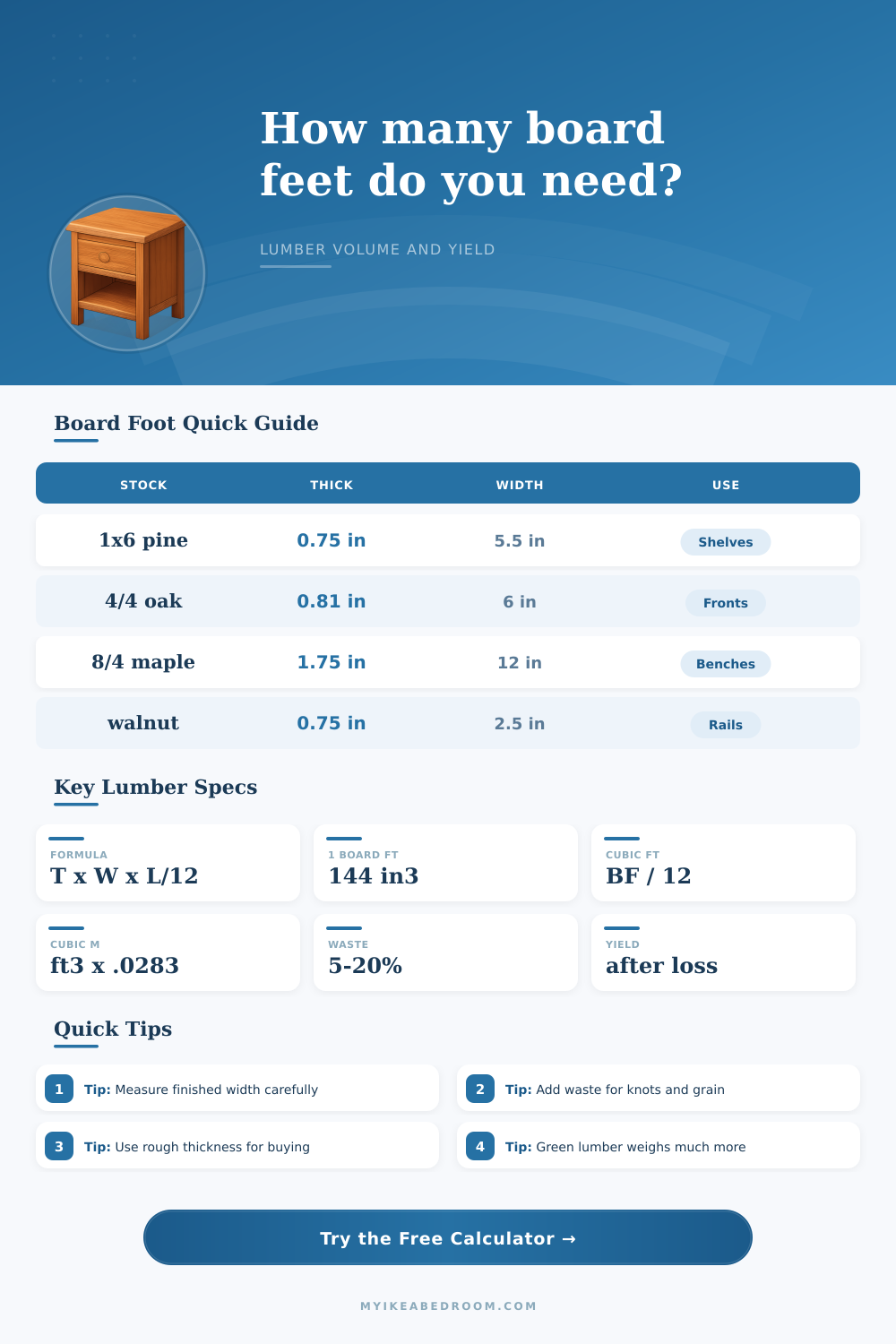
| One board foot | 12 in x 12 in x 1 in | 0.00236 m3 | Buying and comparing lumber volume |
| Board feet formula | Thickness in x width in x length ft / 12 | Convert to imperial first | Straight boards and rectangular blanks |
| Cubic feet | Board feet / 12 | ft3 x 0.0283168 | Weight and storage space |
| Metric lumber volume | m3 x 423.776 = board feet | Length m x width m x thickness m | Millimeter-based project planning |
| Nominal stock | Typical rough thickness | Typical finished thickness | Planning note |
|---|---|---|---|
| 4/4 boards | 1.00 in | 0.75 to 0.81 in | Drawer fronts, shelves, face frames |
| 5/4 boards | 1.25 in | 1.00 to 1.06 in | Thicker tops and robust rails |
| 6/4 boards | 1.50 in | 1.25 to 1.31 in | Small legs and chunky trim |
| 8/4 boards | 2.00 in | 1.50 to 1.75 in | Bench slabs, posts, thick furniture parts |
| Species | Approx density | Workability cue | Bedroom project fit |
|---|---|---|---|
| Pine or cedar | 23 to 28 lb/ft3 | Light, easier to cut, dents sooner | Closet liners, shelf boards, light trim |
| Poplar or cherry | 30 to 36 lb/ft3 | Medium weight, stable for paint or clear finish | Face frames, drawer fronts, shelf edging |
| Walnut or birch | 38 to 42 lb/ft3 | Moderate to dense, good for visible parts | Cabinet rails, panels, accent shelves |
| Oak, maple, ash | 42 to 47 lb/ft3 | Dense, strong, heavier to handle | Tops, benches, bed platforms, structural rails |
| Allowance item | Typical range | What it covers | When to increase it |
|---|---|---|---|
| Saw kerf | 2% to 5% | Blade width, crosscuts, rip cuts | Many small drawer or rail parts |
| Planing and jointing | 4% to 12% | Flattening, thicknessing, edge cleanup | Cupped, twisted, or rough-sawn boards |
| Defect waste | 5% to 20% | Knots, checks, sapwood, grain selection | Visible furniture faces or matched grain |
| Moisture weight | 8% to 35% | Extra water in air-dried or green boards | Outdoor-stored or recently sawn lumber |
Shelf Boards
Common stock: 1x6 or 1x8 pine
Yield focus: width and straightness
Allowance: 8% to 12%
Drawer Fronts
Common stock: 4/4 oak, birch, cherry
Yield focus: clear faces and matched grain
Allowance: 12% to 18%
Rails and Stiles
Common stock: walnut, poplar, ash
Yield focus: long straight rips
Allowance: 10% to 16%
Bench Slabs
Common stock: 8/4 maple or oak
Yield focus: thickness after flattening
Allowance: 15% to 25%
Calculating board feet are necessary because calculating board feet will allow you to determine the volume of lumber that is needed for a project that you are planning to complete. You must calculate the volume of lumber for cost efficiency in purchasing the lumber; buying too little lumber will make it impossible to complete the project, while buying too much lumber will waste money. Furthermore, you can use the calculated number of board feet when you go to the lumberyard to purchase the lumber, and this number represent the volume of lumber that is needed for your project.
The inputs that is required for a lumber yard calculator are necessary to account for the fact that the lumber that is purchased at the lumber yard is typicaly in a rough form. The lumber comes in larger thickness than the thickness that will end up in the project, as the lumber will be flattened and thinned while it is being constructed into a planar project. You must account for the loss of thickness of the lumber during planing; otherwise, too much lumber will be purchased.
How to Calculate Board Feet for a Wood Project
Furthermore, you must use the waste percentage field in the calculator to account for the fact that not all lumber that is cut will be usable; there are knots in the lumber, there are cracks in the lumber, and there may be an extra length of lumber that is needed for the project joinery. If you change the waste percentage, it is possible that the total cost of the lumber changes, which will affect the species of the lumber that is purchased. The species of the lumber that will be bought is important in that the density of that species will impact the weight of the lumber.
The weight of the lumber will impact the ease with which you can move that lumber. Another important field in the calculator is the moisture state. The behavior of kiln-dried lumber is different than green lumber, as the green lumber contains more water; green lumber will weigh more than kiln-dried lumber because the green lumber contains free water molecules within its cellular structure.
It is important that you correctly choose the moisture factor for the project; otherwise, it is possible that the weight of the lumber will be a surprise when the lumber is purchased. The output of the calculator that indicates the finished lumber yield will differ from the total raw board feet that is calculated. The yield of the lumber will impact the amount of lumber that is thrown away during the construction of the project; a low percentage of yield means that a lot of lumber will be discarded.
The percentage of yield for lumber is low if the project is dependent upon specific grain pattern of the lumber; a high percentage of yield means that a lot of lumber will be utilized in the project to create the necessary project components, which occur when the project components are long and the lumber is clear of defect. The percentage of yield of the lumber will help to show the project that will be created before lumber is cut. Reference tables exist to convert the measurements of lumber that is purchased at the lumber yard to the measurements that exist within the project drawing.
The lumber yard sells the dimensions of lumber using nominal measurements (four-quarter, eight-quarter) but the dimensions that are actualy cut from the lumber are those that are surfaced. The allowance field in the calculator are used for the difference in these two types of measurements. The calculator that is built that translates one unit system to another (metric/imperial) is helpful, as it ensures that no mental calculations is required during the process of calculating the lumber.
Common mistake with lumber yard calculators include treating the dimensions of the finished lumber as if they were the dimensions of the lumber that is purchased. You should not treat the dimensions of the finished lumber as the dimensions for the lumber that is purchased, as the hardwood must be planed and jointed; the lumber loses thickness during this process. Furthermore, it is a common mistake to apply the same waste percentage to each species of lumber.
The waste percentage should not be the same for each species of lumber; for example, cherry wood has to be cut more selectively than pine wood to remove defects from the boards. The adjustment of the waste percentage according to each species will ensure that the lumber yard will not have to order more lumber than what is calculate by the calculator. While the lumber yard calculator will provide an estimate of the amount of lumber that will be needed, it is also important to use your own judgment and experience in determining how much lumber to purchase.
A board may appear to be straight and even when standing in the lumber yard, but it may bow when the board is cut to specific lengths. Live-edge lumber will also require that you average the measurements of a board, as you cannot use the measurement of just one part of a live-edge board. Your measurements of the lumber should be taken twice and with an extra allowance for waste; the calculator does not take into account the characteristic of any individual board.
One benefit of using a lumber yard calculator is that you can compare lumber price and species at the lumber yard. Using the total number of board feet that you have calculated, you can determine whether or not the price on the lumber tag match the price of the lumber you are carrying home. While there are many variable of lumber that should be considered in pricing, there is no variable that is more important than the calculation of the total board feet.