❄ Mini Split Room Size Calculator
Estimate mini split BTU capacity from room dimensions, ceiling height, insulation, climate zone, sun exposure, window area, occupants, electronics heat, open-plan spillover, and heating or cooling mode.
Load a realistic room, then adjust every field to match your insulation, windows, climate, and open-plan conditions.
Load breakdown
The recommended band rounds to common mini split nominal sizes while keeping the calculated room load visible.
| Climate zone | Cooling base | Heating base | Typical signal |
|---|---|---|---|
| Mild coastal | 24 BTU/sf | 28 BTU/sf | Small temperature swings |
| Mixed seasonal | 30 BTU/sf | 35 BTU/sf | Balanced heating and cooling |
| Hot humid | 36 BTU/sf | 26 BTU/sf | Latent cooling matters |
| Hot dry | 34 BTU/sf | 24 BTU/sf | Sun exposure can dominate |
| Cold winter | 26 BTU/sf | 44 BTU/sf | Heating capacity check |
| Very cold | 24 BTU/sf | 52 BTU/sf | Low-temperature heat pump check |
| Condition | Low | Typical | High-load signal |
|---|---|---|---|
| Insulation | 0.88 tight shell | 1.08 average | 1.32 drafty shell |
| Ceiling height | 8 ft baseline | 10 ft adds about 12% | Lofts can add 20%+ |
| Sun exposure | 0.94 shaded | 1.00 balanced | 1.22 sunroom glass |
| Open plan | 1.00 closed | 1.08 doorway | 1.28 loft or open stair |
| Nominal class | Tons | Typical planning band | Room pattern |
|---|---|---|---|
| 6,000 BTU/hr | 0.50 ton | 5,400-6,600 BTU/hr | Very small insulated room |
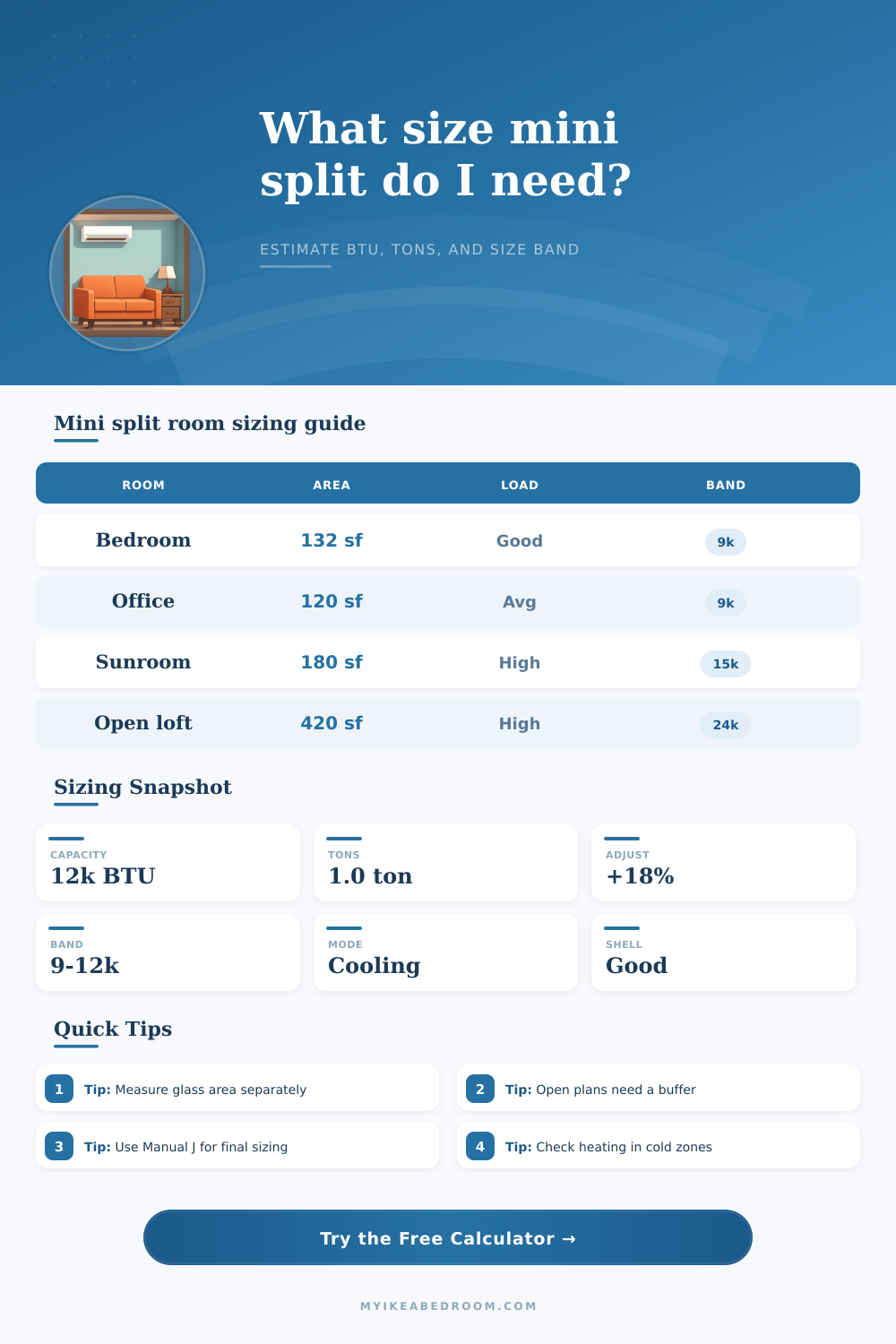
| 9,000 BTU/hr | 0.75 ton | 8,100-9,900 BTU/hr | Bedroom or office |
| 12,000 BTU/hr | 1.00 ton | 10,800-13,200 BTU/hr | Primary bedroom or small suite |
| 15,000 BTU/hr | 1.25 ton | 13,500-16,500 BTU/hr | Sunroom or large bedroom |
| 18,000 BTU/hr | 1.50 ton | 16,200-19,800 BTU/hr | Open suite or compact living area |
| 24,000 BTU/hr | 2.00 ton | 21,600-26,400 BTU/hr | Open loft or multi-use room |
| Preset | Area | Primary load driver | Default focus |
|---|---|---|---|
| Small bedroom | 132 sq ft | Balanced room shell | Cooling capacity |
| Sunroom | 180 sq ft | High glass and west sun | Cooling capacity |
| Open loft | 420 sq ft | Open plan and high ceiling | Heat pump larger load |
| Basement suite | 252 sq ft | Cold-zone heating | Heating capacity |
| Home office | 120 sq ft | Electronics heat | Cooling capacity |
| Garage studio | 280 sq ft | Drafts and open spillover | Heating capacity |
Counts sun, glass, occupants, and electronics as heat that the mini split must remove.
Uses climate heating intensity and gives partial credit for steady internal heat sources.
Compares cooling and heating estimates, then sizes from the larger design requirement.
Averages heating and cooling for mild climates where neither season clearly dominates.
To size a mini split air conditioners, you must understand the thermal load of the room. Mini split air conditioning unit sizing require looking beyond the square footage of the area. If the air conditioner is to small for the area, it will run constantly to reach the target temperature.
If it run constantly, it will add to the electric costs and wear out the compressor. If the air conditioner is too larger for the area, it will cool the air rapid but not extract enough moisture from the air. If the air conditioner does not extract moisture from the air, the area will feel cold and clammy.
How to Size a Mini Split Air Conditioner
Therefore, you must find a mini split air conditioner that provide the correct balance between temperature and moisture control in the room. The insulation of the room will impact the BTU requirement for the mini split air conditioner. If the room have good insulation like moddern buildings with spray foam insulation and double pane windows, the room will require less power from the mini split air conditioner.
For older rooms with thin wall and drafty windows, more power is required to maintain a consistent temperature in the room. These insulation level will impact the size of the mini split air conditioner required. The sunlight that enter the windows impacts the BTU requirement.
Large west facing windows will allow the room to absorb more solar heat than north facing windows. The sunlight will heat the furniture and floors that it land on. These heated object will radiate heat back into the room.
The total area of glass in the room will determine the amount of solar heat that enter the room. Human bodies and electronic device add to the thermal load of the room. Humans and electronics create heat.
Thus, these internal heat source will increase the total amount of heat that the mini split air conditioner must remove from the room. If you dont account for the heat created by the humans and the electronic device, the room may not reach the target temperature with the mini split air conditioner that you have sized for it. The volume of air in the room impact the performance of the mini split air conditioner.
The ceiling height in the room and the floor plans create the volume of air in the room. If the ceiling are vaulted, there is more air volume in the room than in a house with eight foot ceilings. Therefore, a mini split air conditioner with a higher BTU rating is required.
Open floor plan allow the conditioned air to escape through open doorways. Therefore, the open plan will increase the workload of the mini split air conditioner as it must cool more air in the house. The climate in which you will install the mini split air conditioner will impact the size of the unit.
In cold climate, heat pumps that are part of mini split air conditioning system will lose efficiency. Therefore, to compensate for the loss of efficiency, a larger mini split air conditioner will be required. Focus on the larger of the two loads, either the heating load or the cooling load.
By focusing on the larger load, the mini split air conditioner will be able to handle the most common condition in either the cooling or heating season. The air conditioner will be available in nominal size class. These classes include 9k, 12k, and 18k BTU unit.
Find the size class that come closest to your design load. However, use a nominal size class that have a small buffer built into its size for your design load. A ten percent margin between the mini split air conditioners size and the total thermal load will allow it to handle heatwaves without being too large for the room.
Professionals will calculate the size of the mini split air conditioner using a formal load calculation process. However, the estimate provided will allow you to find the realistic size for your mini split air conditioner.