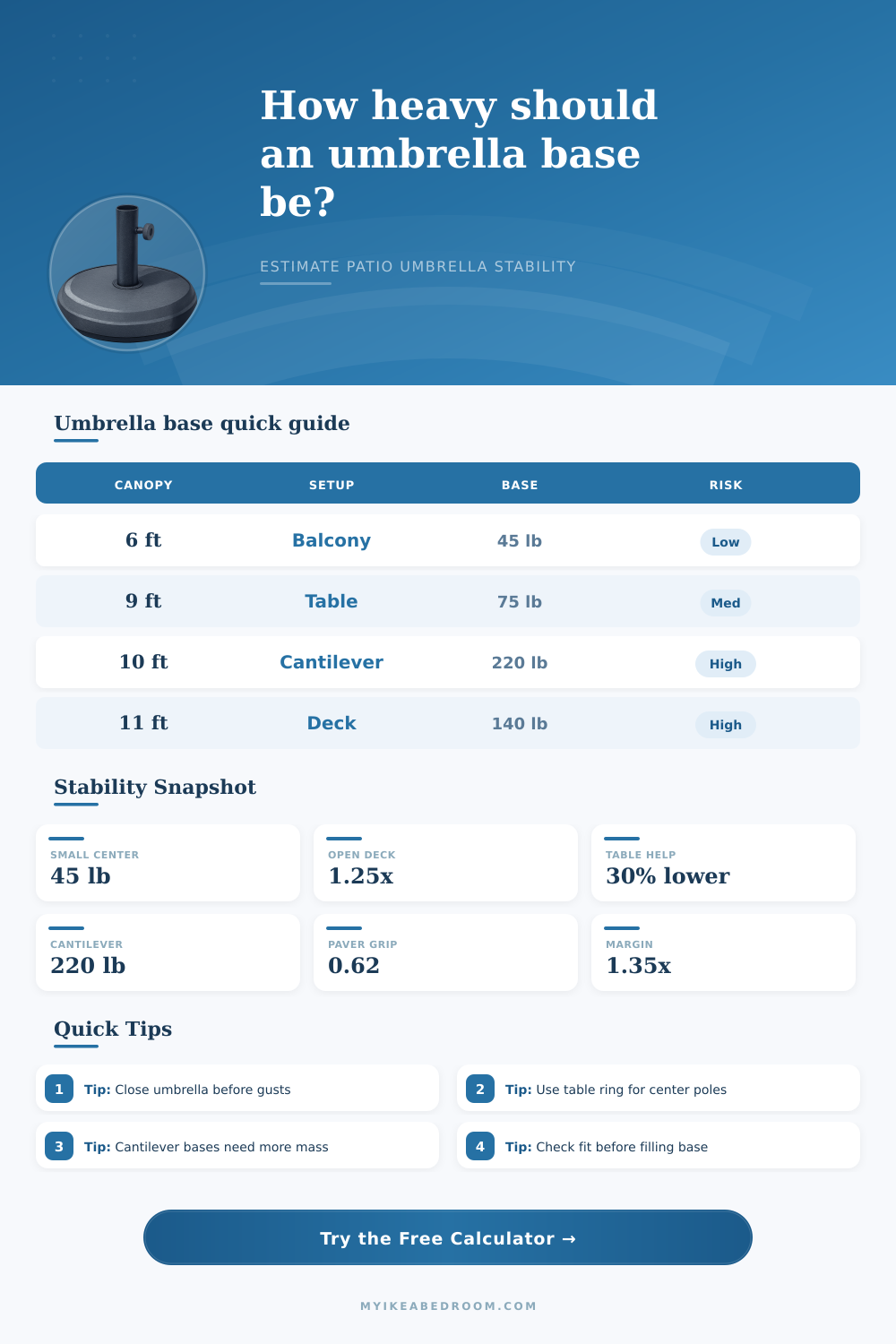
Patio Umbrella Base Weight Calculator
Estimate recommended umbrella base weight from canopy diameter, height, pole size, table support, wind exposure, footprint, umbrella type, surface friction, and safety margin.
Load a common patio umbrella setup, then adjust the exposure, footprint, surface grip, and safety margin for the exact place where the shade will stand.
| Exposure setting | Multiplier | Typical location | Planning note |
|---|---|---|---|
| Sheltered courtyard or wall | 0.75x | Fence, wall, or dense planting nearby | Still close the canopy when weather changes. |
| Typical patio or garden | 1.00x | Average yard with some wind breaks | Good default for everyday shade planning. |
| Open deck or yard | 1.25x | Railings, broad paving, or open lawn | Use more base mass and a wider footprint. |
| Exposed deck, rooftop, or pool | 1.50x | Upper deck, pool edge, or corner lot | Plan conservatively and close early. |
| Frequent gust corridor | 1.80x | Between buildings or along a narrow side yard | Consider no-open use when gusts are forecast. |
| Umbrella setup | Canopy size | Starting range | Use this range when |
|---|---|---|---|
| Balcony center pole | 5 to 6.5 ft | 40 to 60 lb | Small canopy, low height, and some wind shielding. |
| Dining table center pole | 7.5 to 9 ft | 65 to 95 lb | Table ring supports the pole and reduces wobble. |
| Freestanding center pole | 9 to 11 ft | 95 to 150 lb | No table support or the setup sits in open exposure. |
| Market style canopy | 10 to 11.5 ft | 120 to 180 lb | Larger canopy, taller hub, or heavier fabric panels. |
| Cantilever or offset | 9 to 11 ft | 200 to 300 lb | Offset arm places canopy load away from the base center. |
| Surface or base contact | Friction factor | Footprint cue | Planning effect |
|---|---|---|---|
| Rough concrete or textured stone | 0.75 | Base grips without sliding | Best contact for resisting both slide and tip. |
| Pavers or composite deck | 0.62 | Good grip with small joints | Balanced default for many patios and decks. |
| Wood deck or smooth slab | 0.52 | Smoother contact area | Needs more weight or a wider base footprint. |
| Smooth tile or sealed concrete | 0.42 | Base may slide before tipping | Add anti-slip pads and avoid windy placement. |
| Grass, mat, or uneven surface | 0.38 | Contact points are uneven | Level the base and treat the result conservatively. |
| Support detail | Adjustment used | Best case | Watch point |
|---|---|---|---|
| Through-table with a snug ring | 28% lower demand | Center pole dining sets | The table must be heavy and stable itself. |
| Partial or loose table opening | 12% lower demand | Older tables or wide pole holes | Wobble can still load the collar quickly. |
| No table support | No reduction | Freestanding lounge shade | Footprint and base mass carry the full load. |
| Loose base collar | 10% added demand | Missing reducer or worn sleeve | Correct the fit before adding more height. |
Best use: Small canopy, low height, sheltered rail or wall.
Stability driver: Footprint fit and sudden side gusts.
Base cue: Compact heavy base with anti-slip contact.
Best use: 7.5 to 9 ft dining shade through a table ring.
Stability driver: Table support quality and pole sleeve fit.
Base cue: Do not count the table as the only ballast.
Best use: Larger patio shade where furniture does not support the pole.
Stability driver: Canopy area, height, and exposure multiplier.
Base cue: Wide footprint plus conservative margin.
Best use: Offset lounge seating where the pole sits outside the table area.
Stability driver: Offset arm leverage and rotating canopy angle.
Base cue: Follow manufacturer ballast first.
Planning estimate: This calculator is a stability planning estimate, not an engineering approval. Always follow the umbrella manufacturer's minimum base requirement and close the canopy before gusts, storms, or unattended periods.
Footprint check: A heavier base with a narrow contact patch can still wobble. If the score is high, improve the collar fit, widen the footprint, lower exposure, or move the umbrella to a more sheltered position.
An umbrella can act as a surfaces for the wind to land on. Because the umbrella catch the wind, the wind can create enough force to tip the umbrella over. Many peoples believe that the umbrella base need to be heavy to provide enough stability for the umbrella.
However, there are several different factor that go into determining how stable an umbrella will be when in use. For instance, if the umbrella base is too light for an umbrella, the wind will tip the umbrella and its base. One of the factor that goes into determining the stability of an umbrella is the type of surface upon which the umbrella is placed.
How to Keep an Umbrella Stable
For instance, if you place an umbrella on a smooth surface, there will be less friction between the umbrella base and the ground. In this case, the umbrella will slide on the smooth surface and be less stably. Conversely, if you place an umbrella upon a textured surface, there will be more friction between the umbrella base and the ground, which will allow for the umbrella to remain in one place.
Another of the factor that goes into determining the stability of an umbrella is the type of umbrella that is utilize. For instance, center pole umbrellas is balanced, while cantilever umbrellas are not balanced. The cantilever umbrella create leverage with the way the canopy is placed on one side of the pole.
This leverage place the umbrella in a state where a greater weight is require for the base to remain stable. The location of the umbrella is another of the factor that will have an impact upon the stability of the umbrella. For instance, if you place the umbrella in a sheltered courtyard, it will experience less wind.
In this case, it will not have to counteract the force of as many wind with its umbrella base. However, if the umbrella is placed on a rooftop or pool deck, it will encounter more wind, which will require a greater weight for the umbrella base to remain stable. In this case, you can utilize a calculator to determine the weight required for the umbrella base based off the wind exposure in you specific location.
Some people may believe that placing the umbrella through a dining table will provide enough stability for the umbrella. However, a dining table will not prevent the wind from acting upon the umbrella base. The force of the wind will act upon the umbrella, its pole, and the umbrella base.
Thus, if the umbrella has a light base, it will tip. Another of the factor that will impact the stability of the umbrella is the fit of the umbrella pole within the umbrella base. If the pole is not secure within the base collar, the pole will begin to tilt before the umbrellas base can provide resistance against the force of the wind.
This tilting create more leverage for the umbrella against the base, which will lead to the umbrella tipping over. Therefore, the pole should of fit tight within the umbrella base to prevent the umbrella from tilting. Finally, another of the factor that will have an impact upon the stability of the umbrella is the weight limit of the umbrella base.
Regardless of how stable the umbrella may be, the umbrella base will have a limit to the strength of the wind that it can withstand. For this reason, it is important to close the umbrella when utilize the patio for other activities, or during periods of storm. Closing the umbrella will prevent the umbrella from catching the wind, which ensure that the wind cannot create the force that will tip the umbrella and its base over.