Kitchen Recessed Lighting Layout Calculator
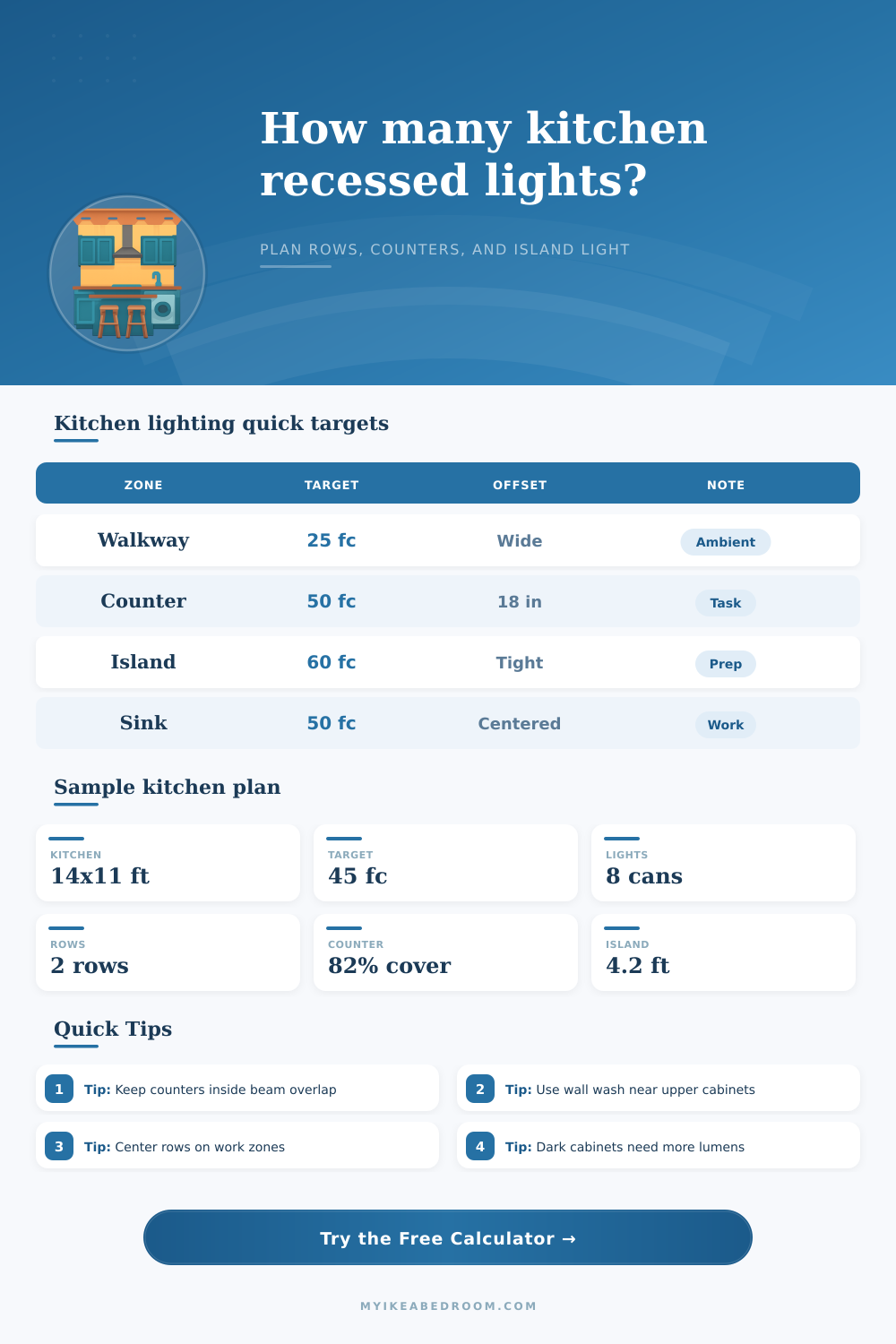
Plan recessed light count, row spacing, counter coverage, island task spacing, wall wash offset, and delivered foot-candles from kitchen dimensions, ceiling height, fixture lumens, beam angle, cabinets, and work zones.
Load a kitchen scenario, then tune the ceiling height, counter lengths, island size, wall wash offset, fixture beam, lumens, cabinet obstruction, spacing multiplier, and target foot-candles.
Counter rows: Keep recessed fixtures close enough to the cabinet face that the beam reaches the counter before your body casts a shadow. The wall wash offset input helps check that row.
Island zones: Treat the island as its own task area. A room-average layout can look bright while leaving prep space uneven, especially with narrow beams or dark finishes.
When you design kitchen lighting, you need to consider the different task that take place in a kitchen. Each of these tasks requires a different amount of light to be effectively performed. A kitchen has many task that must be completed, and each task requires specific levels of light to be performed proper.
One approach to lighting a kitchen that is often used is to place light in a grid formation across the kitchen. However, placing lights in a grid will create shadow in the kitchen, as shadows are created when an object block the path of the light. To prevent shadows from being created, the kitchen should be divided into specific zone.
How to Plan Kitchen Lighting
These zones include the prep area in the kitchen, the walkways, and the kitchen islands. Each of these areas will require a different level of light. The prep areas in the kitchen will require the most highest level of light.
A walkway, in contrast, will not need to have as much light in the kitchen to allow individuals to safe walk through the prep area. The amount of light that falls on a given surface in a kitchen can be measured in a unit called foot candle. Foot candles indicate the amount of light that falls on a specific surface in the kitchen.
This measurement help to determine the amount of light that is required to complete a task. If you tried to measure the amount of light in the kitchen as a whole, the levels of light would likely be too high for the prep areas in the kitchen’s countertop, but be too low for the area in the middle of the floor. Therefore, you will have to set specific targets for the amount of light that falls on each of these zone.
For example, the target level for light falling on the kitchen countertops will have to be higher than the light falling on the walkway. Another important factor to consider when lighting a kitchen is the beam angle of the lights. The beam angle determine how the light is distributed in the kitchen.
If the beam angle of the lights is narrow, then each light will illuminate a specific area in the kitchen; however, if the beam angle is wide, the light will spread across a large area in the kitchen. If you use lights of narrow beam angles, but the lights are too far apart in the kitchen, there will be bright spot on the floor, but there may also be dark spots in the kitchen that have no light falling on them. To avoid these dark spots, the placement of the lights should be align with the beam angles of the lights so that their beam overlap with adjacent lights.
This will ensure that there are no dark spots in the kitchen. One consideration for lighting a kitchen is that the upper cabinets in the kitchen may cast shadows on the countertops. These shadows will occur if the lights is positioned too far back from the edge of the countertop.
To avoid these shadows, the row of lights can be move away from the kitchen walls. This is referred to as the wall-wash offset. By using the wall wash offset, the lights will clear the edges of the upper cabinets and ensure that the countertops is lit.
The color of each of the surfaces in a kitchen will also play a role in how light reflect off those surfaces. When light hits a surface, that surface can reflect some of that light back into the kitchen. The color of that reflected light will depend on the color of the kitchen’s surface.
For example, if the cabinets and countertops are white, those surfaces will reflect a majority of the light that hits them; therefore, the kitchen will appear more brighter with white cabinets and countertops. In contrast, dark cabinets and countertops will absorb most of the light that hits the surfaces. This means that the kitchen will appear darker with dark countertop and cabinets.
Because dark surface absorb light, kitchens with dark counters will require more lumens to appear just as bright as kitchens with light countertops. Another area of consideration within kitchen is the kitchen island. Islands are often used to perform prep task and to serve as breakfast bar.
To allow for even lighting on the islands length, a series of light should be placed on the island instead of a single bright light in the center of the island. A single bright light in the center of the island may reflect too much light onto the island for individuals to comfortable view the counters. By using a series of overlapping lights, the entire island can be lit without causing any area of the island to be too bright compared to any other area on the island.
Finally, there are some additional consideration for lighting a kitchen. For instance, the height of the ceiling in the kitchen will impact the lighting plan. Some lighting plan may allow for the lights to be higher in the kitchen if the ceiling is high.
Additionally, some light fixture will lose some of the light that they produce. This can be due to the amount of dust in the kitchen that may collect on the lights, or the design of the light fixture. For instance, slim wafer will allow less light to pass through the fixtures than deep baffle.
Considerations of factor like ceiling height and light loss will allow for a kitchen lighting plan to be engineered instead of simply guess. By balancing the beam angles, the offset of the lights, and the target for foot candles in the kitchen, it will be possible to create a kitchen where the lights are positioned in such a way that they provide adequate light for each task in the kitchen.