UFO LED Lighting Layout Calculator
Estimate UFO high-bay fixture count, row and column spacing, maintained foot-candles, lux, coverage diameter, edge offsets, and spacing-to-height ratio for shops, aisles, gyms, and storage bays.
Pick a realistic starting layout, then adjust the room size, mounting height, fixture lumens, beam angle, reflectance, aisle spacing, obstruction factor, and target light level.
Enter the layout values to estimate a UFO high-bay grid.
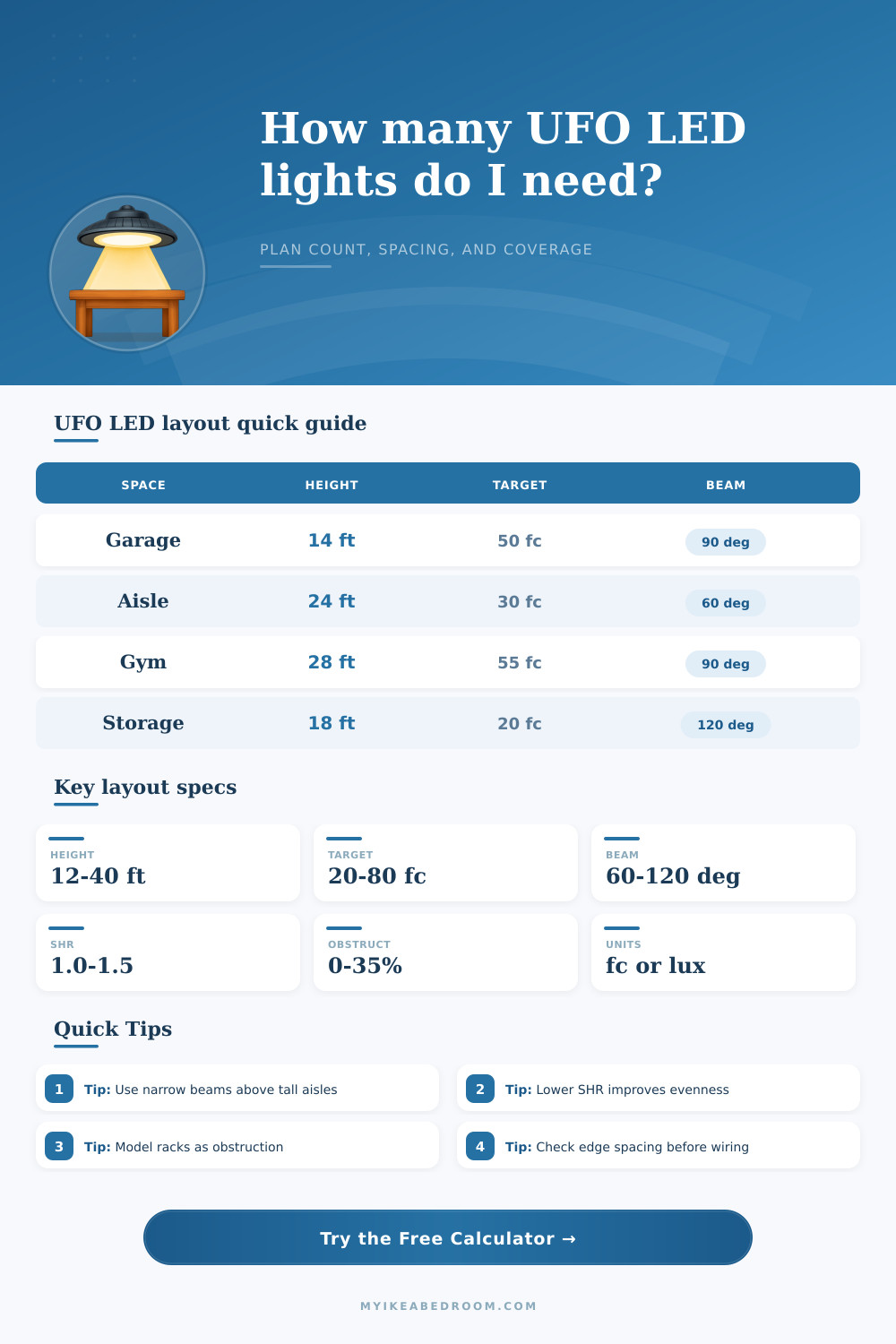
Aisle spacing: In rack rows, keep UFO centers aligned with aisles when possible. If aisle spacing is narrower than the calculated grid, use the aisle dimension as the tighter spacing limit.
Obstructions: Treat stacked goods, lifts, ducts, and dark roof decks as lost light. A higher obstruction factor increases the fixture count before the grid is accepted.
When purchasing high bay lighting, you must find a balance between the amount of light that the high bay lights will produces and the location of that light. Light levels and lumens is two different measurement of light, and each of these measurements should be managed differently. For example, if you purchase high bay lights with a high amount of lumens, but you install the lights at a high distance above the work area, the light will not effective illuminate the work area.
As such, you must account for the distance that the light will travel from the high bay lights to the work area, as well as the way that the beam of light will spread out as the light travels to the work area. The beam angle of the lights can be used to control the spread of the light from the high bay lights. A narrow beam angle will focus the light to hit the floor of a tall aisle, but will prevent the light from hitting the walls of that aisle.
How to Choose and Install High Bay Lights
A wide beam angle will emit a broad beam of light, which is useful for area with low ceilings or workshops. If narrow beams is used in an area with a low ceiling, however, the light will create circles of light in the area, leaving some portion of the work area dark. Many individuals may purchase high bay lights with high wattage without consider the beam angle of the light.
The surfaces within the room can also affect the functioning of the high bay lighting. Light can be reflected from some surfaces, while other surfaces will absorb the light. For instance, a white ceiling will reflect the light back into the work area, while a dark ceiling or an open-joist roof will absorb the light from that area.
Any obstructions within the work area of the high bay lights will absorb the light from those high bay lights. As such, you must consider the percentage of light that any ceilings or obstructions within the work area absorbs when installing the high bay lights. Another factor to consider within lighting design for high bay lights is the spacing to height ratio of the high bay lights.
High bay lights should be spaced within the work area to ensure that the light is spread even throughout the work area, this is referred to as uniformity. If the spacing of the high bay lights to the height of the ceiling is too great, then areas of even light will be created that are too dark to effectively allow the work area to performing certain tasks. A spacing to height ratio that is much closer to 1:1 will allow the beams of light from each high bay light to overlap, and eliminate any shadow from being cast within the work area.
Using a tighter spacing to height ratio may require more high bay lights to be installed within the area, but will help to prevent eye strain from the workers within the area. In addition to the factors described above, it is also important to consider the work plane within the work area. Work planes are often the height at which the work is to be performed.
For instance, if the work is to be performed on a workbench, the work plane will be the height of the workbench. Many people calculate the amount of light that is required within a work area for the floor, but the light levels need to be calculated at the work plane. Such calculations will ensure that the high bay lights are distribute apropriately within the work area.
For high bay lights that are to be used within warehouse aisles, for instance, the work area may have to be lit in a different way than other work areas. High bay lights should be installed to align with the center of the aisles that are to be lit, as lighting the area according to a standard grid within the warehouse will cause the high bay lights to impact the storage rack, instead of the aisles. Finally, there is another factor to consider in the installation of high bay lights: the relationship between the beam angle, the mounting height of the lights, and any physical obstacles within the work area.
It is often better to provide slightly more light to a work area than to under-illuminate the work area altogether. Any considerations must be provided to the cost of installing additional high bay lights relative to the difficulty of working in an area that is too dark. The beam angle, the mounting height of the high bay lights, and any reflectance of the work area will create an area that are suitable for the work that is to be performed within that work area.