Wall Art Placement Calculator
Calculate wall art centerline height, top and bottom edges, total group width, clearance above furniture, and proportion score for single pieces, pairs, rows, grids, and gallery arrangements.
Choose a common wall art situation, then adjust the furniture, art, wall, eye level, gap, clearance, arrangement, ceiling height, and room use.
Placement breakdown
| Anchor below | Group width target | Bottom clearance | Placement note |
|---|---|---|---|
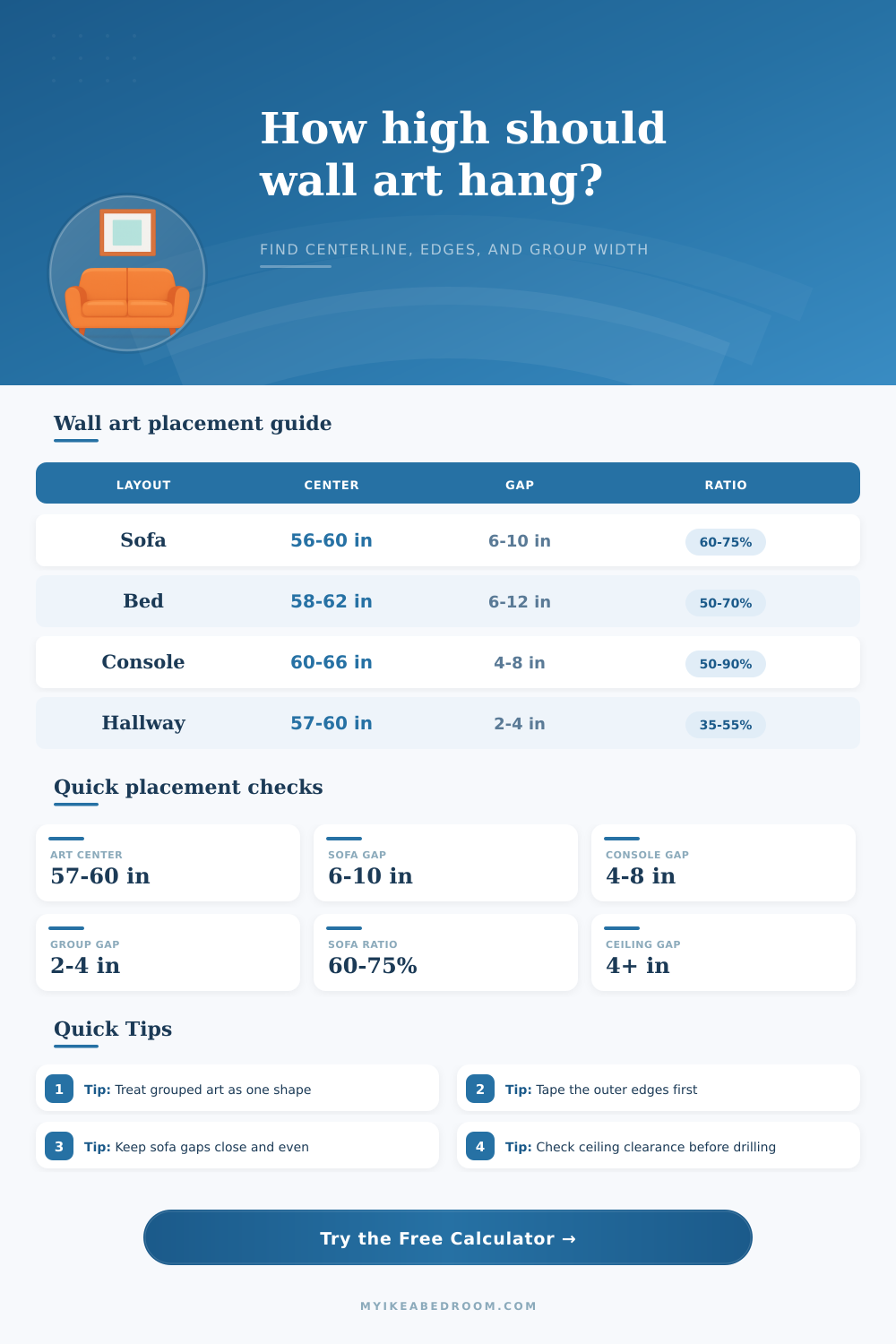
| Sofa or sectional | 60% to 75% of sofa width | 6 to 10 in | Keep the group visually connected to the seating. |
| Bed or headboard | 50% to 70% of bed width | 6 to 12 in | Use the headboard height as the bottom reference. |
| Console or dresser | 50% to 90% of furniture width | 4 to 8 in | Mirror and art can be wider than a narrow print. |
| Desk or work surface | 45% to 75% of desk width | 8 to 14 in | Leave room for monitors, lamps, and pin boards. |
| No furniture | 35% to 55% of wall width | 18 in or more from floor | Use eye level and wall margins as the main controls. |
| Arrangement | Group width formula | Group height formula | Best use |
|---|---|---|---|
| Single piece | One art width | One art height | Statement art, mirror, or large canvas. |
| Side-by-side pair | 2 pieces plus 1 gap | One art height | Bed pair, console pair, or balanced sofa art. |
| Horizontal row | Count pieces plus gaps | One art height | Hallway series, triptychs, dining room groups. |
| Vertical stack | One art width | Count pieces plus gaps | Narrow walls and tall accent zones. |
| Balanced grid | Columns plus gaps | Rows plus gaps | Office walls, square gallery groups, poster sets. |
| Loose gallery cluster | Cluster spread estimate | Cluster spread estimate | Mixed frames treated as one outer rectangle. |
| Room use | Starting centerline | Why it shifts | Check before hanging |
|---|---|---|---|
| Living room seating | Eye level minus 2 to 4 in | Viewed while seated and tied to sofa height. | Bottom gap should feel anchored, not floating. |
| Bedroom wall | Eye level minus 2 to 3 in | Art often sits above a headboard or dresser. | Keep top edge below the ceiling zone. |
| Entry or hallway | Eye level | Most viewers are standing and moving. | Side margins and consistent gaps matter most. |
| Dining room | Eye level minus 1 to 3 in | People view it both seated and standing. | Avoid placing centerline too high above a sideboard. |
| Kids room | Eye level minus 4 to 6 in | Lower sightlines suit smaller viewers. | Use secure hardware and keep cords out of reach. |
| Preset | Typical group | Wall or furniture width | Primary check |
|---|---|---|---|
| Art over sofa | 48 to 66 in wide | 78 to 96 in sofa | Group width should land near two-thirds of sofa width. |
| Bed pair | Two 20 by 28 in pieces | 60 to 76 in bed | Pair should sit centered over the headboard. |
| Console mirror | 30 to 42 in mirror | 42 to 60 in console | Leave space for lamps and objects on the console. |
| Gallery trio | Three 16 by 20 in frames | 84 to 120 in wall | Use consistent gaps and one shared centerline. |
| Hallway series | Four 12 by 16 in frames | 96 to 144 in wall | Keep the row narrow enough for side margins. |
Furniture anchored
Best for: Sofas, beds, consoles, dressers, and desks.
Priority: Match group width to furniture width first.
Watch: The eye-level center may need to rise for clearance.
Eye-level wall
Best for: Hallways, entries, and open blank walls.
Priority: Keep the centerline near average standing eye height.
Watch: Side margins matter more than furniture ratio.
Horizontal series
Best for: Trios, hallway runs, dining walls, and sofa groups.
Priority: Control total width after gaps are included.
Watch: Long rows can overpower short furniture.
Vertical stack
Best for: Narrow wall bays and tall accent moments.
Priority: Check top and bottom edges before drilling.
Watch: Tall groups often need a lower centerline.
Hanging art correctly require that you follow the rules of geometry. If you dont correctly place your art, your art could appear as if it is disconnect from the room. Many person tend to hang their art too high into the room.
This is because people often envision the location of their art while standing in the room. However, people view their art while sitting on a sofa or lying down on there bed. Therefore, people must take into consideration the height of the furnitures in the room as well as the eye level of the individuals that occupy the room.
How to Hang Art at the Right Height
The standard eye level for art is sixty inches from the floor. Many art gallery use this height for their art installations. However, peoples homes are not the same than art galleries.
Peoples homes contain sofas, beds, and other furniture that may impact the placement of art. For this reason, the standard height of sixty inches can be balanced with the furniture in the room. A calculator can help people determine the best placement for the art in the room.
The calculator allow for people to weigh the height of the furniture in the room against the height of the ceiling and the dimension of the art. For instance, if people use a calculator to input the height of a console or the width of a sofa, the calculator will tell people the exact placement of the bottom of the art. By using such a process, people will ensure that the art does not drift away from the furniture in the room.
The width of the art should be proportional to the width of the furniture. The width of the art could appear too small or too large for the furniture in the room. The art should be two-thirds the width of the furniture.
If people are hanging a group of frame, the calculation must include the gaps between the frames. Calculators can treat a group of frames as a single object so that the calculator can account for the gaps between those frames. The purpose of the room will change how people calculate the eye level of the art in the room.
For instance, if the art will be in a hallway where people will be standing, people can use the standard eye level. However, if the art will be in a dining room where individuals will be sitting, the art should be lowered to be more comfort for those eating meals. The height of the individuals in the room could change the eye level for the art in that particular space.
Once people have calculated the dimension of the art, they will use painters tape to mark the boundary box of the art on the wall. Painters tape will help people to see the mass of the art before drilling a nail into the wall. By using painters tape, people can move the art if it is too high.
Another important consideration before placing the art on the wall is the height of the ceiling in that room. If art is too high from the ceiling, the room can appear even more small. Therefore, people should of ensure that there is several inch between the art and the ceiling in the room.
People can use these mathematical rules to hang your art correctly on the wall. Although people may want to move the art to create a casual or formal look in the room, starting with these calculated dimensions for the art will help to ensure the art is correctly hung in the room. By calculating the placement of the art relative to the furniture in the room and the eye level of the individuals in that room, the art will be correctly placed on the wall and will not appear to drift toward the ceiling of that room.