Basement Lighting Layout Calculator
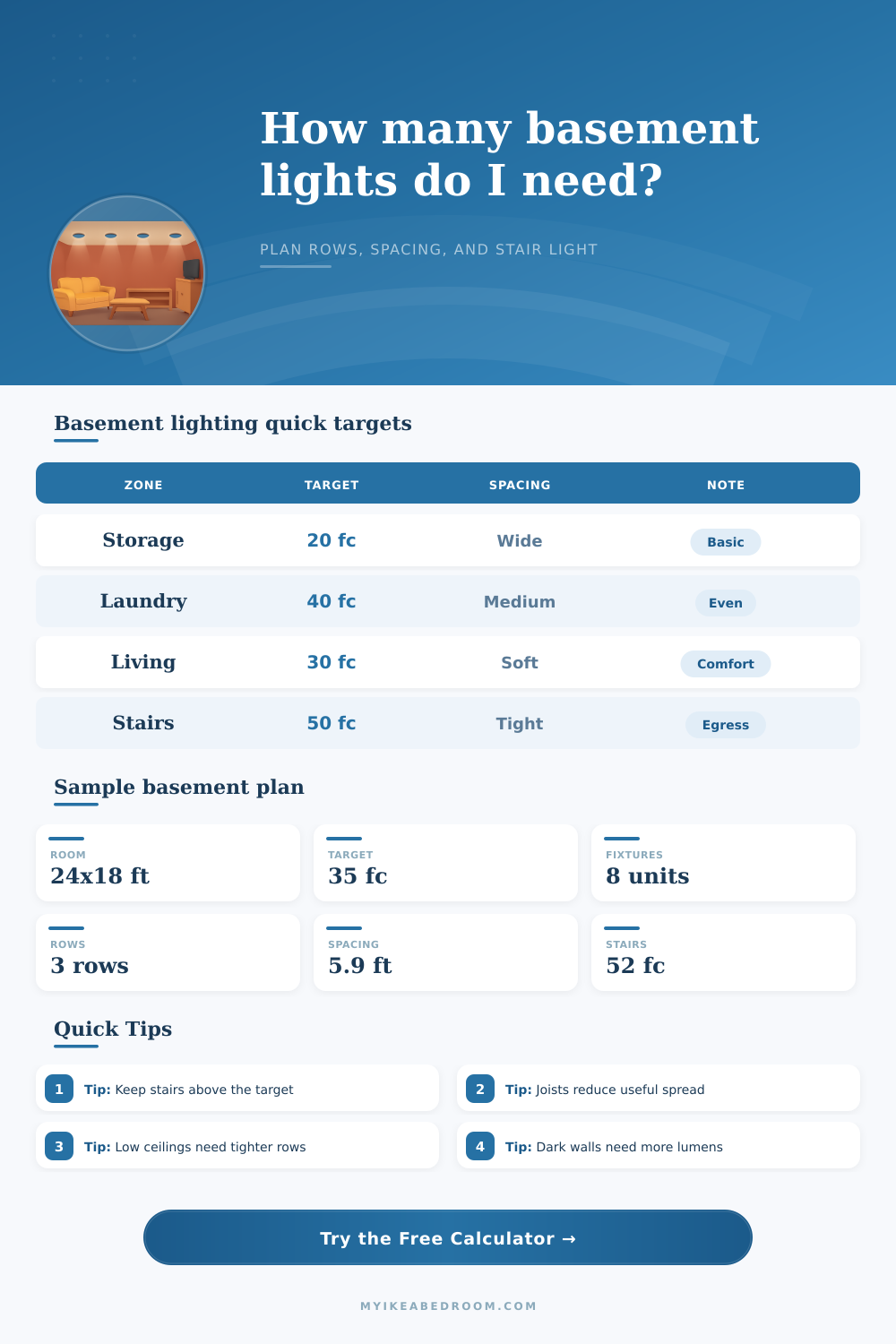
Plan fixture count, row spacing, low-ceiling spacing, stair and egress coverage, and estimated illuminance from basement dimensions, beam angle, fixture lumens, joists, wall reflectance, and room zones.
Load a real basement starting point, then adjust the ceiling height, beam angle, joist obstruction, target foot-candles, stair area, and room zones.
Zone areas raise the effective target where the basement needs extra clarity, especially stairs, laundry, crafts, and storage aisles.
Low ceilings: In short basements, evenness matters as much as total lumens. Use more fixtures at tighter spacing instead of depending on a few high-output points.
Stair zones: Put a fixture near the top and bottom landing when possible. Stairs and egress paths should not rely only on spill light from the middle of the room.
Basement lighting is a process that requires careful planning. When individuals decides to lamp the basement, they often dont have a specific plan for how to light the space. They may purchase bright LED lights and install them throughout the basement.
However, this type of lighting will contribute to bright spots in certain areas of the basement while leaving other areas of the basement in shadows. In planning the lighting for the basement, an individual must consider how the light will be distributed across a plane in the basement. Since basements do not have the benefit of natural sunlight, the lighting must account for the fact that the basement may become a space with shadows in certain areas.
How to Light a Basement
To consider the lighting for the basement, it is first important to determine the task plane for the basement. The task plane is the height at which an individual will be performing task within the basement. For instance, if an individual plans to walk through the storage area of the basement, the task plane will be the floor of the basement.
However, if the individual will be folding laundry at a table in the basement, the task plane will be at waist height. The individual must measure the lighting requirement at the task plane because that is where the light must land. Another important factor to consider when lighting the basement is the reflectance of the walls in the basement.
Reflectance is the measurement of how much light will reflect off of the basement walls. If the basement features white drywall, then the walls will have high reflectance and will reflect the light into the basement. This will allow for fewer light fixture to be installed in the basement compared to a space with dark paneling on the walls.
In basements with dark walls, those dark walls will absorb the light and not reflect it, which may result in insufficient lighting throughout the area. An individual must take note of the reflectance of the basement walls when planning the basement lighting. An additional factor to consider when lighting a basement is the height of the basement ceiling.
For many basements, the ceilings will be relatively low. For such basements, a wide beam angle for the lighting fixtures will ensure that the light is distributed even throughout the basement. If an individual uses a narrow beam angle for lighting in a basement with low ceilings, the lights will create circles of light on the floor.
These circles of light will leave areas in the basement that are darker than others. A wide beam angle will cause the beams of light to spread and overlap with other beams of light before they hit the floor. This will eliminate the shadows that may be created in the basement.
Additionally, overhead obstacles such as wooden joist will block some of the beams of light from the ceiling to the floor. Each time that the beams of light encounter a beam of wood, some of the light will be lost. The lost light will create shadows in the basement.
The layout of the basement may need to be adjusted to account for these obstacles to the light beams. Safety in the basement is another factor in the planning of the basement lighting. Areas of the basement that pose a safety risk to the individuals in the basement should have more light provided for them.
The stairs in the basement should be especially well-lit to ensure that the individuals using them are not exposed to a potential hazard from the lack of light. The lighting level in these stairs should be higher than the rest of the basement. For instance, there does not need to be the same level of light in an area for storing items versus the stairs.
It is better for the staircase to have an excess amount of light provided for it than for some of the basement to be lit by the light that spills out of another part of the basement. Once the individual has planned the basement in relation to these safety issue, the individual can determine the amount of light that will be required for the basement and the number of light fixture that should be installed throughout. Additionally, the individual can plan the layout of the basement at this time.
For instance, grid layout are often used for family rooms in the basement. Additionally, in unfinished basements, it is common for the lines of the wooden joists to be followed to allow for the wiring to be installed in an even number throughout the basement. By planning the basement lighting in relation to each of these specification, an individual will not make a mistake in the installation of the lights in the basement.
Additionally, planning the lighting for the basement will ensure that it is both functional and safe for those who use the basement.