Slipcover Yardage Calculator
Estimate furniture slipcover fabric by separating body panels, loose cushions, skirt drop, piping strips, seam allowance, pattern repeat waste, nap direction, and final adjusted yardage.
Load a common slipcover project, then adjust dimensions, cushion count, skirt length, fabric width, seam allowance, pattern repeat, nap direction, and piping.
Slipcover yardage breakdown
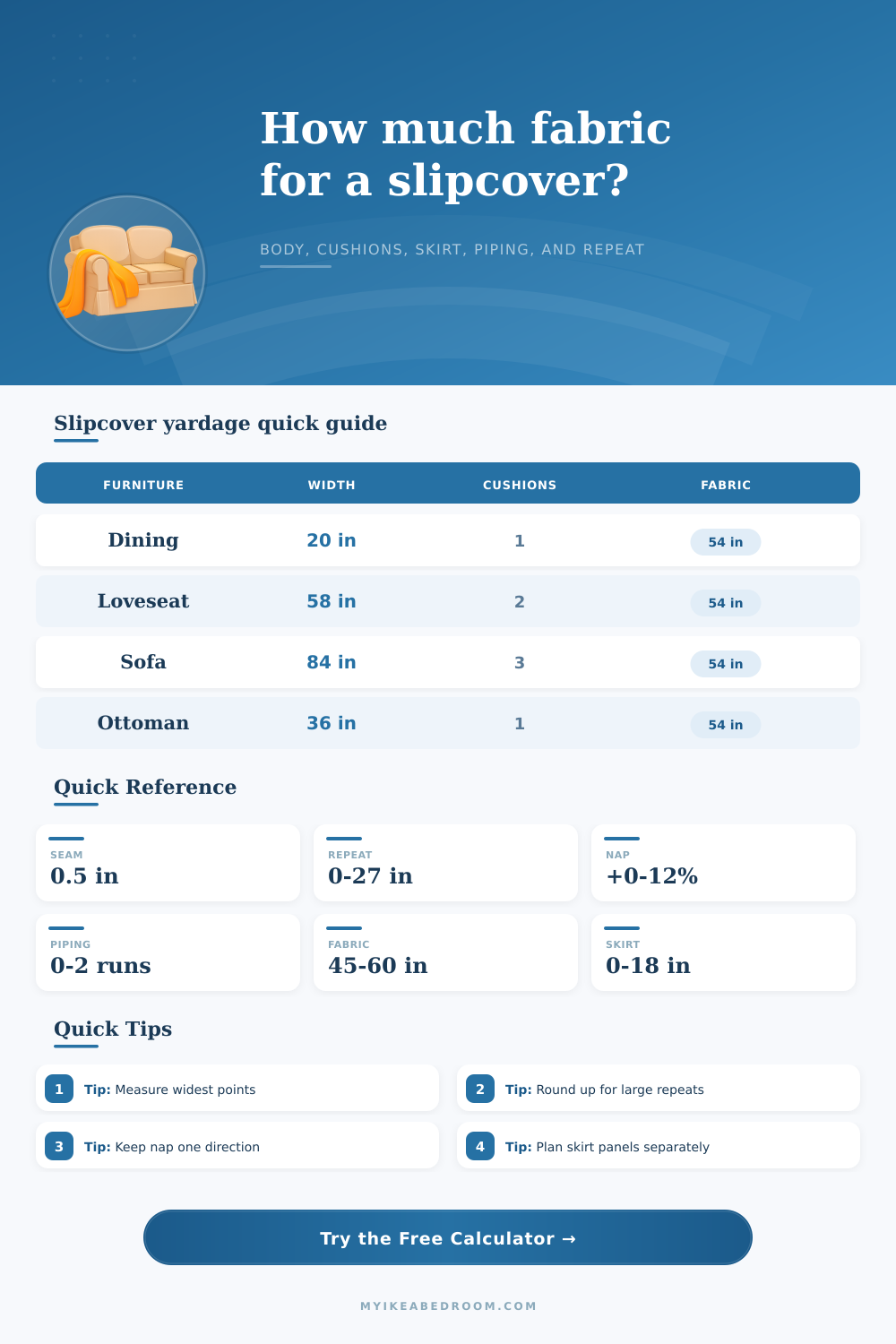
| Furniture type | Typical seat width | Cushion count | Yardage behavior |
|---|---|---|---|
| Dining chair | 18 in to 22 in | 0 to 1 | Small body, skirt often matters |
| Slipper chair | 24 in to 30 in | 1 | Low arms, broad front panels |
| Wing chair | 28 in to 34 in | 1 | Higher back and shaped sides |
| Loveseat | 52 in to 64 in | 2 | Body yardage and cushion yardage are similar |
| Sofa | 72 in to 90 in | 2 to 3 | Wide panels may need separate drops |
| Fabric width | Common use | Panel layout | Planning note |
|---|---|---|---|
| 45 in | Light decor fabric | More vertical drops | Best for chairs and narrow panels |
| 54 in | Upholstery fabric | Standard slipcover planning | Often fits chair backs and cushion faces |
| 58 in to 60 in | Wide home fabric | Useful for sofa cushions | Check usable width after selvedges |
| Railroaded | Wide benches and sofas | Width runs across furniture | Keep nap and motif direction consistent |
| Allowance | Common input | What it changes | Use when |
|---|---|---|---|
| Seam allowance | 0.375 in to 0.625 in | Adds to every cut edge | All sewn slipcovers |
| Pattern repeat | 0 in to 27 in | Rounds panel lengths upward | Printed or matched fabric |
| Nap allowance | 5% to 12% | Adds directional cutting waste | Velvet, chenille, one-way motifs |
| Handling allowance | 5% to 12% | Adds final sewing buffer | Fitted covers and bulky fabric |
| Preset | Seat size | Skirt drop | Typical detail |
|---|---|---|---|
| Parsons chair | 20 in × 18 in | 14 in | Long tailored skirt |
| Armchair | 32 in × 30 in | 8 in | Arms and one cushion |
| Loveseat | 58 in × 34 in | 12 in | Two boxed cushions |
| Ottoman | 36 in × 36 in | 10 in | Top, sides, piping, skirt |
Armless cover
Best for: dining chairs, parsons chairs, benches, and slipper chairs.
Most yardage sits in the seat, back, skirt, and cushion panels instead of arm pieces.
Arm cover
Best for: club chairs, wing chairs, loveseats, and sofas.
Arms add inside, outside, and top panels, so fabric width and nap direction matter more.
Skirted cover
Best for: tailored chair covers and sofa covers with a floor drop.
The calculator treats skirt fabric as long panel runs around the furniture perimeter.
Patterned cover
Best for: stripes, florals, checks, and visible one-way motifs.
Panel cuts are rounded upward to repeat increments before nap and handling allowances.
When calculating an amount of upholstery fabric that is needed to create a slipcover for a piece of furniture, there are several factors that must be considered. Upholstery fabric is typicaly expensive and upholstery fabric is often difficult to replace with an exact color match. Many people makes the mistake of measuring only the surface area of the furniture that is to be slipcovered.
However, because furniture has curves and seams, this isnt the only measurement that must be taken into account. Additional fabric will be necessary to account for upholstery fabric that covers curved arms and upholstery fabric that dip into the creases of the seat. One of the reasons that additional upholstery fabric will be required beyond that which is suggested by the dimensions of the furniture is for the fabric seams themselves.
How Much Upholstery Fabric You Need for a Slipcover
Each edge of the slipcover that you will sew to another edge will require a seam allowance. These allowances will add up to an additional amount of upholstery fabric beyond the dimensions of the furniture. Additionally, the fit of the slipcover will impact the amount of upholstery fabric that is required.
For example, if the slipcover is to fit the furniture in a tailored fashion, there will be less upholstery fabric that is required relative to a slipcover that is to allow for extra tucking of the slipcover cover onto the furniture. Another variable that will impact the amount of upholstery fabric that is required is the width of that upholstery fabric. Upholstery fabric typicaly come in a standard width.
However, the usable width of the upholstery fabric is less than the total width of the upholstery fabric because you must trim the selvedge of the upholstery fabric prior to use. Thus, if the width of the slipcover is greater than the usable width of the upholstery fabric, upholstery fabric will have to be purchased in additional lengths to accommodate for this difference. If the upholstery fabric to be used has a pattern, the pattern will also increase the amount of upholstery fabric that will be required to create the slipcover.
If the upholstery fabric is solid-colored, you can place the panels of upholstery fabric anywhere on the slipcover. However, if the upholstery fabric is patterned, the patterns will need to line up at the seams between different panels of slipcover. To achieve this, it is likely that inches of upholstery fabric will have to be discarded.
Thus, patterned upholstery fabric will require more upholstery fabric to create the slipcover different than solid upholstery fabric. Some upholstery fabrics, like velvet and chenille, has a nap. The nap of the upholstery fabric dictates that you will have to cut each piece of upholstery fabric for the slipcover in the same direction.
If you cut some pieces of upholstery fabric with the nap of the fabric facing up and other pieces of upholstery fabric is cut with the napped fabric facing down, it is possible that those pieces will appear to be of different colors. Thus, because the pieces cannot be flipped to save space, any slipcover that uses upholstery fabric with a nap will require additional upholstery fabric to the amount that is calculated based on the dimensions of the slipcover. Finally, it is also necessary to account for trim and skirts for the slipcover.
Piping and welting will require additional linear footage of upholstery fabric. The same is true for the length of the skirt for the slipcover. Additionally, it is also likely that some amount of upholstery fabric will be purchased as an extra allowance in case there is any errors in measuring or cutting the upholstery fabric.
Thus, an allowance for upholstery fabric to act as insurance against errors would of been purchased beyond the amount of upholstery fabric that is required to account for each of the variables discussed in this introduction.