🍽️ Dining Room Size Calculator
Find the ideal dining room dimensions for your table, chairs, and clearance needs
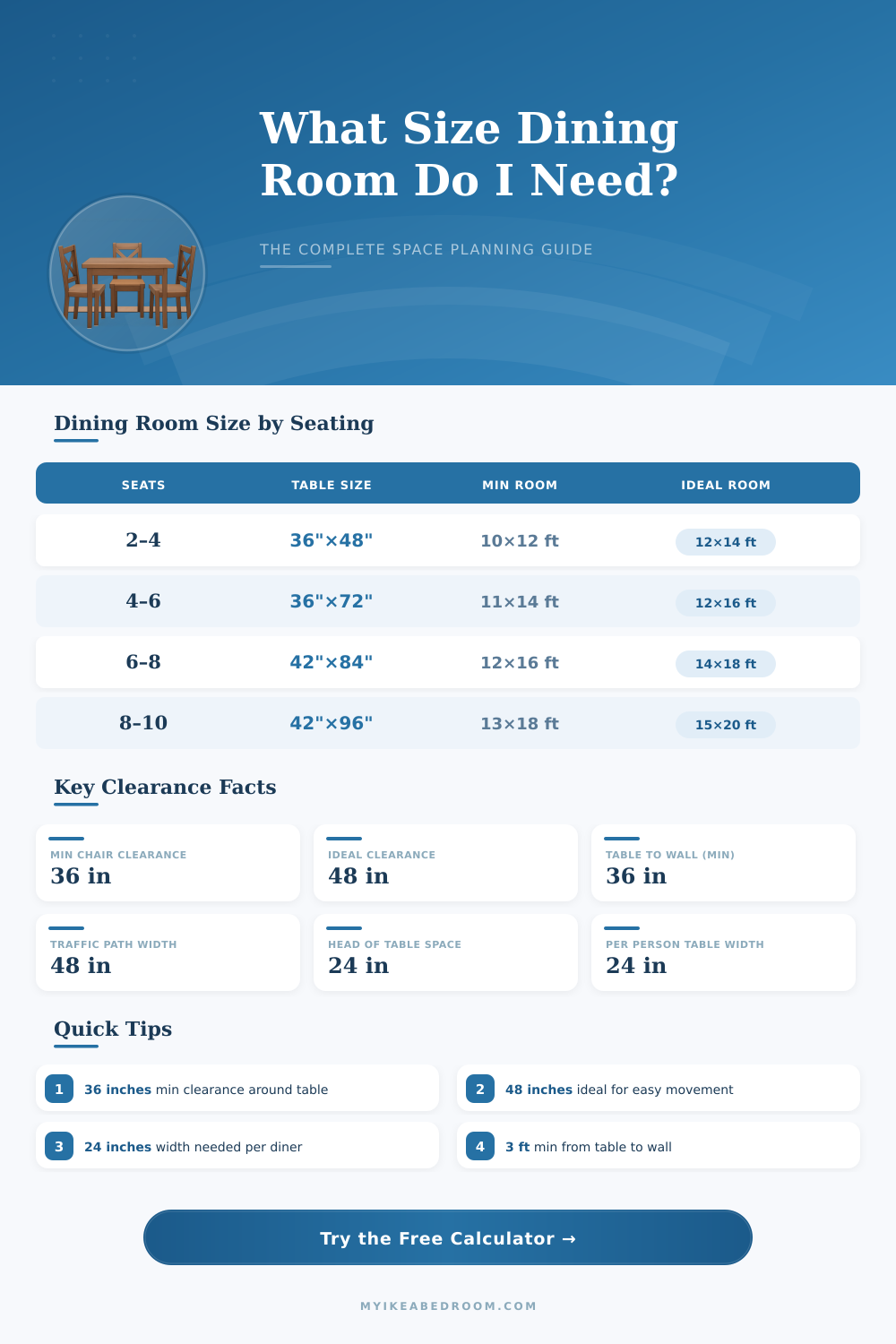
| Seats | Min Room Size | Ideal Room Size | Table Size (Rect) | Sq Ft (Ideal) |
|---|---|---|---|---|
| 2 | 8 × 10 ft | 10 × 12 ft | 24" × 36" | 120 sq ft |
| 4 | 10 × 12 ft | 12 × 14 ft | 36" × 60" | 168 sq ft |
| 6 | 11 × 14 ft | 12 × 16 ft | 36" × 72" | 192 sq ft |
| 8 | 12 × 16 ft | 14 × 18 ft | 42" × 84" | 252 sq ft |
| 10 | 13 × 18 ft | 15 × 20 ft | 42" × 96" | 300 sq ft |
| 12 | 14 × 20 ft | 16 × 22 ft | 42" × 108" | 352 sq ft |
| Table Shape | Dimensions | Seats | Min Room (w/ 42" clear) |
|---|---|---|---|
| Round | 36" diameter | 2–4 | 10 × 10 ft |
| Round | 48" diameter | 4–6 | 11 × 11 ft |
| Round | 60" diameter | 6–8 | 12.5 × 12.5 ft |
| Rectangle | 36" × 60" | 4–6 | 10 × 12 ft |
| Rectangle | 36" × 72" | 6 | 10 × 13 ft |
| Rectangle | 42" × 84" | 6–8 | 10.5 × 14.5 ft |
| Rectangle | 42" × 96" | 8–10 | 10.5 × 16 ft |
| Square | 36" × 36" | 4 | 10 × 10 ft |
| Square | 48" × 48" | 4–6 | 11.5 × 11.5 ft |
| Activity / Use | Min Clearance | Recommended | Notes |
|---|---|---|---|
| Pulling out chair | 32" (81 cm) | 36" (91 cm) | Seated + stand room |
| Serving / walking by | 36" (91 cm) | 44" (112 cm) | With tray space |
| Main traffic path | 36" (91 cm) | 48" (122 cm) | Two-person passing |
| Sideboard / buffet | 36" (91 cm) | 48" (122 cm) | Opening drawers |
| Bar cart access | 30" (76 cm) | 36" (91 cm) | Single-person access |
| China cabinet | 24" (61 cm) | 36" (91 cm) | Door swing clearance |
When you choose a dining table for your home, you must consider an amount of space that your dining room has. Many individuals will consider the size of the dining table that they intends to purchase, but they must also consider the amount of space that is required for individuals to move around the dining table. A dining room is a space in which individuals must move, and it is a space in which individuals must pull out chair.
Thus, if there isnt the correct amount of space for movement in the dining room, it will become both crowded and difficultly to use. In order to plan out your dining room, you must measure several different zone within the dining room. One zone is the footprint of the dining table itself, another zone is the space that is required for the chair to pull out of the table, and a third zone is the area within the dining room in which individuals must walk through the dining room.
How to Plan Space for Your Dining Table and Chairs
If these three zones begin to overlap within your planning of the room, your dining room will lack the space necessary for the individuals in your home to move throughout the area. The depth of the chairs within the dining room is another consideration for the layout of your dining room. The depth of the chairs will change when individuals use the chair; the chairs may be relatively small when they are tucked into the dining table, but the individuals will make the depth of the chairs larger when they sit in the chairs and push the chairs away from the dining table.
Therefore, it is important to ensure that the chairs depth is measured while the chairs are in this used state, rather than when the chairs are tucked beneath the dining table. If you fail to account for the depth of the chairs when they are in use, you will find that there is not enough space for those chair to pull out of the dining table. Addition to the dining room may include the placement of sideboard or buffets.
These sideboards or buffets will occupy some of the space within the dining room, as well as require some of the space to allow for the individuals to access the sideboards or buffets. Therefore, you should account for the depth of the sideboards and buffets and the depth of the access path for those sideboards and buffets prior to determining the space within the dining room for the chairs to pull out of the dining table. Otherwise, the sideboards and buffets will reduce the width of the dining room.
Another consideration for the placement of dining tables within the home is the swing of the doors within the dining room. The door swing will claim part of the width of the dining room for the door when it is open, and it is possible for the swinging door to hit one of the chairs within the dining room if the two element are located in the same area within the room. Therefore, it is important to account for the swing of each of the doors that open into the dining room to ensure that the doors will not hit any of the dining room furniture.
Additionally, if the door swing claims part of the dining room that cannot be used by any other element within the room (a “dead zone”), it may be more beneficial to purchase a round dining table different than a rectangular dining table. The size of the rug that you will place within the dining room is another consideration for the layout. If the rug is too small for the area of the dining room in which the chair will be placed, the back legs of the chairs may become caught upon the edge of the rug.
Should the back legs of the chairs become caught upon the edge of the rug, the chairs may begin to wobble, and the chairs may damage the rug. Therefore, you should consider the size of the rug to ensure that the chairs will remain entirely on the rug when the individuals are removing the chair from the dining table. In homes that are relatively small in size, a banquette may be incorporated into the dining area.
A banquette is a bench that is pushed against one of the walls in the dining room, and often eliminates the need for a pull-out zone for the chairs that sits on the banquette. Thus, the use of a banquette may allow the placement of a larger dining table within a smaller area in the home. However, it is still important to ensure that there is enough space to allow for the individuals who use those chair to move out of the way of the dining table.
The success of the dining room may include both the host of the dinner and the guest who are to attend the dinner. The host may want to ensure that they can move from the kitchen to the dining table, and that each of the guest has enough space to sit and enjoy their meal. Thus, calculating the dimension of the dining room prior to its construction could of helped to ensure that the dining room will be successful in its function.