🌬 Room Size CFM Calculator
Estimate ventilation CFM from room volume, ACH target, occupancy, heat and moisture load, duct loss, fan efficiency, filter restriction, ceiling height, and room usage.
Load a realistic room, then tune the ACH target, restrictions, and added heat or moisture loads for your actual fan path.
Calculation breakdown
Results will appear here after calculation.
| Usage type | Typical ACH | Common reason | Starting point |
|---|---|---|---|
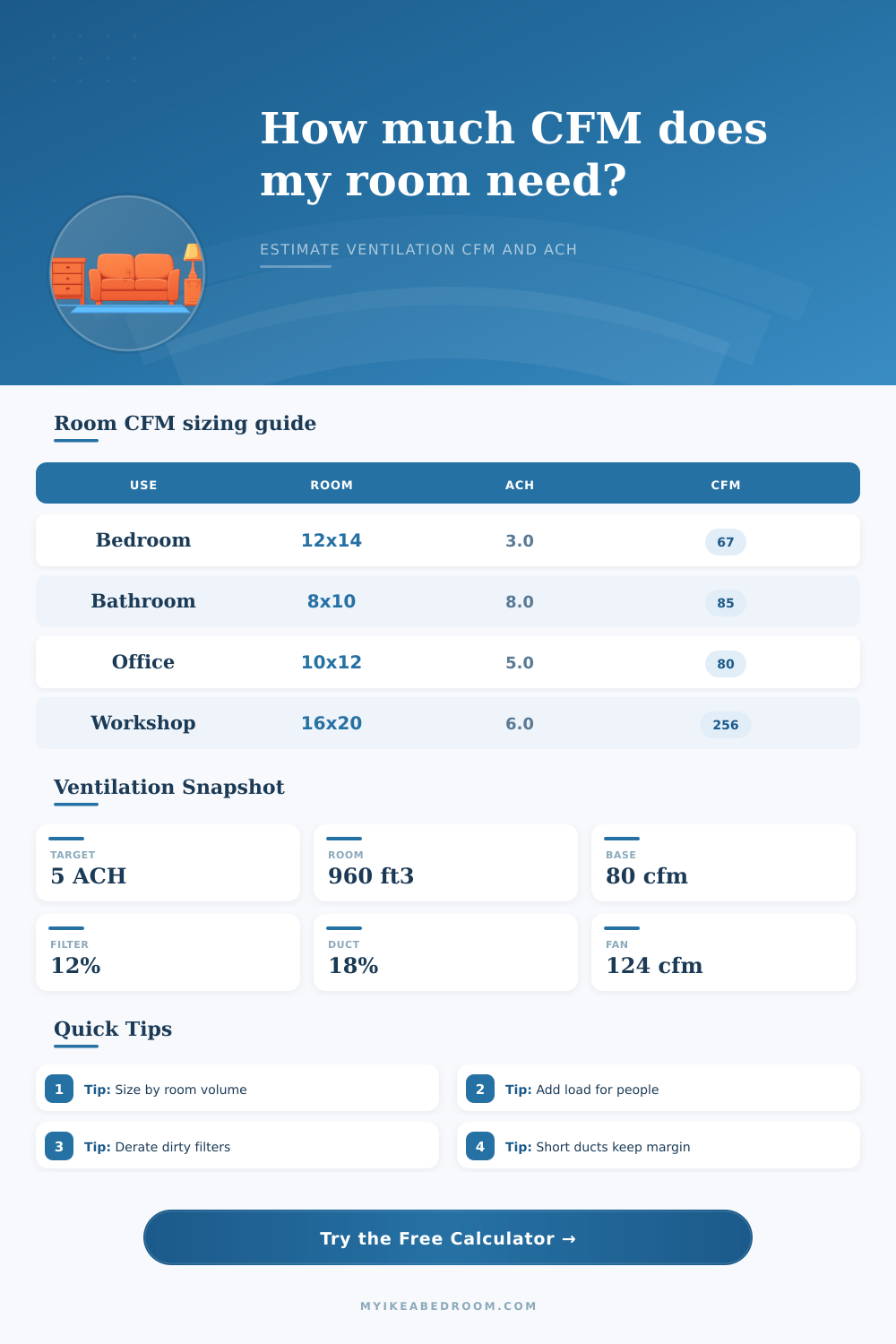
| Bedroom | 2 to 4 ACH | Comfort and stale air control | 3 ACH |
| Bathroom | 6 to 8 ACH | Odor and moisture exhaust | 8 ACH |
| Home office | 4 to 6 ACH | People plus small electronics | 5 ACH |
| Workshop | 6 to 10 ACH | Dust refresh and heat removal | 6 ACH |
| Laundry | 5 to 8 ACH | Moisture and utility heat | 6 ACH |
| Duct condition | Input loss | Typical signs | Margin note |
|---|---|---|---|
| Direct wall fan | 5 to 10% | Short sleeve, one cap | Low loss |
| Short duct | 10 to 18% | One to two elbows | Normal margin |
| Long duct run | 20 to 35% | Several elbows or roof cap | Use reserve |
| Tight flex duct | 30 to 50% | Sags, bends, small diameter | High risk |
| Filter path | Input range | Best use | Check |
|---|---|---|---|
| No filter | 0% | Bathroom or exhaust only | Keep grille clear |
| Clean coarse filter | 5 to 10% | Supply or transfer air | Inspect monthly |
| Dense clean filter | 12 to 22% | Dust-sensitive rooms | Watch airflow |
| Loaded filter | 25 to 45% | Temporary derating check | Replace filter |
| Room | Volume | Target ACH | Base CFM |
|---|---|---|---|
| 10 x 10 x 8 ft office | 800 ft3 | 5 ACH | 67 cfm |
| 8 x 10 x 8 ft bathroom | 640 ft3 | 8 ACH | 85 cfm |
| 12 x 14 x 8 ft bedroom | 1344 ft3 | 3 ACH | 67 cfm |
| 16 x 20 x 8 ft workshop | 2560 ft3 | 6 ACH | 256 cfm |
Use a smaller derating when the fan has a short path, open grille, and no filter in the airflow.
Rooms with a return path hold ACH better because the fan is not fighting a sealed door or pressure pocket.
Moisture allowance raises the required CFM beyond simple volume-based ACH sizing.
Tall rooms need more airflow because the fan must exchange a larger air volume before ACH target is met.
Air circulation is an necessary process to maintain the air quality within a room. Stagnant air within a room can lead to the retention of certain odor, moisture within the air, and fine dust particles that can accumulates within the air. Many people attempt to fix stagnant air within the room by purchasing the largest fan available.
However, purchasing an oversized fan to circulate air within a room are incorrect due to the unnecessary noise and electricity that the fan will use. An undersized fan also is incorrect in that it will not clear the air from the corners of the room. To determine the proper amount of air movement within a room, it is necessary to understand the relationship between the air volume within a room and the velocity at which the air moves within that close space.
How to Keep Room Air Fresh and Choose the Right Fan
Air circulation calculations considers how often the air within a given space is completely replaced with fresh air. The measurement of how many times the air within a specific volume of space is replaced within a sixty-minute period are referred to as Air Changes per Hour, or ACH. Rooms such as bedrooms may have a low required ACH to provide for the occupants comfort.
Rooms that may contain individuals performing tasks that create moisture, heat, or other requirements of the room may require a higher ACH within those spaces. Air change per hour calculations also consider the number of individuals within a space. Each individual within a room will add to the moisture and heat within the area.
Therefore, adding more individuals to a room will increase the ACH calculation for that space. Other items within a space, such as electronic equipment that create heat, will also increase the ACH calculations for that space. The actual movement of air created by a fan is often different then the air movement that the manufacturer’s ratings for that fan represent.
In the real world, fans move air through ductwork within a space. Any obstructions to that airflow will create static pressure. Static pressure will affect the movement of air created by that fan.
For example, if the ductwork that a fan utilizes is long or sagged, static pressure will develop along those duct. The static pressure created along these ducts will reduce the amount of air that can move through the ductwork. As a result, the actual movement of air created by the fan in that space will be less than the number represented by the manufacturer’s rating.
Another factor that can reduce the actual movement of air that is circulated in a space is the use of filter. Coarse filters will allow air to pass through with minimal resistance created by the filter. However, dense filters, such as HEPA filters or dirty filters will create resistance to the movement of air within the system.
As a result, using filters that create resistance will reduce the ACH within that space. For these reasons, it is necessary to account for the potential for airflow reduction within the system by selecting a fan that incorporates a margin of reserve. Any system that operates at the minimal ACH requirement for that space will fail if the filters for that system become dirty.
A system that includes a margin of reserve will have enough airflow to maintain the ACH within the space even without using the system’s filters at their best. The specific use of a room can alter the ACH that is required within that space. For example, if a room incorporates a high number of plants into the space, the room will have a high load of moisture within the air.
High moisture load will increase the ACH requirement for that space to avoid the development of mold. Workshops that contain fine particulates will also create a requirement for high ACH ratings within those spaces. If the air movement provided by the fan within a space is insufficient, there are steps that can be taken to increase the ACH created within that space.
Either you can increase the rating of the fan, or the restrictions to the movement of air within that space can be reduced. By treating each element within a space, the room itself, the individuals within the room, the equipment within that area, and the ductwork (as a system), you should of achieve an appropriately balance between providing necessary air changes per hour within the space while minimizing the energy used by that system.