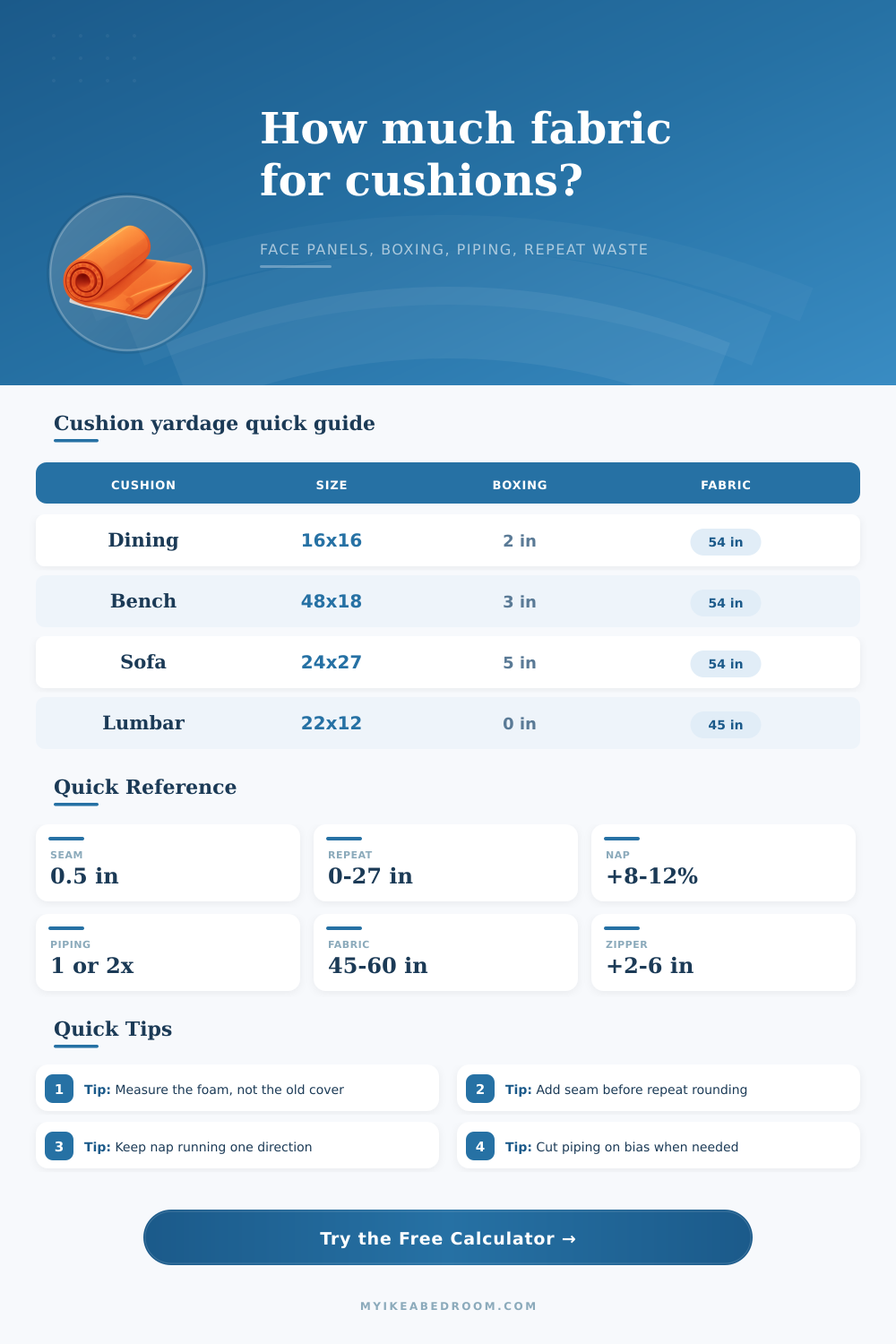
Fabric Yardage Calculator for Cushions
Estimate cushion face panels, boxing strip yardage, zipper or flap allowance, piping fabric, fabric-width layout, pattern repeat rounding, nap direction waste, and total yardage before cutting.
Load a common cushion format, then adjust size, quantity, seam allowance, fabric width, print repeat, nap, zipper allowance, and piping for your project.
Calculation breakdown
| Cushion type | Typical finished size | Usual thickness | Common cover detail |
|---|---|---|---|
| Dining chair pad | 15 in to 18 in square | 1 in to 2 in | Knife edge or slim boxing |
| Bench cushion | 42 in to 72 in wide | 2 in to 4 in | Boxing with zipper back |
| Sofa seat cushion | 22 in to 28 in deep | 4 in to 6 in | Boxing plus double piping |
| Outdoor cushion | 20 in to 26 in square | 3 in to 5 in | Boxing and directional fabric |
| Lumbar pillow | 12 in × 22 in | 0 in to 1 in | Envelope flap or zipper |
| Fabric width | Best cushion use | Layout behavior | Planning note |
|---|---|---|---|
| 42 in to 45 in | Pillows, chair pads | Fewer panels fit across | Check usable width after selvedges |
| 54 in | Home decor fabric | Often fits two small faces | Common for upholstery prints |
| 58 in to 60 in | Outdoor fabric | Helpful for wide cushions | Mind one-way stripe direction |
| Railroaded fabric | Long bench cushions | Width runs along roll width | Enter the usable rail width |
| Pattern or nap | Calculator treatment | Waste tendency | Use when |
|---|---|---|---|
| Plain fabric | No repeat rounding | Lowest | Solid cotton, linen, canvas |
| Small repeat | Cut depth rounded upward | Low to medium | Small geometric and stripe prints |
| Large repeat | Faces and boxing add repeat waste | Medium to high | Botanical, scenic, large motifs |
| Velvet or nap | Adds one-way nap allowance | High | Pile, chenille, directional texture |
| Allowance | Common input | What it changes | Check before cutting |
|---|---|---|---|
| Seam allowance | 0.375 in to 0.625 in | Raises face and boxing cut sizes | Match your sewing method |
| Zipper allowance | 2 in to 6 in | Adds extra boxing length | Use more for flaps or overlap backs |
| Piping strip | 1.25 in to 2 in | Adds narrow strip yardage | Bias cuts may need extra cloth |
| Handling waste | 5% to 12% | Raises final total yardage | Increase for bulky or fraying fabric |
Knife edge
Best for: slim pillows, chair pads, and soft inserts.
Uses only face panels plus optional piping, so yardage is usually the lowest.
Boxed cushion
Best for: foam seats, benches, sofas, and outdoor pads.
Adds side boxing strips based on cushion perimeter, thickness, seam, and closure allowance.
Pattern matched
Best for: visible motifs on face panels or joined cushion sets.
Rounds cut depth upward to the repeat, then separates repeat waste from handling waste.
Directional nap
Best for: velvet, chenille, corduroy, and one-way prints.
Keeps pieces oriented the same way and adds a nap allowance to the total plan.
When you purchase upholstery fabric, you must calculate the exact amount of fabric that you need to purchase. This is so that you wont run out of fabric during the upholstering process. When people shops for upholstery fabric, they often feel anxious about the cutting of the fabric.
The cutting of upholstery fabric is a permanent action, and once the fabric is cut, it cant be undone. To ensure that you do not run out of fabric, you must account for several factor. These factors include seam allowance, boxing strips, zipper allowances, fabric nap, and pattern repeats.
How to Measure Upholstery Fabric for Cushions
When measuring fabric for a cushion, people may be surprised to discover that the cushion require more fabric than a simple rectangle of the same dimensions as the cushion. Cushions are three-dimensional objects. For boxed cushions, a strip of fabric call boxing wraps around the cushion insert.
The boxing must be at least the same height than the insert. However, you must also include seam allowances in the measurement of the boxing. Seam allowances are added for the purpose of sewing the pieces of upholstery fabric together.
If the boxing is cut without seam allowances, the boxing will be too smallly to properly fit the cushion. Another factor that you must consider is the zipper allowance. The zipper allowance include the space for the zipper and the extra fabric needed to make a flap to cover the zipper.
If you do not include the allowance for the zipper in the measurement of the upholstery fabric, the cushion will appear to be gaping open when someone sit on the cushion. To avoid this problem, include the zipper allowance when you calculate the amount of upholstery fabric that you need. The texture of the upholstery fabric, also known as the nap, can also affect the amount of upholstery fabric that is purchased.
Some upholstery fabric includes a nap to the fabric. For instance, velvet and chenille fabrics has naps to them. The nap of the fabric is the direction of the fabric’s fibers.
If a person cuts a piece of velvet with the nap facing up and another piece of velvet with the nap facing down, the velvet will appear to be a different color. To ensure the color of the velvet is the same throughout the piece of upholstery fabric, you must cut each piece of velvet with the same direction of the velvet facing the same direction. This limits the ability to flip the upholstery fabric patterns.
Hence, the amount of velvet required will be greater than a non-napped fabric. Another factor that you must consider is the pattern repeats in the upholstery fabric. If the upholstery fabric features a pattern, such as a floral or geometric shape, you must align the patterns when you lay out the upholstery fabric on the table.
The patterns cannot simply be placed edge to edge on the cushion. By having to shift the patterns of each piece of upholstery fabric, some upholstery fabric will be wasted in the creation of gaps between patterns. To account for the amount of upholstery fabric that is wasted due to these pattern gaps, you must increase the total yardage of upholstery fabric.
The type of cushion that is to be made will change the amount of upholstery fabric that is required. Knife edge pillows are simply two squares of fabric. There is no boxing use in a knife edge pillow.
Boxed cushions are made with support in mind. A boxing strip wrap around the insert. Knife edge pillows do not use boxing, but boxed cushions do.
In addition, when measuring a boxed cushion, you must measure the size of the foam insert rather than the old fabric cover for the cushion. The reason for measuring the foam insert instead of the old fabric cover is to allow for the compressibility of the foam insert and the stretchibility of the upholstery fabric. Finally, add a small allowance for handling the upholstery fabric to the total amount that is calculated.
When cutting the upholstery fabric, some error will occur. The allowance for errors in cutting the fabric ensures that there is an extra quarter yard of upholstery fabric. It is always better to have an extra quarter yard of upholstery fabric than to run short of it altogether.
If short of upholstery fabric, the project will not be completed. By adding a handling allowance, a zipper allowance, and a seam allowance to the total amount of fabric that is measured for the project, people will have the amount of upholstery fabric necessary to complete the project correctly.