Golden Ratio Room Calculator
Compare a room to 1.618 proportions, solve a target dimension, and size the focal furniture, rug, wall art, and anchor relationship for a balanced layout.
Pick a real room setup, then adjust dimensions, anchor width, rug, art, tolerance, and layout priority.
Golden ratio breakdown
| Proportion | Formula | Room use | Practical note |
|---|---|---|---|
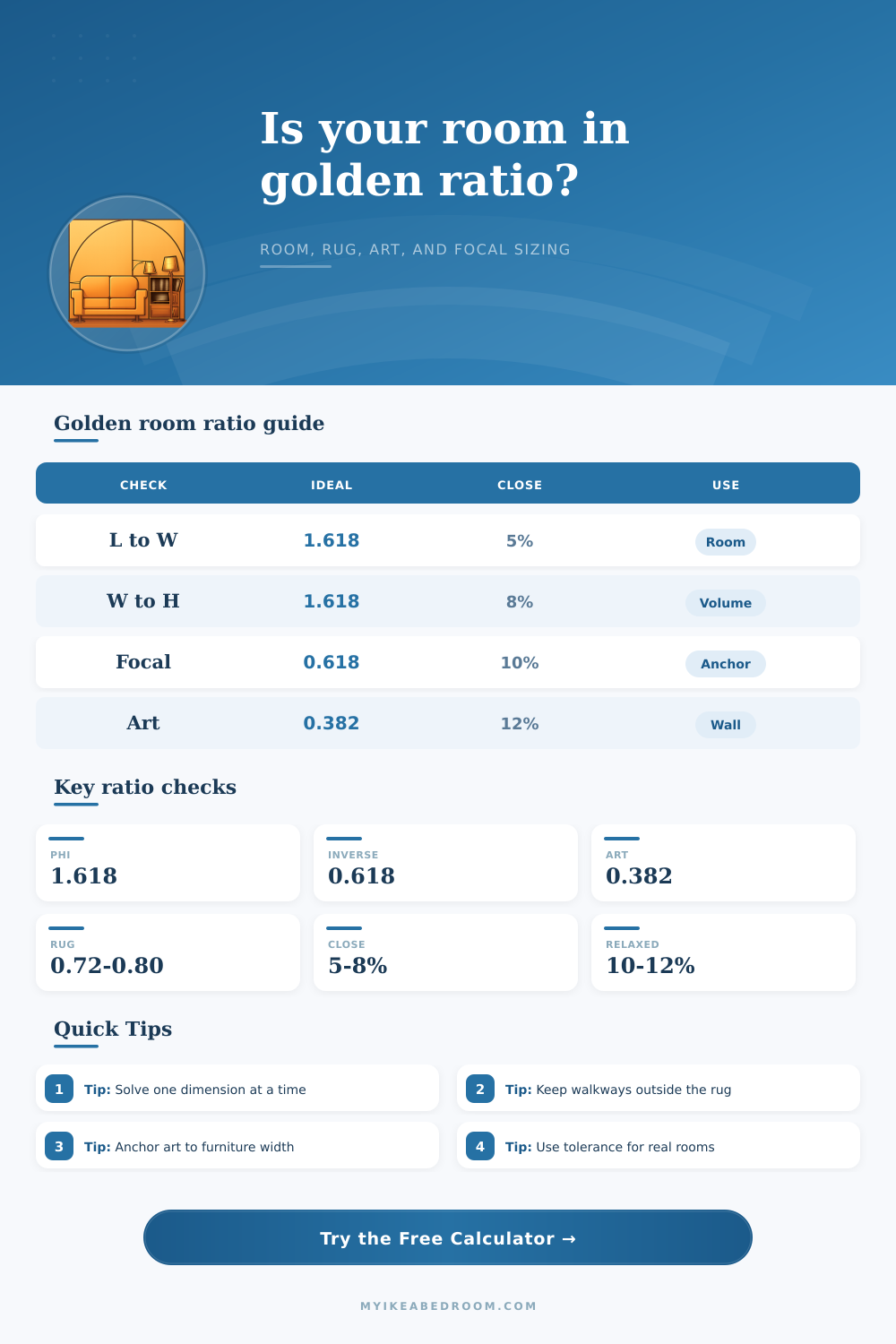
| Phi | Long side divided by short side = 1.618 | Length to width | Best used as a target range, not a demolition rule. |
| Inverse phi | Short side divided by long side = 0.618 | Furniture to wall | Good for headboards, sofas, consoles, and focal zones. |
| Golden section | One part near 38.2%, one part near 61.8% | Wall art placement | Helps decide whether art fills enough of a wall span. |
| Double check | Compare room, height, rug, and art together | Whole layout | A balanced room can pass some checks and miss others. |
| Anchor item | Golden focal target | Rug target | Check before using |
|---|---|---|---|
| Twin or daybed | Anchor width divided by 0.618 | Rug 24 in to 36 in wider than bed | Keep door swing and dresser drawers clear. |
| Queen bed | Headboard or art near 0.618 of wall span | 8 ft by 10 ft is a common balanced start | Nightstands can widen the visual anchor. |
| King bed | Wide focal wall often needs paired art or lamps | 9 ft by 12 ft often holds the bed zone | Check side clearance before chasing a ratio. |
| Dining table | Table width near 0.382 to 0.50 of room width | Rug 24 in or more beyond chair pullout | Circulation matters more than exact phi. |
| Sofa or media unit | Main piece near 0.618 of the wall span | Front legs should sit on the rug when possible | Leave walking paths at the open side. |
| Wall or furniture span | 38.2% art width | 61.8% focal width | Best fit |
|---|---|---|---|
| 48 in span | 18 in | 30 in | Small art pair, narrow mirror, compact shelf. |
| 72 in span | 28 in | 44 in | Queen headboard wall, console, writing desk. |
| 96 in span | 37 in | 59 in | Large art, triptych, sofa wall grouping. |
| 120 in span | 46 in | 74 in | King wall, long media wall, sideboard zone. |
| 144 in span | 55 in | 89 in | Open living room or wide bedroom wall. |
| Rug relationship | Simple target | Golden-ratio check | Layout priority |
|---|---|---|---|
| Bed centered on rug | Rug 1.35x to 1.55x bed width | Bed width near 0.618 of rug width | Use when bed is the room anchor. |
| Table centered on rug | Rug 48 in or more wider than table | Table near 0.55 to 0.62 of rug width | Use when chair pullout is important. |
| Seating zone | Rug covers front legs and table | Main sofa near 0.618 of rug length | Use for living rooms and studios. |
| Small room rug | Leave 12 in to 24 in floor border | Rug width near 0.72 to 0.80 of room width | Use when the architecture dominates. |
Compact bedroom
Architecture first: solve ideal width from available length, then keep the bed and rug inside walkway limits.
Best when the room is already fixed and furniture must adapt.
Queen bedroom
Anchor first: check bed width against rug width and the focal wall before changing art size.
Nightstands can be treated as part of the visual bed zone.
Long living room
Zone first: divide the long wall into 38.2% and 61.8% sections to place seating or storage.
A rug can define the golden section without moving walls.
Gallery wall
Focal first: size the total art grouping against the wall span, not just one frame.
The calculator compares current art to both 38.2% and 61.8% targets.
The golden ratio is a mathematical proportion that can be used to create a sense of balance within a room. Balance within a room is achieved when the proportion of the walls, the furniture, and the open space within that room contain a specific mathematical logic. Many people feels that the rooms that they encounter are either calm or unsettlingly.
The proportion of the objects within the room often causes the feeling within those rooms, not the color of those objects or how costly they are. The golden ratio mimics the mathematical proportions found within nature and can help people to understand in what way they can balance there décor within a room. The golden ratio have a numerical value of approximately 1.618.
How to Use the Golden Ratio to Balance a Room
If an individual divide the length of a room by its width, that mathematical calculation is the ratio of the room. Most rooms, however, do not have a proportional measurement of the golden ratio, they may be too square or too wide for example. The walls of a given room dont need to be changed to fit this ratio.
However, the individuals who enter it can adjust the furniture and décor within the room to allow the visual element of the room to appear balanced. If the architecture of a room is to be left as is, the inverse of the golden ratio, 0.618, can be used to determine the size of the décor element that are to be placed within that room. When using a calculator to determine the golden ratio for a room, individuals must make a decision of the focus of the room.
If the focus is upon the architecture of the room, the golden ratio will calculate to the ideal dimension of the room. However, if the focus of the room is upon the anchor point in the room (a large area of décor such as a bed or dining table), the proportion of that décor to the rug and the wall will be calculated. That anchor in a room is the most important element of the décor within that space.
The width of the anchor point in that room should determine the size of the rug that is placed within a room. It is common for individuals to make the mistake of purchasing a rug that is too small for the area of décor that it is to be used within the décor. If the width of the anchor point is used to calculate the size of the rug, the rug will act as a foundation for the décor within the room.
The rug will create a boundary for the décor within the room. The same ratio can be applied to the selection of art that is to be displayed upon the walls of a room. Too little art for the size of the walls can create the feeling of afterthought décor.
However, too much art for the size of the walls can be overwhelming for the individuals that enters the room. Art should be selected such that it is of a specific percentage of the total span of the available walls in the décor. Many individuals select art such that it is centered within the walls, but many of those same individuals will forget to scale the art to the size of the walls in which it is to be displayed.
Another mathematical element that relates to décor within a room is the height of the ceiling in which that room is contained. The height of the ceiling will alter the way that an individual feels a room. High ceiling and narrow walls will create the sensation of a hallway within the room.
To even out the verticality of the décor in the room, horizontal décor can be added. If a room feels too tall to the individuals in that room, décor that draws the eye downward should be incorporated within that space. Conversely, if the room feels as if it is compressed within the area that is to be decorated, elements that draw the eye to the length of the décor in the room can be used.
The golden ratio does not have to be perfected within a room for it to still feel balanced. A room that is within five or ten percent of the calculated golden ratio will still appear balanced to the individuals that enter the décor. While perfection isnt required, random décor placement should of been avoided.
Each element of décor within a room should have a mathematical reason for its placement within that space. By utilizing the mathematical proportions of the décor within a room, an individual can remove visual tension from that décor and create a more balanced, cohesiv décor for that space.