Window-to-Wall Ratio Calculator
Estimate gross wall area, clear glass area, window-to-wall ratio, daylight fit, privacy adjustment, obstruction impact, sill and head checks, and a wall balance score.
Choose a realistic bedroom or home-office wall, then adjust the windows, openings, orientation, privacy, target daylight, sill height, and head height.
Window group 1
Window group 2
Window group 3
Calculation breakdown
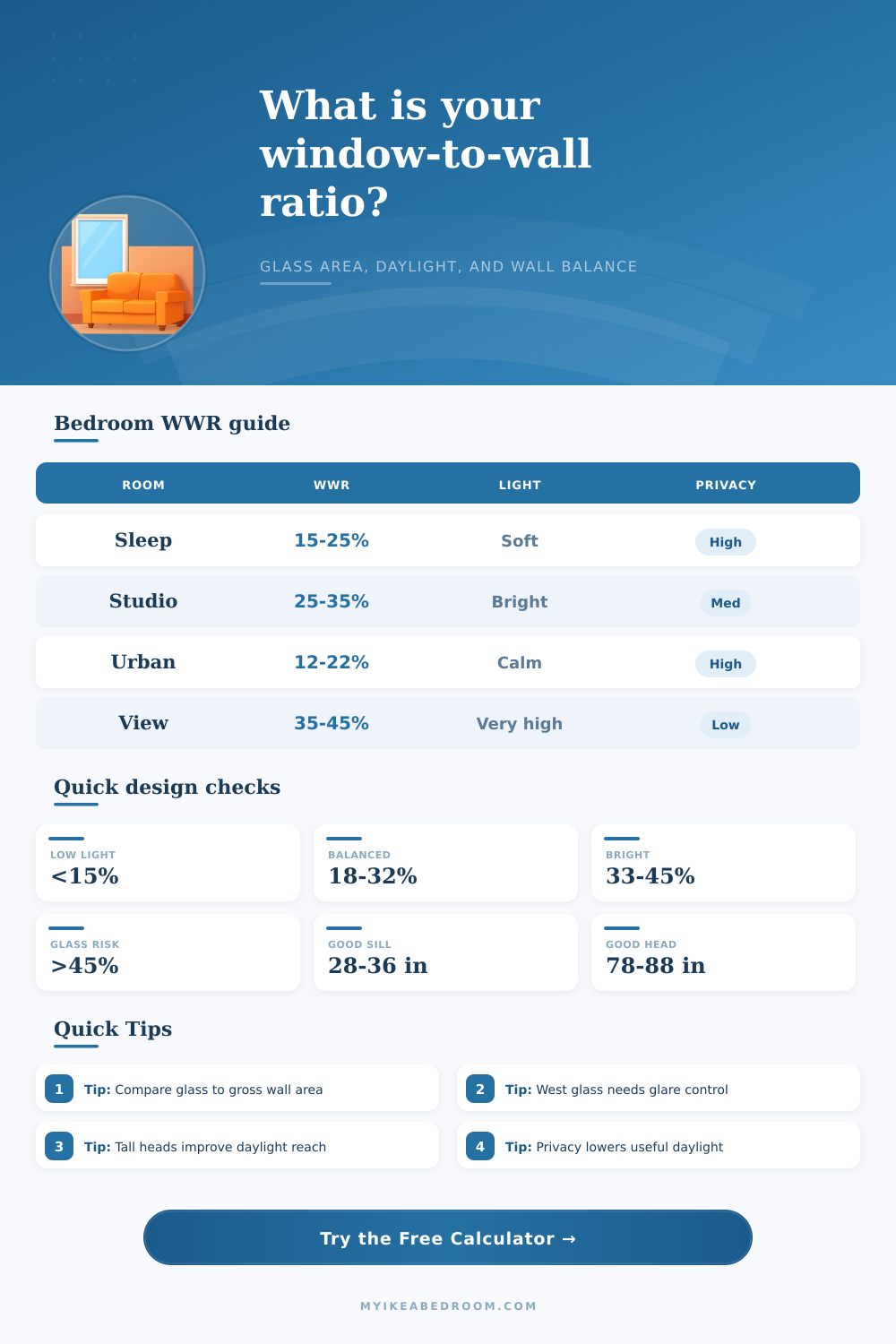
| WWR band | Typical bedroom feel | Daylight expectation | Design watch point |
|---|---|---|---|
| Under 15% | Enclosed, privacy-first wall | Low daylight unless exposure is clear | May need higher head height or a second opening. |
| 15% to 25% | Calm bedroom proportion | Soft to moderate daylight | Works well when privacy and sleep comfort matter. |
| 25% to 35% | Open and bright wall | Balanced daylight for many rooms | Check glare on south and west exposures. |
| 35% to 45% | View-focused bedroom or studio | High daylight and strong connection outside | Privacy, heat gain, and furniture placement need review. |
| Over 45% | Glass-heavy feature wall | Very bright, sometimes excessive | Often needs shading, privacy, or a revised target. |
| Condition | Calculator factor | Best target response | Balance note |
|---|---|---|---|
| North-facing | 0.95 daylight multiplier | Consider the upper end of target WWR | Usually easier to keep glare controlled. |
| East-facing | 1.00 daylight multiplier | Use the target directly | Morning brightness suits bedrooms and offices. |
| South-facing | 1.12 daylight multiplier | Smaller WWR can still feel bright | High heads help distribute light deeper into the room. |
| West-facing | 1.06 daylight multiplier | Target with privacy and glare in mind | Late-day glare may reduce usable daylight comfort. |
| Blocked view | Subtracts blocked-sky percentage | Raise target or improve head height | Neighboring walls and deep overhangs can dominate the result. |
| Dimension | Common range | Calculator effect | Room planning note |
|---|---|---|---|
| Low sill | 18 in to 27 in | May improve view but reduce furniture wall space | Check bed, desk, radiator, and storage height. |
| Bedroom sill | 28 in to 36 in | Scores well for privacy and layout flexibility | Often leaves usable wall below the window. |
| High sill | 42 in and above | Privacy improves, daylight reach may fall | Useful near beds or close neighboring windows. |
| Moderate head | 78 in to 84 in | Good balance for standard-height rooms | Works with many shade and curtain layouts. |
| High head | 84 in to 96 in | Improves daylight reach and score | Especially helpful when WWR is modest. |
Quiet bedroom wall
15% to 25% WWR usually keeps a sleep-first wall calm while still admitting useful daylight.
Best with moderate sill height and limited blocked sky.
Bright work wall
25% to 35% WWR can suit a bedroom office when glare and screen placement are controlled.
East and north exposures are often easier to balance.
Privacy-heavy wall
12% to 22% WWR may be enough when the wall faces a street, walkway, or close neighbor.
Higher sills can protect privacy without removing all glass.
View-focused wall
35% to 45% WWR favors views and daylight but needs stronger privacy and glare planning.
Non-glass openings can lower the wall balance score.
A window to wall ratio is a mathematical measurement of the area of the glass in relation to the area of the wall. Many people believe that if there is more glass in a wall, there will be more light in that space. However, adding more glass dont always result in more light in that space.
The amount of light in a space will be related to the area of the glass in relation to the solid area of the wall. The ratio of glass to solid area of the wall can be used to find a balance between the amount of light desire in a space and the need for privacy and comfort from the elements. Comparing the total area of clear glass in a space to the gross area of that space calculates the ratio of glass to wall area.
How much glass should a wall have
The gross area of the space is the total area of the wall, including the area that is cover by glass. The gross area is used in these calculations to take into account the fact that the wall area can be used for other features of the structure. If the ratio of glass area to wall area is increased too much, there will be less area in the wall for furnitures and the structure to remain insulated against the element.
The orientation of the wall will impact the amount of light and heat that enter the space through the windows in that wall. Walls that are exposed to the north in the northern hemisphere will receive some of the least light in relation to the other cardinal directions. Walls that are exposed to the south will receive significant amount of light and heat throughout the day.
Therefore, the ratio of glass to wall area must take into account the orientation of the wall to determine how much light and heat will enter the space through the windows. Another factor that will impact light in the space is any obstructions to the view of the sky from the space. Any structures or elements in the area that block the view of the sky will limit the amount of light that enter the space through the windows.
Factors like these can be accounted for in the calculation of the ratio to determine whether the design of the space need to contain more glass to compensate for the obstructions, or if the height of the windows should of been increased. The height of the windows in relation to the floor, the sill height and head height of the windows is two other factors that can have an impact on the efficiency of the ratio of glass to wall area. If the height of the bottom of the windows (the sill height) is too high, there will be privacy with the area outside of the window, but the high height will limit the amount of light that enter the space.
If the height of the bottom of the windows is too low, there may not be enough space in the wall to place furniture in the space. The height of the top of the windows (the head height) can also impact the amount of light in the space. If the head height of the windows is high, the light can reflect off of the floor and continue into the space, increasing the distance that the light can travel into the space.
Privacy in the space can also impact the ratio calculations. If people use blinds or frosted glass in the windows to maintain privacy in the space, the amount of light that enters the space will be reduced. Thus, high ratios of glass area to wall area may not be beneficial for those who require privacy to maintain in their spaces.
The need for visibility of the outside of the space versus the need for luminosity in the space must be balanced in these calculations. The balance score for a space is a measurement of the intersection of the variables related to the space: the amount of light that enters the space, the flexibility of the area for the placement of furniture, and the proportion of the space itself. Walls with a low ratio of glass area to wall area may feel more stable in relation to the area that it enclose, but it may also create a space that is too dark for those who desire to see light in their spaces.
Walls with high ratios of glass area to wall area will allow for significant amount of light to enter the space, but may lead to excessive heat in the space during hot seasons of the year. An attempt to find a middle ground will allow a space to have enough glass in the wall to provide visibility of the daylight to the occupants of the space, but still leave enough solid area of the wall to provide security to the occupants of the space and to allow for the placement of furniture. Each of these calculations can assist in making informed decision about the desired ratio of glass to wall area in a structure and plans for that structure.