Curtain Fullness Calculator
Plan curtain width, panel count, fabric widths, fullness ratio, returns, overlap, pleat style, hems, shrinkage, pattern repeat, lining yardage, and finished coverage from one cut list.
Choose a real window treatment setup, then adjust the measurements, fabric width, heading style, lining, and repeat to match your cloth.
Cut list breakdown
| Heading style | Typical fullness | Works best with | Planning note |
|---|---|---|---|
| Flat panel or tab top | 1.3x to 1.6x | Linen, cotton, casual panels | Use less cloth when stack space is tight. |
| Grommet or eyelet | 1.6x to 2.0x | Ready-made style panels | Odd panel counts can make the final edge face backward. |
| Rod pocket gathered | 1.8x to 2.5x | Light cottons, sheers, cafe curtains | More fullness helps small gathers look intentional. |
| Wave heading track | 2.0x to 2.2x | Continuous track curtains | Keep the ratio close to the tape or carrier spacing. |
| Double pinch pleat | 2.0x to 2.5x | Dining rooms, bedrooms, lined drapes | 2.25x is a useful middle setting for many fabrics. |
| Triple pinch or goblet pleat | 2.5x to 3.0x | Formal spaces and tall windows | Check fabric weight before adding heavy lining layers. |
| Measurement item | Common allowance | Purpose | Where it affects math |
|---|---|---|---|
| Pole or track width | Actual hardware span | Covers the opening and stack position | Base coverage width |
| Return allowance | 2 in to 4 in per side | Wraps fabric back to the wall | Added before multiplying fullness |
| Center overlap | 3 in to 6 in total | Prevents a center light gap | Added to finished coverage |
| Side hems | 1 in to 2 in per side | Finishes each visible panel edge | Added to cut width, removed from finished width |
| Join seam loss | 1/2 in to 1 in per seam | Accounts for joining fabric widths | Subtracted from available flat cloth |
| Fabric width | Typical use | Cut planning | Watch point |
|---|---|---|---|
| 45 in goods | Small cafe curtains, light cotton | May need extra joins for wide windows | Pattern matching can raise yardage quickly. |
| 54 in goods | Most decor fabrics and lined panels | Common width for pairs and pinch pleats | Side hems and seams reduce usable width. |
| 60 in goods | Sheers, linens, wider plain fabrics | Can reduce cut widths on medium windows | Confirm usable width after selvage trimming. |
| 110 in goods | Railroaded sheers or wide drapery cloth | Can sometimes run width across the bolt | Check nap, grain, and pattern direction first. |
| Detail | Calculator handling | Best practice | Result impact |
|---|---|---|---|
| Plain fabric | No repeat rounding | Use 0 repeat | Shortest cut length |
| Small repeat | Rounds each drop up to repeat | Use the vertical repeat from the label | Adds modest yardage |
| Large motif | Rounds every cut panel length | Plan extra before centering motifs | Can add one repeat per cut |
| Privacy lining | Uses lining width and drop allowance | Cut slightly shorter than face fabric if desired | Adds lining yardage only |
| Interlining plus lining | Counts two lining layers | Check heading bulk before pleating | Doubles lining yardage layer count |
Sheer living room
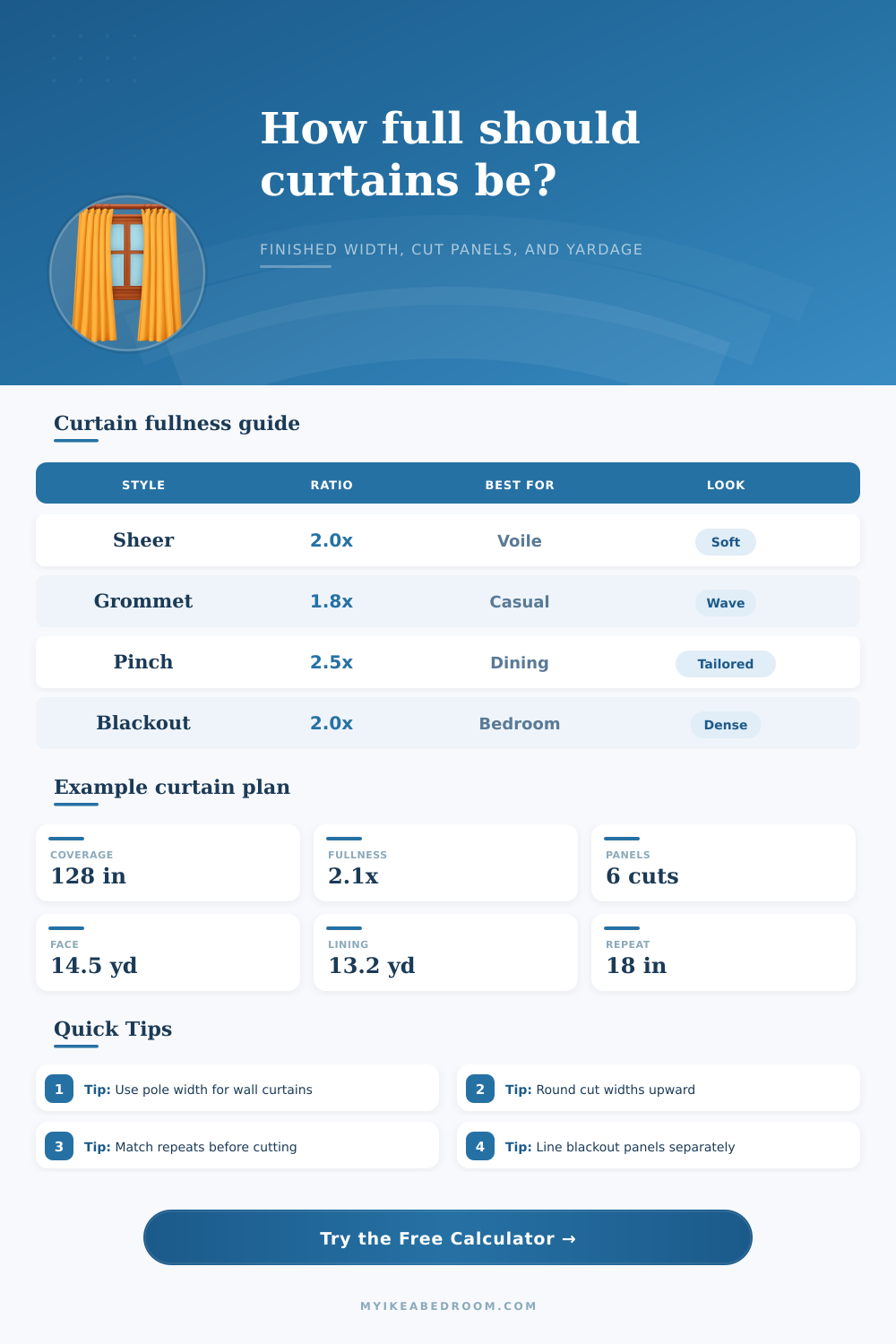
2.0x fullness keeps voile soft without crowding a medium pole.
Best checked with low shrinkage and no lining.
Blackout bedroom
2.0x to 2.25x balances dark coverage with manageable stack.
Returns and overlap matter more for light control.
Pinch pleat dining
2.5x fullness gives enough cloth for tailored pleats.
Round cut widths up so each panel has equal sections.
Wave track
2.0x fullness usually matches wave tape carrier spacing.
Use track width, not glass width, for the main measurement.
To create curtains with a professional appearance, you must purchase more fabric then the width of the window. Many people makes the mistake of purchasing curtains with enough fabric to cover the width of the window. However, purchasing only enough fabric to cover the width of the window will result in curtains that dont have enough fullness to create pleasingly ripples in the fabric.
Fullness is the extra amount of fabric that is purchased for the curtains beyond the width of the window. When measuring the curtains needed for a room, it is necessary to take measurements beyond the glass of the window. If you only measure the glass of the window, the curtains will leak light at the edges of the window.
How to Measure and Buy Curtains
You must measure the hardware span of the curtain rods. The hardware span of the curtain rods is the width of the rods plus the returns of the rods. By including the returns in the measurement of the curtains, the curtains will look as if they is built into the walls of the rooms.
By including the returns in the curtain measurements, the curtains will not appear as if they are hovering in front of the window. After you have established the width of the curtains needed for the rooms, you need to apply a fullness ratio to those measurements. The fullness ratio will tell you how much fabric to purchase beyond the width of the curtains.
The fullness ratio will depend on the style of the heading of the curtains. For instance, if your curtains have a flat panel or tab top heading, they will require less fullness than pinch pleat curtains. Pinch pleat curtains have fabric that is sewn into folds, so there will need to be more fullness in the fabric for the curtains to look good.
The fullness ratio will also determine the weight of the curtains. High fullness ratios will create many folds in the curtains. Using a high fullness ratio will make the curtains create a dense and opulent look in the rooms.
However, using a high fullness ratio will create a large stack of the curtains when they are open. This large stack of the curtains may block sunlight from entering the windows in the rooms. Therefore, you have to choose between having many folds in the curtains or having sunlight enter the rooms.
Another consideration in purchasing curtains is the fabric of the curtains. Many natural fabric will shrink when washed. If the fabric shrinks after you have hung the curtains, it may ruin the hemlines of the curtains.
Therefore, you must account for the shrinkage of the natural fabric of the curtains. Additionally, many fabrics have a pattern. To account for the pattern, you must shift the cuts of the fabric.
By shifting the cuts of the curtains, you will use more fabric to account for the pattern of the curtains. Using more fabric will increase the cost of the curtains. Another factor in the purchase of curtains is the lining of the curtains.
Many people use linings in the curtains to provide privacy in the rooms. There are two types of linings used in curtains. A privacy lining prevents people from getting a view of the rooms behind the curtains.
People use blackout linings to prevent light from entering the rooms behind the curtains. Many people also use interlining, which is a layer of batting that goes between the face fabric of the curtains and the lining. Interlining will add thermal insulation to the curtains.
However, it will also add weight to the curtains. Therefore, the hardware for the curtains must be strong enough to support the weight of the curtains with the interlining. Finally, you must consider the standard width of fabric bolts when purchasing the curtains.
Curtains are sold in fabric bolts of a standard width. Therefore, you may need to purchase more than one width of fabric to create the curtains. The joined pieces of fabric are referred to as cut panels.
If your calculations show that you need two and a quarter widths of fabric, you will have to purchase three widths of fabric. Purchasing more widths of fabric will give the curtains more fullness. It is better for the curtains to have too much fullness than too little fullness.
Finally, you must even the joins of the curtains so that the curtains will look symmetrical on the left and right side of the windows in the rooms.