Lumens Calculator Room Size
Estimate total room lumens, fixture count, lumens per sq ft, and brightness margin from room size, activity level, fixture output, ceiling height, wall reflectance, shade loss, and dimming reserve.
Load a common room plan, then tune the light level, fixture output, shade style, and reserve for the way the room is actually used.
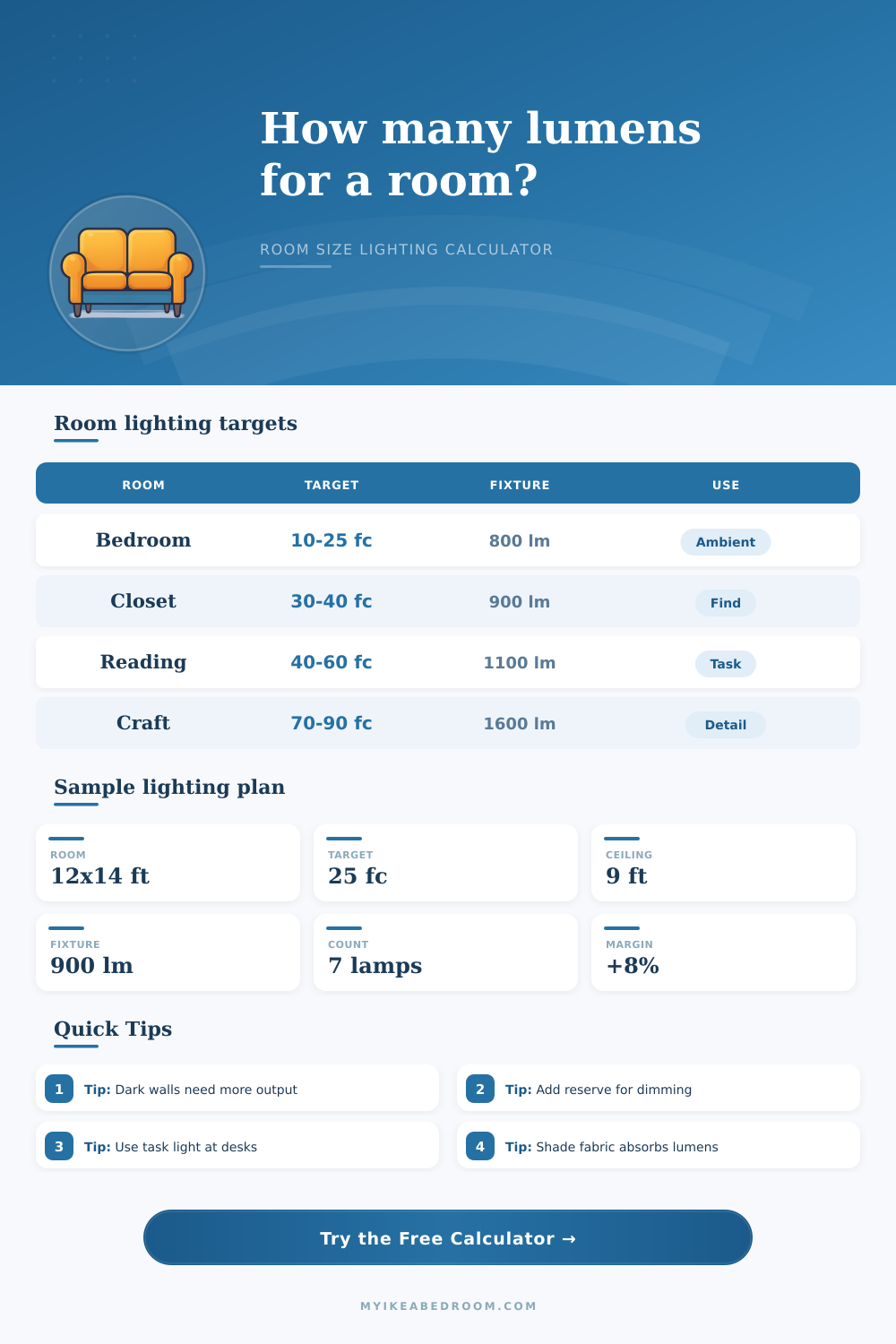
| Activity | Suggested fc | Suggested lux | Typical room use |
|---|---|---|---|
| Bedroom ambient | 10-20 fc | 110-215 lux | Relaxing, TV, soft general light |
| Bedroom dressing | 20-35 fc | 215-375 lux | Clothes, drawers, brighter cleanup |
| Reading or desk work | 40-60 fc | 430-645 lux | Focused task zones with local light |
| Craft, sewing, detail work | 70-100 fc | 750-1075 lux | Fine contrast and color matching |
| Ceiling height | Factor | Why it changes | Common fix |
|---|---|---|---|
| 7-8 ft | 0.95x | Light source is closer to the task plane | Use lower glare fixtures |
| 8-9 ft | 1.00x | Standard room height baseline | Use normal ambient spacing |
| 10-12 ft | 1.10-1.22x | More distance reduces useful light | Add output or layers |
| Vaulted | 1.38x | Light spreads into unused upper volume | Aim or lower fixtures |
| Condition | Multiplier | Effect | Best use |
|---|---|---|---|
| Pale walls, white ceiling | 0.90x | Reflects light back into the room | Bright bedrooms and offices |
| Average painted room | 1.00x | Baseline room calculation | Most home rooms |
| Medium colors, wood surfaces | 1.12x | Absorbs a noticeable share of light | Dining and living rooms |
| Dark walls or dense shades | 1.28-1.38x | Needs more fixture lumens | Moody bedrooms, dark offices |
| Fixture type | Typical lumens | Spread | Planning note |
|---|---|---|---|
| Table lamp bulb | 450-800 lm | Local pool | Count shade loss for fabric shades |
| Ceiling flush mount | 1200-3000 lm | Wide ambient | Works well for bedrooms and halls |
| Recessed downlight | 600-1000 lm | Focused cone | Use more units for even coverage |
| Linear or panel fixture | 2000-5000 lm | Broad task | Useful for offices, crafts, kitchens |
10-20 fc keeps ambient light calm.
Best when bedside or wardrobe task lights do the close work.
20-35 fc gives comfortable table light.
Add dimming reserve so meals and cleanup both feel right.
40-60 fc supports books and close tasks.
A floor lamp can raise the target without overlighting the room.
70-100 fc helps detail and color work.
Use brighter fixtures plus even spacing to reduce shadows.
Layered room check: If the margin is strongly negative, raise fixture lumens or lamp count. If it is strongly positive, choose dimmers or lower-output lamps so the room is not harsh.
Shade and surface check: Dark shades, dark walls, high ceilings, and heavy furniture all reduce useful light. The multipliers keep the result closer to the light that reaches the room.
To properly light a room, one must understand the relationship between the light source, the size of the room, and the surfaces within the room. Many peoples attempt to light their rooms based off solely upon the brightness of the light bulbs that they purchase. Often, people will either end up with a room that is too bright, or a room that is too dim.
Brightness isnt determined by a single number on a bulb, but brightness is determined by how that light interact with the environment. One must first understand the difference between watt and lumens. Watts indicate the amount of energy that a bulb consume to produce light, but lumens indicate the amount of light that the bulb produces.
How to Light a Room
When lighting a room, one should focus upon lumens to determine the brightness of the room. Additionally, foot-candles indicate the intensity of the light that land upon a specific surface within the room. Thus, foot-candles will provide information about how many lumens land upon every square foot of the area within the room.
The colors within the room also play a critical role in how the light will function within that area. For example, if the walls within the room are dark and the furniture is dark, those dark colors will absorb most of the light that enter the room. Thus, dark colors will make the room feel more dim then if it had all light-colored walls and floors.
Conversely, if the colors within the room tend to be dark, there will have to be more lumens within the bulb to compensate for the brightness that the light-colored walls and floors are reflecting. Thus, one must account for the color of the walls and the color of the furnitures within the room when calculating the number of lumens that the bulbs should provides to that space. The height of the ceiling within the room will also affect the brightness within that area.
Light tends to spread out within the environment as it moves away from the source of that light. Thus, if an area has a high ceiling, the light will travel further towards the floor, reducing the intensity of the light that fall upon the floor. One must account for the height of the ceiling within the room when calculating the brightness that is required for that space.
The type of light fixture that are used within the room will also affect the brightness within that area. Many light fixtures has shades made of fabric or glass. These shades will block some of the lumens that the bulbs produce, reducing the brightness within the fixture.
Thus, if one uses a shade made of a dark fabric, it will block a percentage of the lumens produced by the bulbs. In this case, the bulbs will have to produce more lumens to ensure the desired brightness. It is important to understand that different activities within the room require different levels of brightness.
For instance, different brightness level are required for the bedroom versus a kitchen area. Therefore, it is important to provide various brightness levels within the room. One way of providing various brightness levels is by installing a dimmer switch within the room.
Because different rooms require different levels of brightness within the area, different types of rooms require different number of foot-candles. For instance, a craft room may require a high number of foot-candles to allow for detailed craft projects, while a hallway may require a low number of foot-candles for the task of walking through the area. Providing too few foot-candles in a craft area will make it difficult for an individual to see their craft, but providing too many foot-candles in a nursery may result in an excesive amount of brightness in the area.
When calculating the brightness margin within a room, one should aim for a comfortable brightness level for the peoples who utilize the area. If the brightness margin is positive, there are enough lumens to the space to avoid creating a too dim area. Too many lumens can be balanced out by installing a dimmer switch, but too few lumens may require the replacement of the light bulbs.
One should of aim to provide an even distribution of light within the room to allow for individuals to both perform their movements within the area and perform their various room activities.