🌡 Room Heater Size Calculator
Estimate room heating load from room volume, insulation, climate temperature difference, window area, exterior walls, warm-up speed, efficiency, and primary or supplemental heat mode.
Load a realistic room, then adjust dimensions, window area, temperature difference, and heat mode to match your space.
Heat loss breakdown
Adjust the inputs to compare heater sizes for the room.
| Insulation level | Wall factor | Air factor | Typical room signal |
|---|---|---|---|
| Excellent | 0.35 | 0.010 | Tight modern room with low drafts |
| Good | 0.45 | 0.014 | Insulated bedroom or office |
| Average | 0.60 | 0.020 | Older room with moderate leakage |
| Weak | 0.80 | 0.030 | Thin envelope or leaky windows |
| Drafty | 1.05 | 0.045 | Basement, garage, or very loose room |
| Climate case | Target indoor | Outdoor reference | Delta to enter |
|---|---|---|---|
| Mild evening | 68 F | 45 F | 23 F |
| Cool winter day | 70 F | 35 F | 35 F |
| Cold night | 70 F | 20 F | 50 F |
| Very cold start | 70 F | 5 F | 65 F |
| Metric example | 21 C | 4 C | 17 C |
| Heater size | BTU/hr equivalent | Best-fit output band | Count behavior |
|---|---|---|---|
| 500 W | 1,706 BTU/hr | Very small supplemental load | More units for larger rooms |
| 750 W | 2,559 BTU/hr | Small bedroom assist | Rounds up load in smaller steps |
| 1,000 W | 3,412 BTU/hr | Bedroom or office support | Good when 1,500 W is oversized |
| 1,500 W | 5,118 BTU/hr | Common single-room output | Default auto choice for many rooms |
| 2,000 W | 6,824 BTU/hr | Larger room or faster recovery | Reduces count for high loads |
| 3,000 W | 10,236 BTU/hr | High-output room heating | Used for very large estimates |
| Preset | Area | Windows | Mode focus |
|---|---|---|---|
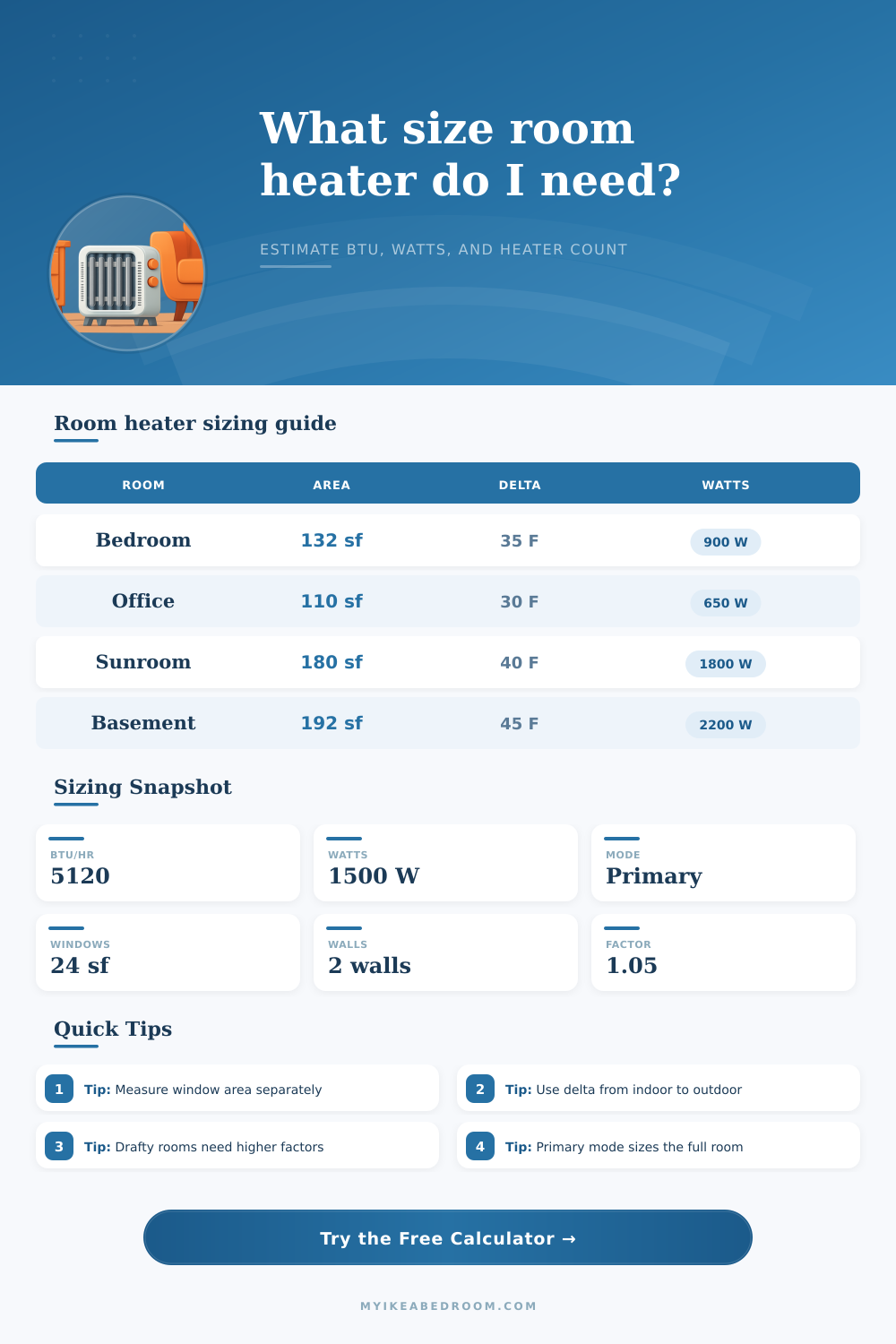
| Small bedroom supplemental | 132 sq ft | 18 sq ft | Assist an existing system |
| Drafty basement room | 192 sq ft | 8 sq ft | Full-room primary load |
| Insulated home office | 110 sq ft | 14 sq ft | Steady primary heat |
| Sunroom with windows | 180 sq ft | 84 sq ft | Fast warm-up with glass load |
| Open bedroom suite | 288 sq ft | 42 sq ft | Shared or primary heat |
Sizes for a heater that helps an existing system carry part of the room load.
Works for shared heating where the room heater does most of the recovery work.
Uses the full room heat-loss estimate before warm-up speed and buffer are applied.
Adds capacity for rooms that start colder or need faster temperature recovery.
In order to select an space heater for a room, it is important to have an understanding of how heat move and how heat escapes from a room. Most people selects a space heater for a room based off the physical size of the room. However, the physical size of the room isnt the only factor that must be consider in determining the amount of heat that a space heater is required to be dispensed into the room.
For instance, the space heater must overcome the amount of heat that leave the room through the windows, doors, and walls of the room. Heat moves towards the coldest point within the room, so any space heater for the room must provide enough energy to compensate for the heat that leaves the room. One of the factors to consider is the insulation of the room.
How to Choose the Right Space Heater for a Room
With poor insulation for the room, heat will leave the room at a rapidly rate, and the space heater will have to work to provide heat for the room to stay at a steady temperature. The difference in the temperature outside of the room and the temperature within the room (the temperature delta) is another factor to consider. With a significant temperature difference between the outside of the room and the inside of the room, more heat will be lost from the room, and a space heater with more heating power will be required to compensate.
People often select a space heater based upon the climate that is required to heat the space to provide enough heat for the indoor space to remain comfortabley. However, the space heater that is selected for a room may not provide enough heat to maintain the comfort of those in the room when the outdoor temperature drop. Another factor to consider is whether the space heater will be used as a primary heat source for the room or as a supplemental heat source.
A primary heat source will have to provide enough heat for the entire room alone, while a supplemental heat source will only need to provide heat for the remainder of the room that another system (such as a furnace) is already heated by. Finally, another factor to consider is the warm up speed for which the desired temperature for the room. A space heater that will heat a room to a desired temperature quick will have more heating power than a space heater that is only intended to heat a room to a desired temperature and remain at that temperature.
Space heaters are typically measured in BTUs and watts. For space heaters of standard sizes, the wattage is typically 1500 watts. It is common for a room that requires more heat than a single space heater can provide will be represented by two space heaters of smaller size.
This helps to ensure that heat is distributed even in the room, and it prevents cold spots from developing within the room. Furthermore, it is also important to include a buffer in the calculation of the amount of power that is required of a space heater. The sizing buffer will account for heat loss that might occur in the room (such as if a door to the room is opened).
By incorporating a sizing buffer into the space heater power calculation (for example, ten or fifteen percent), the space heater will not have to work at maximum capacity at any given time. This will allow the space heater to last for a more longer period of time, and it will allow for more control of the amount of electricity that the space heater uses. However, the power of the space heater should also be balanced against the electrical circuit in the room to ensure that the space heater will not trip the circuit breaker.