King Size Brick Calculator
Plan king-size brick walls, veneer faces, returns, openings, course layout, wythe count, waste, and mortar volume from one masonry worksheet.
Load a masonry scenario, then adjust brick dimensions, openings, returns, and course height to match your actual wall.
Brick and mortar breakdown
| Brick type | Actual face | Joint | Planning module |
|---|---|---|---|
| King size face | 9 5/8 in by 2 5/8 in | 3/8 in | 10 in by 3 in |
| King size tight joint | 9 5/8 in by 2 5/8 in | 1/4 in | 9 7/8 in by 2 7/8 in |
| King soldier face | 2 5/8 in by 9 5/8 in | 3/8 in | 3 in by 10 in |
| King veneer wythe | 9 5/8 in by 2 5/8 in | 3/8 in | About 4.8 per sq ft |
| Bond pattern | Brick effect | Cutting allowance | Best planning use |
|---|---|---|---|
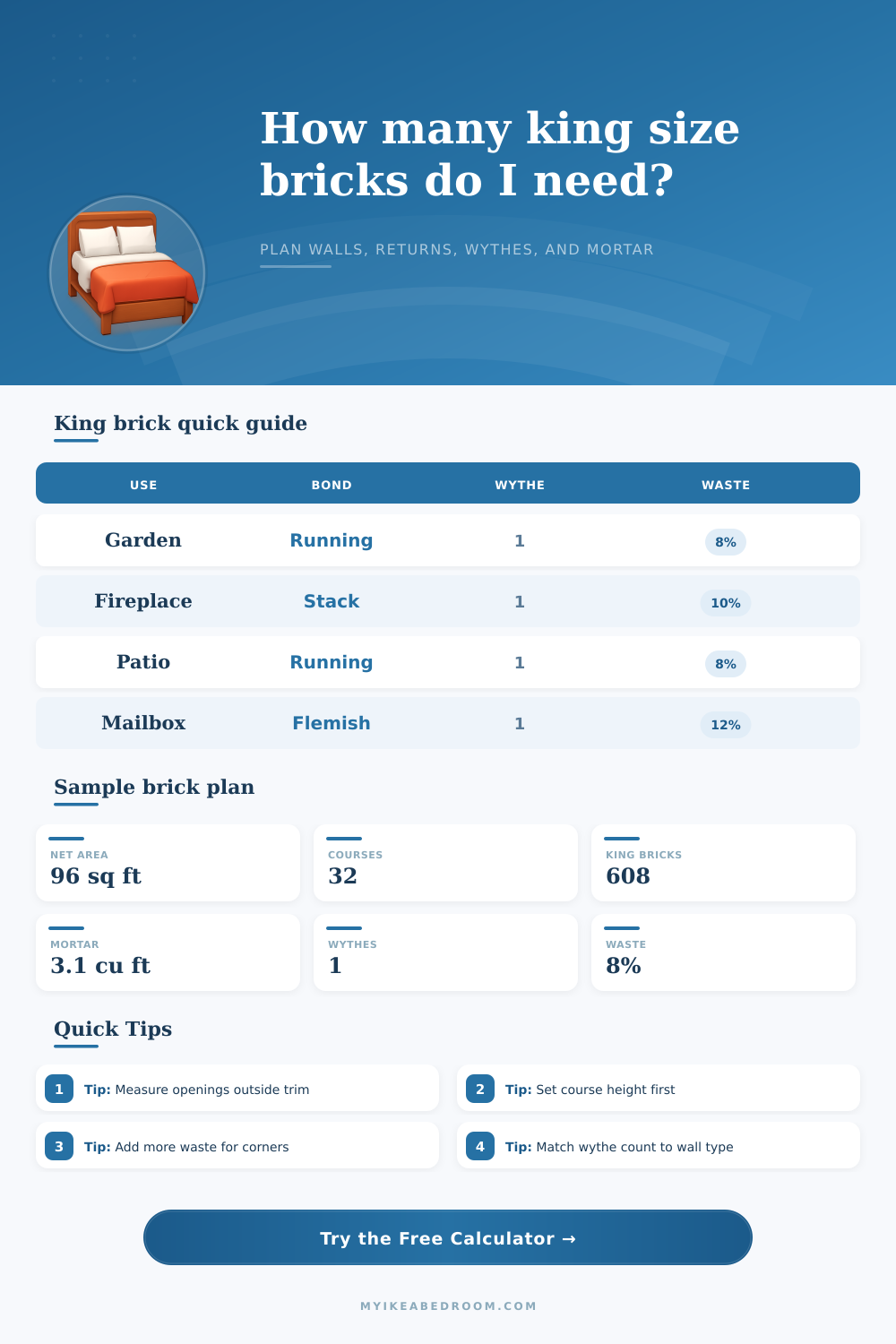
| Running bond | Standard stretcher courses | Low to moderate | Garden walls, veneer, patio walls |
| Stack bond | Aligned vertical joints | Low | Flat accent panels and fireplace faces |
| Flemish bond face | Header pattern effect | Moderate | Mailbox faces, piers, decorative returns |
| English bond face | Alternating visual courses | Moderate | Traditional wall faces and thick panels |
| Course height | 2 ft wall | 3 ft wall | 4 ft wall |
|---|---|---|---|
| 2 7/8 in tight joint | 9 courses | 13 courses | 17 courses |
| 3 in standard king course | 8 courses | 12 courses | 16 courses |
| 3 1/8 in heavy joint | 8 courses | 12 courses | 16 courses |
| 10 in soldier course | 3 courses | 4 courses | 5 courses |
| Scenario | Net face area | Wythe count | Approx bricks |
|---|---|---|---|
| 12 ft by 3 ft garden wall | 36 sq ft | 1 | 173 king bricks |
| Fireplace surround face | 42 sq ft | 1 | 202 king bricks |
| 24 ft by 2.5 ft patio wall | 60 sq ft | 1 | 288 king bricks |
| 18 ft by 4 ft double wythe wall | 72 sq ft | 2 | 691 king bricks |
When you plan to build a wall with masonry, calculating the number of bricks you will need is one of the first step in the process. If you purchase too many bricks, you will be throwing away the excess brick. Additionally, if you purchase too few brick, you wont be able to complete you masonry project.
To calculate the number of bricks for a project, a mason must account for various variable. The first calculation is the net area of the wall. The net area of the wall is the total area of the wall minus the area of any opening in the wall.
How to Work Out How Many Bricks You Need for a Wall
For example, the total length and height of the wall must have the area of any vents or void for fireplaces subtracted from the total length and height of the wall. Many people will forget to account for these area. If you do not account for these areas, you will purchase too many brick for your project.
By calculating the net area of the wall, you will ensure that you will not overpay for bricks that you dont need for the wall. The next calculation is the height of the bricks. A king-size brick will have a specific height, but the height of the course include the height of the brick and the mortar bed joint.
When building a wall, you will add the mortar bed joint to every row of brick. If you do not use the course height for your building project, an incorrect measure may be made of the height of the wall. The third calculation is the number of wythes in the wall.
A wythe is a single layer of bricks for a wall. The wall could contain only one wythe or multiple wythes. If you have two wythes, then your wall will have two layer of bricks.
A wall with two layers of bricks will require twice as many bricks as a wall with only one layer of bricks. You will also need to account for the extra mortar that multiple wythe in the wall will require. The next calculation is the type of bond for the bricks.
A running bond is one of the most common type of bonds for bricks. However, a Flemish bond is decorative and will require cutting of some of the bricks. If you choose a decorative bond, you will have to purchase more bricks to account for the cutting of the bricks.
The best way to account for this is with a reference table that tells you how many bricks are required for each type of bond. You can use the reference table to determine if the decorative bond is worth the extra cost of the additional bricks. Another thing to account for is the return in the wall.
Returns are bricks that turn the corner of a wall to hide the raw edge of the bricks. To build returns, you must cut some of the bricks. Any cutting of bricks will lead to waste of bricks.
If your project include returns, you should of account for this and purchase extra brick. This will ensure that you will not run out of bricks while building returns and corners of your masonry project. Finally, you must account for the amount of mortar that will be required for the project.
Mortar is needed in the head joint between the bricks and the bed joint beneath the bricks. The amount of mortar that is required for your project can be calculated so that you do not run out of mortar while you are building your wall. If you do run out of mortar while building your wall, its possible that the mortar will have dried out and created seam in your wall.