Bathroom Mirror Height Calculator
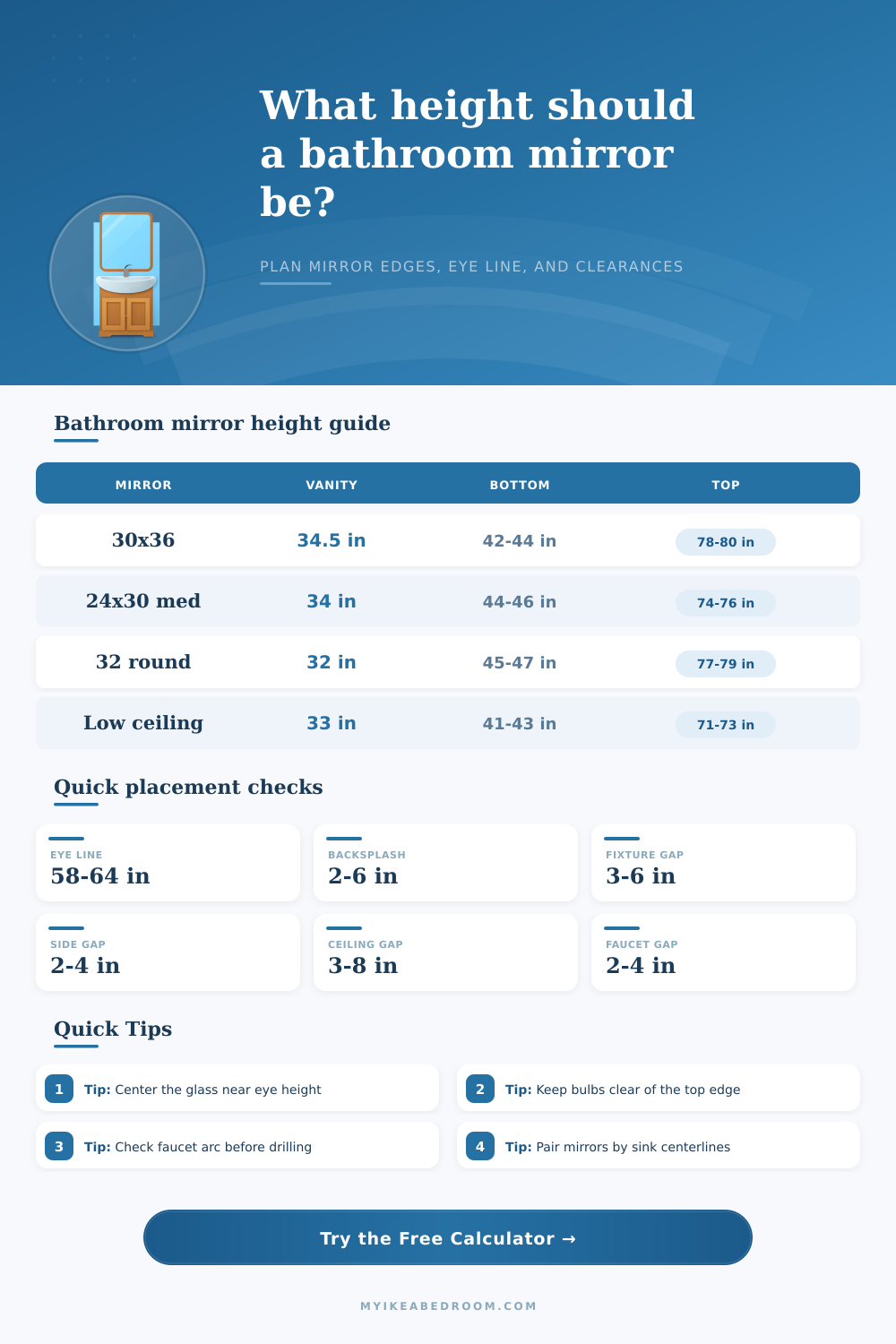
Place a vanity mirror by measuring the vanity, faucet, backsplash, fixture, ceiling, side spacing, and the main user eye line, then compare the bottom edge, top edge, and clearance balance before drilling.
Choose a common bathroom condition, then fine-tune the fields for your exact vanity, faucet, light, ceiling, and mirror size.
Placement breakdown
| Setup | Mirror size | Common bottom edge | Common top edge |
|---|---|---|---|
| Single comfort-height vanity | 30 x 36 in rectangle | 42 to 44 in from floor | 78 to 80 in from floor |
| Double vanity pair | 24 x 36 in each mirror | 42 to 45 in from floor | 78 to 81 in from floor |
| Medicine cabinet | 24 x 30 in recessed cabinet | 44 to 47 in from floor | 74 to 77 in from floor |
| Round mirror over vessel sink | 30 to 34 in diameter | 44 to 48 in from floor | 76 to 82 in from floor |
| Clearance | Planning range | Measured from | Why it matters |
|---|---|---|---|
| Backsplash to mirror | 2 to 6 in | Backsplash top to mirror bottom | Keeps the glass away from caulk, stone trim, and heavy splash zones. |
| Faucet arc to mirror | 2 to 4 in | Highest faucet point to mirror bottom | Prevents the faucet from visually crowding or touching the reflective field. |
| Mirror top to light | 3 to 6 in | Mirror top to lowest shade or bar | Leaves room for shades, globes, cleaning, and uneven fixture hardware. |
| Mirror side to wall or trim | 2 to 4 in | Mirror edge to sink bay edge | Helps the mirror feel centered without colliding with outlets or side walls. |
| User condition | Eye-line band | Mirror center target | Best mounting style |
|---|---|---|---|
| Average standing adult | 58 to 64 in | Near mirror center or slightly high | Eye-line centered |
| Tall primary user | 64 to 69 in | 1 to 3 in above center | Lifted above backsplash |
| Children or shared family bath | 50 to 58 in | Near lower third to center | Backsplash balanced |
| Seated accessible vanity | 43 to 51 in | Lower half of mirror | Medicine cabinet practical |
| Vanity or sink bay | Usual mirror width | Side clearance | Placement note |
|---|---|---|---|
| 24 in powder vanity | 20 to 22 in | 1 to 2 in each side | Works well with medicine cabinets and slim arch mirrors. |
| 30 to 36 in single vanity | 24 to 32 in | 2 to 4 in each side | Center to the sink, not always the total vanity cabinet. |
| 48 to 60 in double vanity | Two 22 to 28 in mirrors | 2 to 5 in each mirror side | Use sink centerlines for paired mirrors. |
| 72 in wide vanity | One 60 to 66 in mirror | 3 to 6 in each side | Check sconces, outlets, and cabinet trim before choosing width. |
Eye-line centered
Best for: Everyday single vanities.
Priority: Places the user eye height near the mirror center.
Watch: Tall mirrors may need a lower bottom edge.
Lifted above backsplash
Best for: Stone splashes and deck-mounted faucets.
Priority: Keeps the bottom edge above wet trim.
Watch: Eye line can drift low on short mirrors.
Top aligned to light
Best for: Bar lights or tight wall sconces.
Priority: Protects a clean gap below the fixture.
Watch: Backslash clearance can shrink.
Low ceiling priority
Best for: Basements and attic baths.
Priority: Keeps top edge below ceiling and light limits.
Watch: A shorter mirror may be needed.
Installing an bathroom mirror requires that people consider a few different variable prior to installation to ensure that they place the mirror appropriately for the bathroom’s inhabitants. Many people tends to install bathroom mirrors at the wrong height. A bathroom mirror may be installed too low or a bathroom mirror may be installed too high.
Depending on where they install the bathroom mirror, individual will experience different feeling when looking into the mirror. The height of the mirror should be considered in relation to the height of the bathroom’s inhabitants, the height of the vanity upon which they will stand, and the placement of the bathroom’s light fixture. Eye line is the most important of the variable to consider when placing a bathroom mirror.
How to hang a bathroom mirror at the right height
People want to aim for the individual’s eye line such that their eyes is near the vertical center of the mirror. If the mirror is placed too low, individuals will feel like they are looking down into there mirror. Placing the mirror too high will make individuals feel as if they are looking into the ceiling.
In most case, positioning the bathroom mirror to accommodate the individual’s eye line is impossible due to other object in the bathroom. One such object is the backsplash that may be installed between the vanity and the wall of the bathroom. To avoid having sink liquid and toothpaste hit the mirror, it is recommended to leave a gap between the backsplash and the bathroom mirror.
Otherwise, the mirror will require more frequent cleaning due to the liquids hitting the mirror. Additionally, it is also too even for aesthetic reasons to avoid the look of the vanity covering the bathroom mirror. Another object to avoid blocking the bathroom mirror is the sink faucet.
If the sink features high arc faucets, the mirror may be installed too high above the sink to avoid the faucet blocking individuals’ view in the mirror. You must take a measurement from the sink to the mirror to avoid this issue. Finally, the position of the light fixtures must also be consider.
The majority of light fixtures are installed above the vanity where the bathroom mirror will be installed. The bathroom mirror should be installed such that there is a gap between the mirror and the light fixtures. Otherwise, the bathroom mirror may touch the lights, making the wall look cluttered and the lights difficult to clean.
The individual that will use the bathroom will have a significant impact on the placement of the mirror. In the primary bathroom, the mirror can be installed to accommodate the tallest individual in the house. In the shared bathroom, the bathroom mirror must be installed at a height that consider both adults and children using the bathroom.
If the mirror is installed too high, the children will only see a blank wall in their mirror. A decision must be made between the placement of the mirror to accommodate the eye line and the backsplash. Both cannot always be prioritized in the installation of the bathroom mirror.
In a bathroom that contain two sinks (double vanity), the placement of the mirror can be more complex. A common practice is to center the mirror in relation to the vanity. However, if the sinks are not centered on the vanity, the mirror will not be aligned with the person standing in the sink.
Installing the mirror to correspond with the plumbing centerlines of the sinks will ensure that the mirror is aligned with the bathroom’s inhabitants standing in their sink. Before drilling into the wall to install the bathroom mirror, you should simulate the mirror on the wall. Painter’s tape can be applied to the wall to mark the top and bottom of the mirror.
Standing in the sink with the painters tape on the wall, it is possible to determine whether the mirror will hit an individual’s eye line, whether there will be enough space between the mirror and the bathroom’s light fixtures. It is also much easier to move the painter’s tape than it is to repair drywall holes that would of been made during installation. You’ll find that it is alot easier to move the tape than repair holes.
The mirror’s placement is important. Its also vital to recieve the right measurements first. A modern bathroom should look good.