Ceiling Fan Sloped Ceiling Calculator
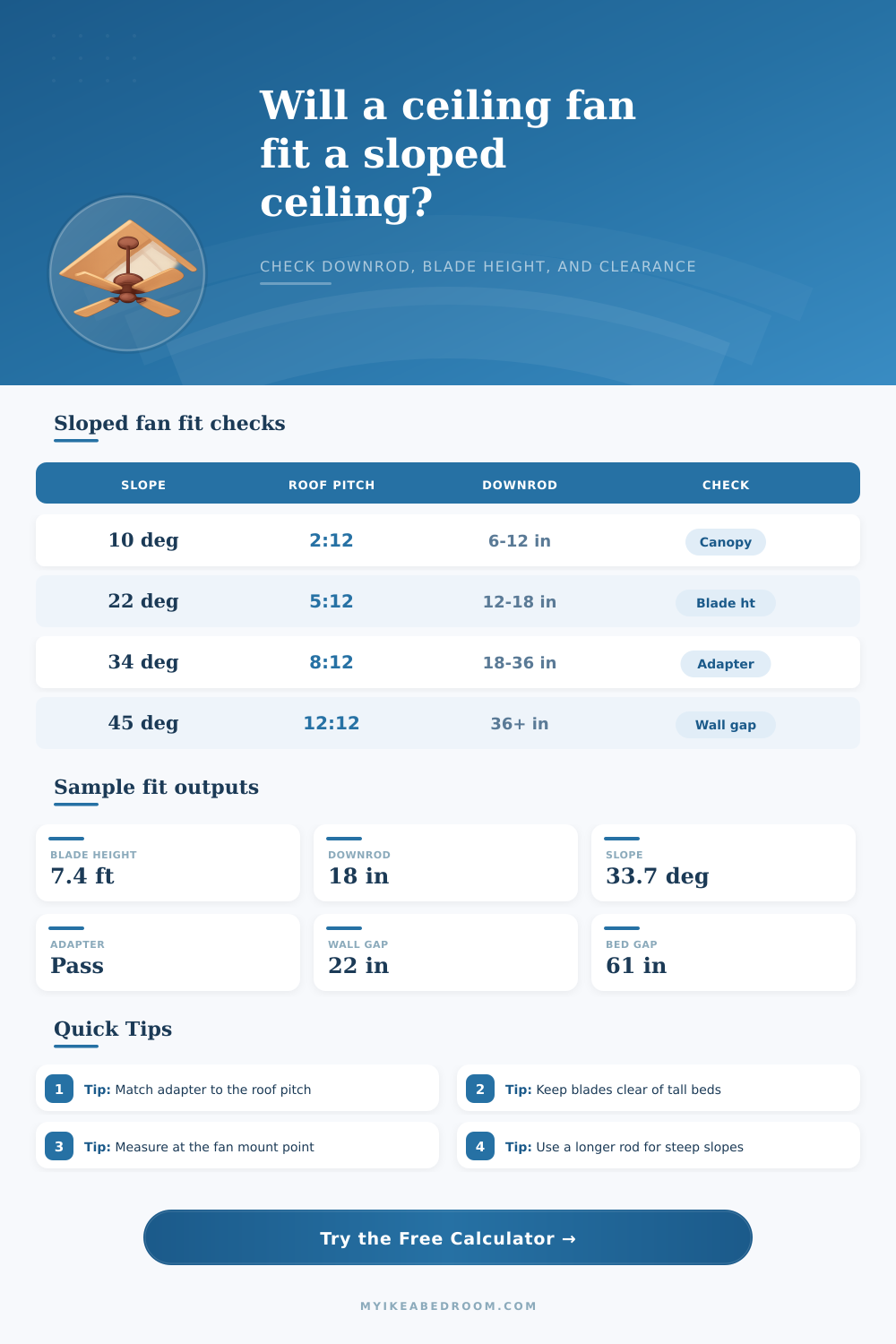
Check whether a bedroom ceiling fan will fit a vaulted, attic, or angled ceiling by comparing downrod drop, blade height, slope adapter capacity, wall distance, and furniture clearance.
Load a realistic sloped-ceiling condition, then adjust the numbers to match the actual fan box and furniture below it.
The result compares the selected downrod with the minimum drop needed to keep the blade circle below the sloped ceiling plane while preserving room and furniture clearance.
Installing an ceiling fan on a sloped ceiling requires specific measurement of that ceiling and specific part to accommodate the slope of that ceiling. Many person may think that any type of ceiling fan can be installed on any type of ceiling, but due to the slope of the ceiling, the blade of the ceiling fan could interfere with the ceiling if those ceiling fan blades attempt to rotate in relation to that ceiling. Before hanging a ceiling fan on a sloped ceiling, one must determine the angle of that slope.
The angle of the slope will determine if the mounting bracket for that ceiling fan is sufficient to allow the fan to hang from the ceiling. Standard mounting bracket have a limit to the angle from which they can be hung; if the angle of the ceiling slope exceeds the limits of the mounting bracket, the ceiling fan will appear crooked. Not only may this create difficulties for the ceiling fan blades to rotate in relation to the ceiling, but it could also lead to the light fixture of that ceiling fan becoming loose over time.
How to Measure and Install a Ceiling Fan on a Sloped Ceiling
In these situations, you should purchase a specialized adapter for ceiling of these angles. Beyond determining the angle of the sloped ceiling, it is also important to measure the length of the downrod for the ceiling fan that is to be installed. For ceiling that are flat, the length of the downrod will determine the height of the ceiling fan.
For sloped ceilings, however, the length of the downrod will determine the amount of clearance that is provided between the ceiling fan blades and the sloped ceiling. Because ceilings slope in relation to the walls of a room, the blades of a ceiling fan will be closer to the ceiling on one side of the ceiling than they will be on the other side. Thus, one should measure the length of the downrod to ensure that the blades of the ceiling fan will not strike the ceiling on the higher side of the slope.
At the same time, though, the ceiling fan should also not hang too low within the room if the downrod is too long. For instance, if there is a bed within the room, it would be uncomfortable for the bed occupants if the ceiling fan were too close to the bed. Another measurement that is required is the distance between each of the fans blades and the walls of that room.
The rotation of the ceiling fans blades will occur in relation to those walls; if the blades are too close to a wall, the rotation of the blades may cause turbulence within the room. Turbulence in the blades of a ceiling fan can lead to that fan making a chopping sound, as well as reduce the amount of cooling air that the fan can emit into the room. Therefore, there should be enough space provided between each of the fans blades and each of the walls in the room.
If the distance between each of the fans blades and the walls is not enough, you may have to change the location of the fan, or one can purchase a ceiling fan with smaller blade diameters. Beyond measuring each of the above element of the sloped ceiling, it is also important to account for the droop of each of the blades of the ceiling fan. Droop is the phenomenon in which each of the blades of a ceiling fan may flex downward in relation to gravity.
This droop is typically minimal when the fan is hung from a flat ceiling. On a sloped ceiling, however, droop can cause the ceiling fans blades to make contact with the ceiling when the fan is rotating. Thus, it is important to account for droop of each of the fans blades in measuring how long the downrod should be.
Finally, there are various reference tables and calculators that can be consulted to ensure that each of the measurement are correct prior to installation of the ceiling fan. If the calculations suggest that the length of the downrod that will be used for the installation is too long for the height of the sloped ceiling, then a conflict will arise between the requirement of providing clearance for the ceiling fans blades to avoid contacting the ceiling and the requirement of allowing for the head clearance of individuals that occupy the room. Since one cannot change the geometry of the room, one of the other installation variable will have to be altered.
It is more efficient to determine these variables and make any necessary adjustment prior to installing the mounting box for the ceiling fan. Thus, by determining the limits of the adapter and the requirements for clearance of each of the blades of the ceiling fan prior to installation, the ceiling fan will operate efficient and effectively once installed.