Wire gauge planning for LED strip feeds and driver leads
LED Strip Cable Size Calculator
Choose a cable size for headboards, shelves, vanities, wardrobes, and room coves by testing two gates at once: voltage drop across the lead and derated ampacity for the installed cable path.
Each preset loads a real room-lighting layout so a short shelf accent, a high-output vanity border, and a full perimeter cove do not all get the same generic wire recommendation.
Calculation breakdown
These quick specs seed the voltage and default watt density so common mono, RGB, RGBW, and pixel strip types start with realistic electrical loads before cable sizing begins.
| Gauge | Area | Ohms / 1000 ft | Base ampacity |
|---|---|---|---|
| 22 AWG | 0.34 mm2 | 16.14 | 3 A |
| 20 AWG | 0.52 mm2 | 10.15 | 5 A |
| 18 AWG | 0.82 mm2 | 6.39 | 7 A |
| 16 AWG | 1.31 mm2 | 4.02 | 10 A |
| 14 AWG | 2.08 mm2 | 2.53 | 15 A |
| 12 AWG | 3.31 mm2 | 1.59 | 20 A |
| 10 AWG | 5.26 mm2 | 1.00 | 30 A |
| System | Typical run | Drop target | Why it matters |
|---|---|---|---|
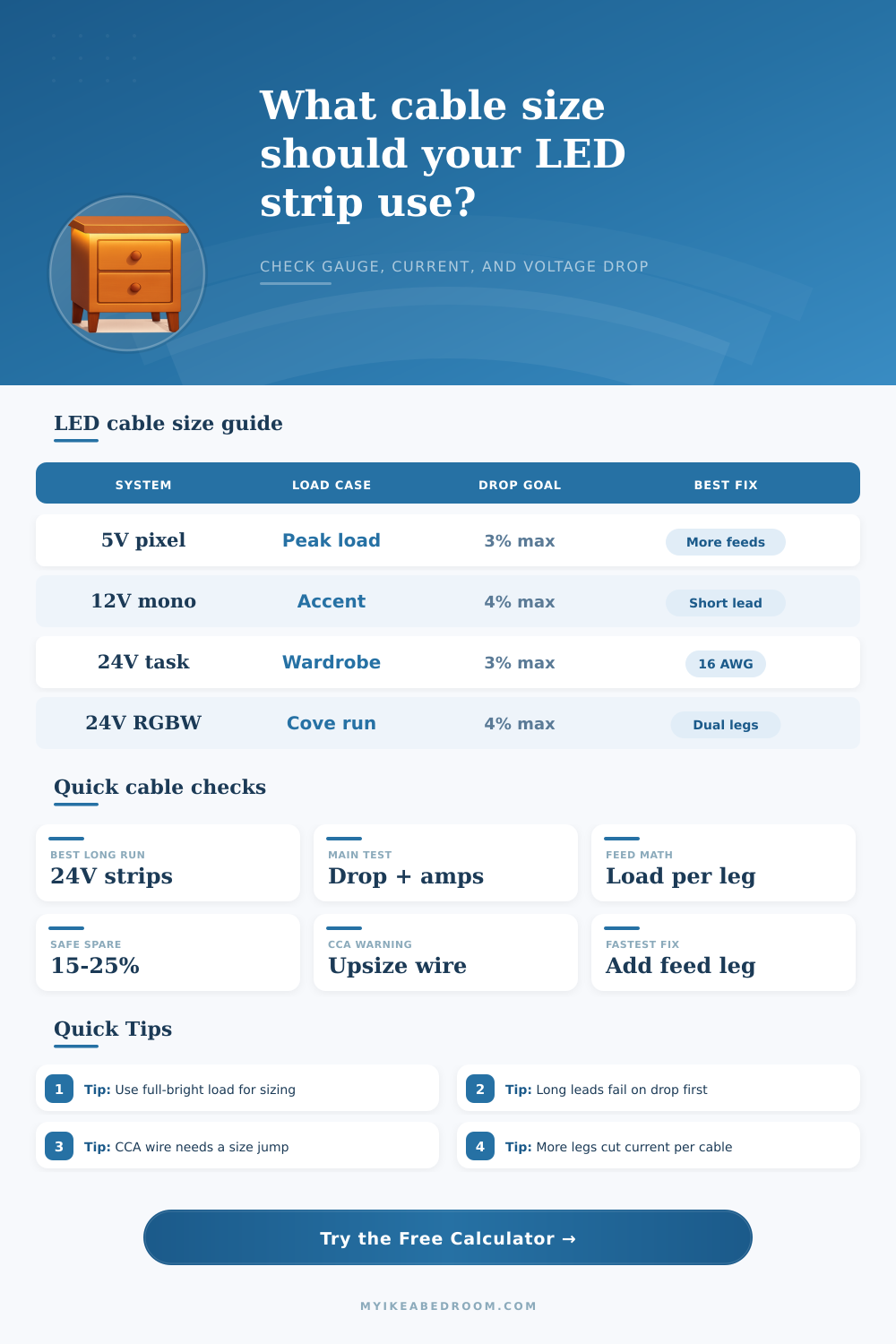
| 5V pixels | Animation and bias lighting | 2-3% | Low voltage magnifies every foot of lead loss. |
| 12V mono strips | Headboards and slim shelves | 3-4% | White fade appears quickly on longer feeds. |
| 24V task strips | Wardrobes and desks | 2-3% | Higher voltage helps, so clean output is easier to hold. |
| 24V RGBW strips | Coves and closet rings | 3-4% | Bright white scenes reveal feed imbalance first. |
| Factor | Adjusted ampacity | Resistance effect | Use note |
|---|---|---|---|
| Pure copper, open air | 100% | 100% | Best case for hidden driver leads. |
| Tinned copper, channel | 86% | 102% | Good corrosion resistance with mild penalty. |
| Pure copper, bundled | 78% | 100% | Heat build-up reduces current comfort. |
| CCA, concealed path | 63% | 162% | Often needs an immediate wire-size jump. |
| Layout | Typical length | Likely cable issue | Safer move |
|---|---|---|---|
| Headboard halo | 6-10 ft | Usually modest current | 18 AWG copper is often enough. |
| Wardrobe rail | 10-16 ft | Remote drivers add lead loss | Use 16 AWG or shorten the lead. |
| Vanity border | 16-20 ft | Bright white scenes spike load | Split into two feed legs when possible. |
| Tray cove | 24-32 ft | Long feeds plus visible fade | 24V strips and thicker home-runs help fast. |
| Closet perimeter | 30-36 ft | Many corners and hidden routes | Add feed legs before jumping strip density. |
| Room cove outline | 40 ft and up | Drop usually beats ampacity first | Use 24V, extra feeds, and shorter driver leads. |
These four cards compare the selected cable against the recommended gauge, then test the same layout with one more feed leg and with a 24V-equivalent electrical load split.
The reason why LED strip lights may appear dim at the far end of the strip of LED light is due to the concept of voltage drops. Voltage drop occur due to the electrical resistance of the wire that connects the LED strip lights to the power supply. As the electricity travels along the wire, the resistance of the wire causes the voltage to drop, which causes the LED lights at the end of the wire to appear dimmer than the LED lights at the beginning of the wire.
These types of low-voltage DC systems (such as 5V pixels and 24V cove strips) are especially sensitive to voltage drop due to the low voltage of the system, low voltages cannot tolerate high levels of resistance. When purchasing wire for you LED strip lights installation, you must consider the gauge of the wire. Wire gauge refer to the thickness of the wire.
Why LED Strip Lights Get Dim and How to Fix It
As such, the higher the gauge number of the wire, the thinner the wire. Many people opt for 18 AWG wire due to its low cost and common availability. However, 18 AWG wire may not be thick enough for your installation.
If you use thin wire for a long installation of LED strip lights, the voltage drop along the wire will become visible, and the colors of the LED strip lights may shift towards yellow. Furthermore, if you bundle the LED strip wires together in a channel, or if you use copper clad aluminum wire for the LED strip lights, the wires may heat up due to the high resistance of the copper. Heat buildup in the wires will reduce the safe amount of current that can travel through the wire.
There are two factors to consider with LED strip lights: voltage drop and ampacity. Voltage drop is the loss of voltage that occurs with every foot of cable carrying the electrical currents to the LED strip lights; the longer the LED strip light installation, the greater the voltage drop. For instance, a 4 percent drop in voltage on a 12 V LED strip light will make that LED strip light appear noticeably dull.
Ampacity refer to the ability of the wire to carry the electrical current without overheating the wire or melting the insulation of the wires. You must consider both of these factors for LED strip lights to avoid voltage drop and dim LED lights, as well as to avoid overheating the wires. The layout of your LED strip lights will change the way in which you calculate the size of the wire for your installation.
For example, if your LED strip light needs to be lit at 14 feet at 3 watts per foot, the total wattage will be approximately 40 watts, or less than 2 amps. If you use a single 10-foot lead of 18 AWG wire, there may be a noticeable voltage drop along the LED strip. However, feeding the LED strip from two separate leads will reduce the current in each wire by half.
For this scenario, a thinner wire of 20 AWG will do the job. Thus, the math changes if you have an LED strip light that you need to power. The environmental factors and the materials used for the wire will also impact the LED strip lights performance.
If you place the power driver for the LED strip lights within the furniture, the driver will create heat that cannot easily escape the piece of furniture. To account for this, you will have to use a derating factor to reduce the safe amperage of the wires. Another consideration is the material of the wire.
Pure copper is the best conductor of electricity for LED strip lights that are exposed to the open air. However, if you install the LED strip lights in locations that is humid with moisture in the air, then tinned copper is the best conductor as it resists corrosion that can form on copper wires in such environments. Lastly, avoid copper clad aluminum as it has higher resistance to the flow of electricity than pure copper.
Furthermore, copper clad aluminum has poorer heat handling capabilities than pure copper. There are different methods of feeding electricity to the LED strip lights. One method is to use a single home run to power the LED strip lights from power supply to the LED strip lights.
Another method is to use parallel legs to feed power to the LED strip lights. Using this method for runs of LED strip lights longer than 20 feet will allow for each wire to carry less current than the other, reducing the voltage drop along the LED strip lights without having to use a thicker gauge wire. For a long perimeter for LED strip lights installation, using four feeds will allow for 16 AWG wire to effectively power the LED strip lights.
To ensure that the LED strip lights run correctly in the furniture, follow a few steps. First, size the wires according to the worst case load requirement for the LED strip lights. Second, split the feeds to the LED strip lights to reduce the current in each wire.
Third, use the appropriate material for the wires according to the environmental factors of the areas in which they will be installed. By following these three steps, the LED strip lights will be bright and consistent in brightness and the wires will not overheat.