Bedroom cove, headboard, under-bed, and wardrobe strip planning
LED Strip Lumens Calculator
Estimate target room lumens, usable strip output, average lux, and recommended run length by blending room size, mounting style, strip efficacy, diffuser loss, surface reflectance, and dimmer ceiling.
Each preset fills a realistic bedroom or storage scenario so low-guide under-bed glow, full perimeter coves, and task-focused wardrobe rails do not all get the same lumen target.
Full lumen breakdown
Results update as soon as you change room size, mounting style, strip family, diffuser, or brightness ceiling.
| Intent | Target Lux | Foot-candles | Typical bedroom use |
|---|---|---|---|
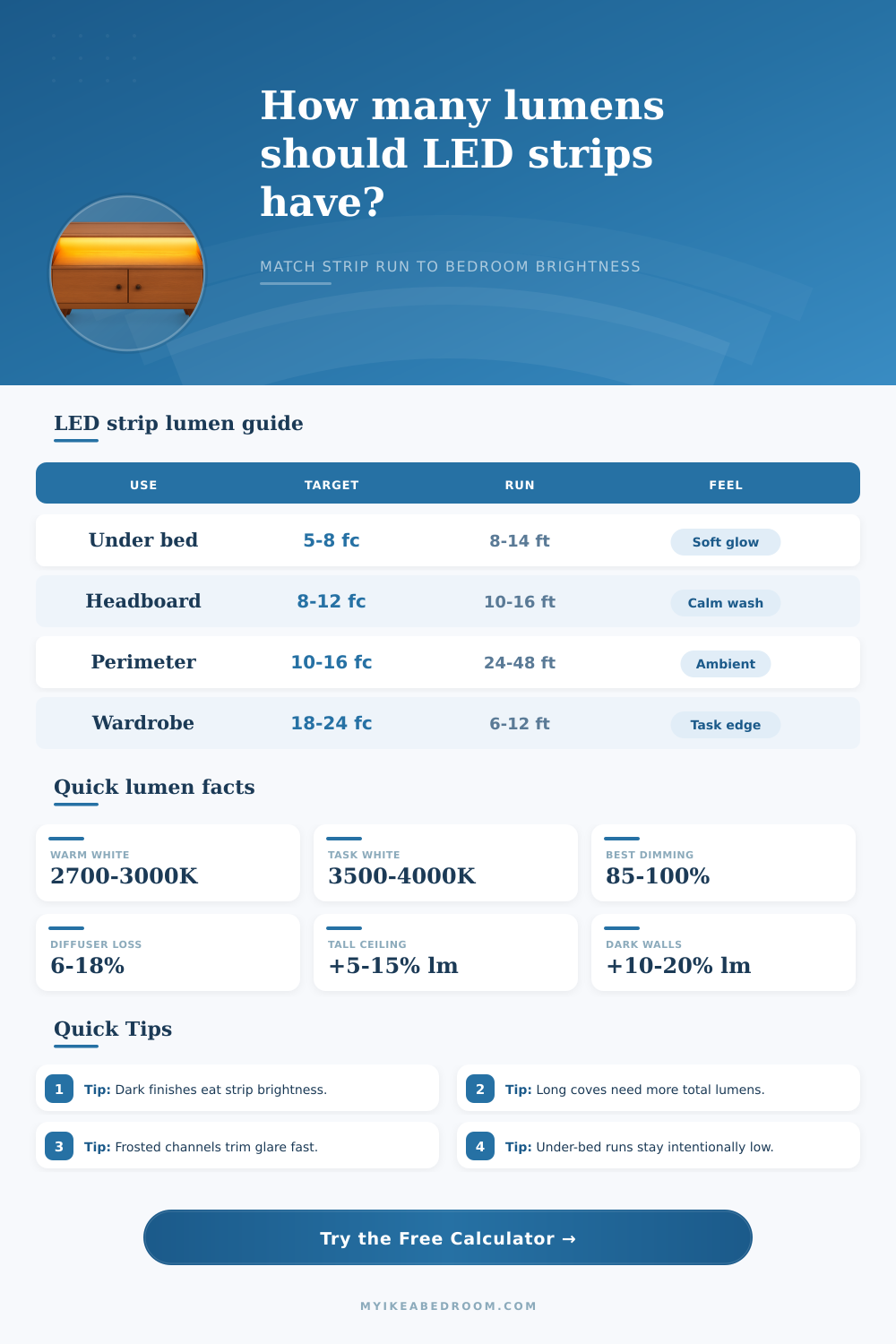
| Guide glow | 55-85 lx | 5-8 fc | Under-bed or late-night pathway |
| Accent mood | 85-130 lx | 8-12 fc | Headboards, shelves, soft wall wash |
| Ambient fill | 110-175 lx | 10-16 fc | General cove or perimeter support |
| Task edge | 190-260 lx | 18-24 fc | Wardrobes, mirrors, and reading zones |
| Strip family | Output | Power | Best use |
|---|---|---|---|
| Eco 24V strip | 220 lm/ft | 2.4 W/ft | Low-key accent and under-bed glow |
| Soft white strip | 300 lm/ft | 3.0 W/ft | Headboards and calm shelf light |
| High-CRI strip | 420 lm/ft | 4.0 W/ft | Main bedroom accent plus ambient support |
| Dense cove strip | 560 lm/ft | 5.5 W/ft | Long coves and tall rooms |
| RGBW strip | 360 lm/ft | 4.8 W/ft | Media walls and scene changes |
| Wardrobe bar strip | 480 lm/ft | 4.4 W/ft | Closet rails and task edges |
| Factor | Multiplier | What it means | Typical effect |
|---|---|---|---|
| Open strip | 0.94 | Minimal cover loss | Highest raw lumen delivery |
| Frosted channel | 0.88 | Softens glare | Good visual comfort, small output trim |
| Deep channel | 0.82 | Lens plus shielding | Lower glare, lower output |
| Dark surfaces | 0.90 | Light absorbed by finishes | Needs longer run or denser strip |
| Perimeter cove use | 0.58 | Indirect ambient delivery | Feels soft and even |
| Wardrobe rail use | 0.78 | Direct task delivery | More lumens reach the target zone |
| Scenario | Room size | Common run | Suggested strip |
|---|---|---|---|
| Headboard halo | 12 x 14 ft | 12-16 ft | 300-420 lm/ft |
| Under-bed frame | 10 x 12 ft | 10-14 ft | 220-300 lm/ft |
| Three-wall cove | 11 x 13 ft | 32-38 ft | 420-560 lm/ft |
| Full perimeter cove | 14 x 16 ft | 50-60 ft | 420-560 lm/ft |
| Wardrobe rail | 8 x 10 ft | 6-12 ft | 420-480 lm/ft |
LED strips can be use in bedroom to provide different type of illumination to the sleeping areas. The light from LED strips can be ambient, accent, or navigation. To properly use LED strips in the bedroom, one must have an understanding of the unit of lumen, which measure the light output of LED strips.
The amount of light that fill the bedroom is reliant upon the lumens of the LED strips and the object in the room. Objects such as walls, ceilings, and furniture will reflect and absorb the light from the LED strips, thus changing the effect that the lumens has upon the bedroom. When purchasing LED strips for bedrooms, one should consider the size of the bedroom.
How to Choose LED Strips for Your Bedroom
Small bedroom require LED strips with less lumens than large bedrooms. This is because large bedrooms has more volume in the rooms than small bedrooms. Additionally, if bedrooms have tall ceilings, more lumens is required for LED strips to provide even illumination throughout the bedroom.
This is because LED strips will disperse the light from the rooms furniture before the light from the strips hit any surface in the bedroom. Depending upon the way that the LED strips are mount in the bedroom, the type of light that is provided will change. For instance, mounting LED strips into coves in the ceiling will allow the bedroom to fill with ambient light from the LED strips; however, the use of coves will cause a loss of light from the LED strips as the light must bounce off of the ceiling into the bedroom.
Under-bed mounts will allow LED strips to provide navigation light in the bedroom for when sleeping individual get up to navigate the bedroom. In this case, the LED strips should be relatively dim in brightness. Lastly, mounting LED strips to the headboard will allow the bedroom to have accent light from the headboard; since this is a form of local lighting, the LED strips will not need to illuminate the entire bedroom.
The color of the finishes of the objects in the bedroom will impact the type of light that the LED strips provide. For instance, if the bedroom has light-colored walls, the LED strips will reflect off of the walls and make the LED strips appear more bright in the bedroom. In contrast, if the walls in the bedroom have dark color or feature dark wood finishes, the LED strips will reflect less light from the walls, and the LED strips will appear dimmer in the bedroom.
In these cases with dark-colored walls, brighter LED strips may be required, or there may be a need for longer run of LED strips. Frosted channels can be used to cover the LED strips to reduce the glare from the bedrooms LED strips, but using frosted channels will reduce the number of lumen that exit the LED strips. When purchasing LED strips for bedrooms, there are different types of LED strips that may suit the function of the bedroom.
For example, LED strips with lower brightness are use for providing subtle accent light in the bedroom, while high-output LED strips provide light for task in the bedroom. High-CRI LED strips may be beneficial in bedrooms as they provide even illumination of skin tone. Additionally, RGBW LED strips allow individuals to change the color of the light in the bedroom with the use of remote control or smartphone applications.
However, RGBW LED strips may have fewer white lumen than pure white LED strips. Additionally, LED strips can be set to utilize dimmers to control the brightness of the LED strips. If the LED strips are set to operate at a lower brightness to reduce the amount of heat that the strips emit, the LED strips will decrease in their overall output.
Due to the complexity of purchasing LED strips for bedrooms, many individual make mistakes. For instance, individuals may purchase LED strips that are too bright for the small size of there bedroom. LED strips that are too bright can create glare in the bedroom.
Additionally, individuals may purchase LED strips that are too dim for their large bedroom. In this case, the bedroom will appear to be dim and there will not be even illumination throughout the bedroom. An individual can calculate the foot-candles in their bedroom as an additional measure of the amount of light that will fall on the sleeper.
Furthermore, individuals should add a buffer of approximately ten percent to the brightness calculation of their bedroom as furniture may cast shadow on the sleeper. Finally, before purchasing LED strips for the bedroom, an individual can test a small run of LED strips in the bedroom to ensure that the brightness of the LED strips is to there satisfaction.