🪨 Gravel Depth Calculator
Calculate cubic yards, bags & weight needed for any gravel or stone project
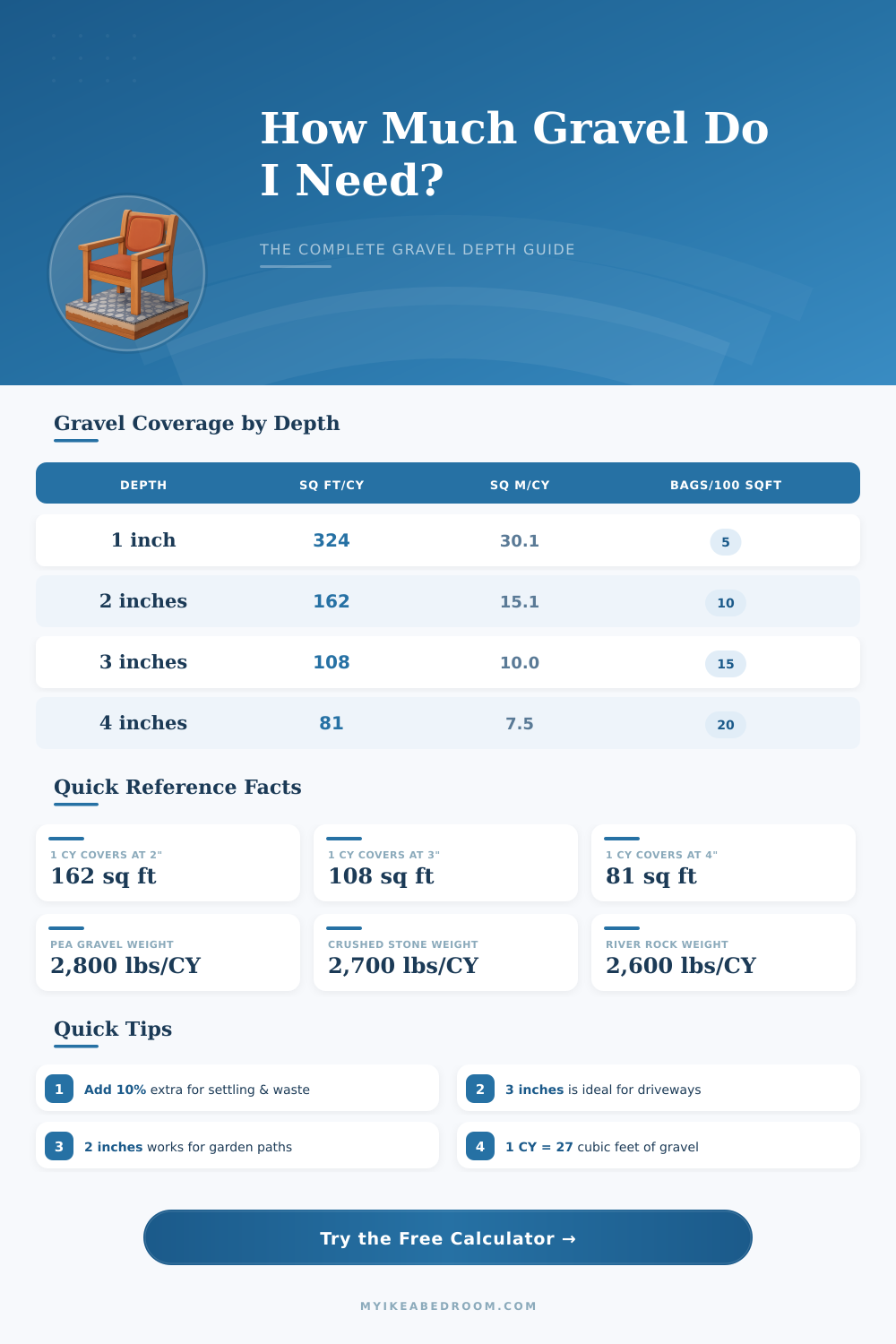
| Depth | Sq Ft / CY | Sq M / CY | Bags (2 cu ft) / CY | Bags (3 cu ft) / CY |
|---|---|---|---|---|
| 1 inch (2.5 cm) | 324 | 30.1 | 13.5 | 9 |
| 2 inches (5 cm) | 162 | 15.1 | 13.5 | 9 |
| 3 inches (7.5 cm) | 108 | 10.0 | 13.5 | 9 |
| 4 inches (10 cm) | 81 | 7.5 | 13.5 | 9 |
| 6 inches (15 cm) | 54 | 5.0 | 13.5 | 9 |
| 8 inches (20 cm) | 40.5 | 3.8 | 13.5 | 9 |
| 12 inches (30 cm) | 27 | 2.5 | 13.5 | 9 |
| Bag Size | Cu Ft / Bag | Bags Per Yard | Coverage at 2" | Coverage at 3" |
|---|---|---|---|---|
| Small bag | 0.5 cu ft | 54 bags | 3 sq ft | 2 sq ft |
| Standard bag | 2 cu ft | 13.5 bags | 12 sq ft | 8 sq ft |
| Large bag | 3 cu ft | 9 bags | 18 sq ft | 12 sq ft |
| Half cubic yard | 13.5 cu ft | 0.5 yard | 81 sq ft | 54 sq ft |
| Full cubic yard | 27 cu ft | 1 yard | 162 sq ft | 108 sq ft |
| Project | Area (sq ft) | Cubic Yards | 2 cu ft Bags |
|---|---|---|---|
| Small garden bed | 100 | 0.93 | 13 |
| Medium flower bed | 200 | 1.85 | 25 |
| Large landscape bed | 400 | 3.70 | 50 |
| One-car driveway | 600 | 5.56 | 75 |
| Two-car driveway | 1,200 | 11.11 | 150 |
| Playground area | 300 | 2.78 | 38 |
| Backyard patio | 500 | 4.63 | 63 |
| Full yard treatment | 2,000 | 18.52 | 250 |
When planning to use gravel for an landscaping project, calculating the volumes of gravel required for the project is essential. Many people makes the mistake of only calculating the surface area of the project required for gravel. However, gravel is a three-dimension material.
The volume of a three-dimensional material are measured by taking the measurement of the three dimension of that material. Since gravel has both surface area and depth, the measurement of the depth of the gravel is necessary for calculating how much gravel are required for the project. Without calculating the depth of the project, people will end up having to order either too little or too much gravels.
How to Figure Out How Much Gravel You Need
The depth that gravel will be laid for the project is essential for determining both the stability and the appearance of the gravel. If the depth of the gravel is too shallowly, the gravel will sink into the soil. If the gravel sink into the soil, there will be dirt and weeds that will be visible through the gravel.
On the other hand, if the depth of the gravel is too deep, it will be unstable when walked upon. Smaller areas such as garden beds will require only a shallow layer of gravel. Garden beds does not need to support much weight.
However, areas such as driveways require deeper gravel to support the weight of the vehicles that will be using the driveway. The deeper the gravel, the more stably it will be to support the weight of vehicles without sinking into the ground. The different types of stone that will be used for the project can also play a role in determining how much gravel will be ordered for the project.
For instance, pea gravel is comprised of rounded stones. Pea gravel is easy to walk on but not very stable for vehicles. Crushed stone is comprised of angular stones.
Crushed stone is more stable but is more difficultly to walk on. Since gravel of different types has different densities, the weight of the gravel will change even if the volume of the gravel is the same. In most instances, you will have to consider the weight of the gravel when gravel is to be ordered for a project.
This is to ensure that the weight of the gravel do not go beyond the weight limits of the transporting vehicle. When using a gravel calculator, it is important to order an overage of gravel for the project. When gravel is laid down, the air gap between the gravel will be compacted.
As the gravel gets compacted, air gaps will close and gravel will settle. This settling of the gravel will lead to a reduction in the total volume of gravel. If people only order the amount of gravel that the calculator indicate for the project, there will not be enough gravel to cover the required area.
It is common for gravel companies to order a percentage of gravel as an overage to account for gravel settling. Ordering an overage of gravel ensure that there will be enough gravel to complete the landscaping project. Another decision that has to be made when purchasing gravel is whether to purchase gravel in bags or in bulk.
Gravel in bags is more convenient for people who want to purchase smaller quantity of gravel for their landscaping projects. However, gravel in bags is typically more expensive than bulk gravel. Bulk gravel is more cost-effective when gravel is to be purchased in large quantities.
Bulk gravel is also easier to move to the project using a wheelbarrow. The other decision that has to be made is whether there will be a base placed beneath the gravel. If the gravel is to be laid directly onto the soil, the gravel will sink into the soil over time.
To avoid this situation, a layer of crushed stone base can be placed beneath the decorative gravel. By using these considerations and decisions when purchasing gravel for a landscaping project, people will be able to ensure that they have the correct amount of gravel for there project.