Brick Size Calculator
Input section stays on the first row, and the results section stays in the row below for clean masonry planning.
Nine realistic project presets with different wall scales and brick modules.
Use wall geometry, joint thickness, brick dimensions, and waste to estimate quantity and mortar.
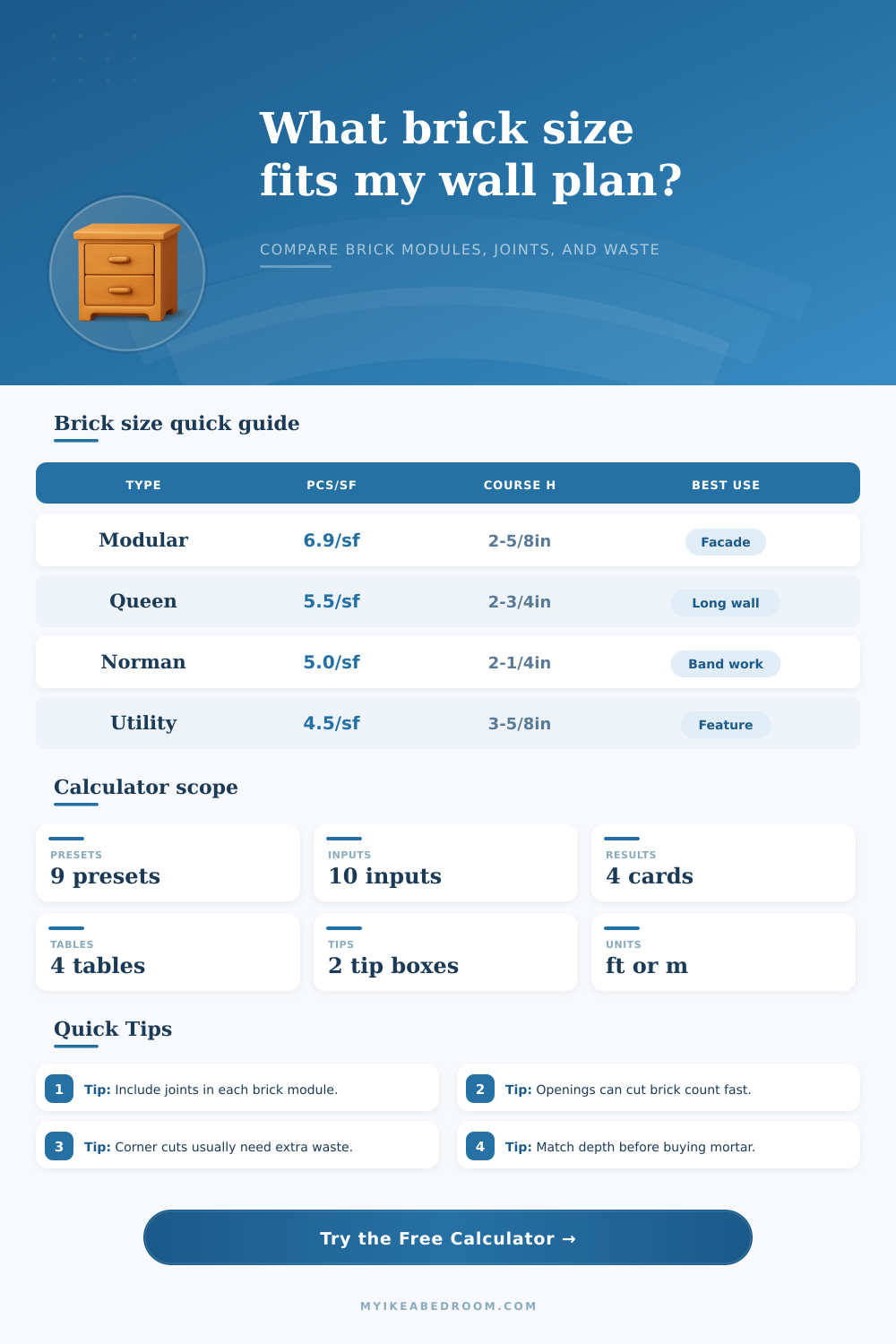
Compare four common brick families against the same wall dimensions.
| Brick type | Actual size (in) | Module (in) | Typical pcs/sf |
|---|---|---|---|
| Modular | 7-5/8 x 2-1/4 | 8 x 2-5/8 | 6.9 |
| Queen | 7-5/8 x 2-3/4 | 8 x 3-1/8 | 5.5 |
| Norman | 11-5/8 x 2-1/4 | 12 x 2-5/8 | 4.6 |
| Utility | 11-5/8 x 3-5/8 | 12 x 4 | 3.0 |
| Joint width | Module change | Count effect | Use case |
|---|---|---|---|
| 1/4 in | Smaller module | Higher pcs/sf | Tighter look |
| 3/8 in | Standard module | Balanced count | Most walls |
| 1/2 in | Larger module | Lower pcs/sf | Rustic work |
| 5/8 in | Large joints | Lower count | Repair match |
| Wall area | Modular pcs | Queen pcs | Norman pcs |
|---|---|---|---|
| 50 sq ft | 345 | 275 | 230 |
| 100 sq ft | 690 | 550 | 460 |
| 150 sq ft | 1035 | 825 | 690 |
| 200 sq ft | 1380 | 1100 | 920 |
| Waste band | When used | Cut pressure | Order note |
|---|---|---|---|
| 5-7% | Simple wall | Low | Few corners |
| 8-10% | Standard work | Medium | Typical safe |
| 11-13% | Many openings | Med-high | Extra cuts |
| 14-16% | Feature bonds | High | Heavy trim |
To calculate the number of bricks requiring to build a brick wall, you must take into consideration the dimension of a brick and the thickness of the mortar joint between the bricks. A brick have certain dimensions to its length and height. Each brick also has a mortar joint, which is the space between the bricks in which mortar is place.
The thickness of the mortar joint can be added to the dimensions of the brick to calculate the installed module of the brick. The installed module is the measurement of each individual brick and mortar joint combinations. For example, if the bricks are seven and five-eighths inches in length with three-eighths of an inch mortar joint, the installed module length is eight inches.
How to Calculate How Many Bricks and How Much Mortar You Need
The installed module can be used to calculate the number of courses of bricks of a certain height, and the number of bricks in a running foot of the length of the wall. Another calculation that must be made is the area of the wall that dont require bricks. Such an area is the area that is opened up for a door or window in the wall.
These door and windows dont require the use of bricks. Thus, the area of the wall that must be covered with bricks must have that area for doors and windows subtract from the total area of the wall. The remaining area is the area that will be covered in bricks.
In addition to this area, a builder will order more bricks to account for any breakage or cutting of bricks to accommodate for the area of the wall that doesnt require bricks. Commonly, eight to twelve percent of the total number of bricks are added to account for waste in the building process. If the wall contains many corners or openings for doors and windows, more bricks will be required to create the corners and openings, and more percent of the total area will be required to account for the cutting of the bricks to form those corners and openings.
Thus, the thickness of the mortar joints between the bricks can change the number of bricks that is required to build the wall; fewer bricks will be needed for thick mortar joint than thin mortar joints. Thicker mortar joints will require more mortar, so you will have to increase the volume of the mortar if use thicker mortar joints. The volume of the mortar refers to the amount of space between the bricks that will be filled with mortar.
There are several type of bricks with different dimensions. Modular bricks are the most common in construction. Queen bricks are larger and require fewer bricks to cover the same area then modular bricks.
Norman bricks are longer than modular bricks and require fewer vertical joint between bricks. Utility bricks are taller and require fewer courses to reach the desired construction height. The size of the brick will change the dimensions of the module, so you must choose the size of the brick prior to laying out the construction calculation.
The pattern for laying the bricks also affect the amount of waste in the construction of the wall. Running bond require fewer cuts than stack bonds. However, structures such as pillars and piers require more bricks and create more waste than a standard straight wall.
The calculated amount of bricks must always be rounded up to the nearest whole unit because mortar contractor sell bricks in large quantities. Other environmental and project-specific factor should be considered. If the house will be exposed to freezing and thawing climate, the dimensions of the module must allow for expansion of the mortar joints.
Walls with complex bond, such as Flemish bonds, require more bricks to complete the wall due to the waste created in the construction of these complex bond. A test of the dry-stacking of the bricks can be perform to test the dimensions of the module. By following the steps list, an accurate estimate of the number of bricks and the amount of mortar will be obtained for the project.
Actually, you should of used the steps list to get an accurate estimate of the number of bricks and the amount of mortar for the project. It’s going to be alot of work to make sure you recieve teh correct amount of furnitures for the job.