Bedroom, closet, vanity, and media-room downlight planning
Recessed Lighting Lumens Calculator
Estimate total recessed-light lumens, fixture count, and center spacing by combining room area, ceiling height, beam angle, trim efficiency, wall reflectance, and your planned dimmer ceiling.
Each preset fills in realistic bedroom and storage scenarios with different targets, ceiling heights, beam spreads, and lumen packages so the count is driven by more than floor area alone.
Full breakdown
| Space use | Target fc | Target lux | Planning note |
|---|---|---|---|
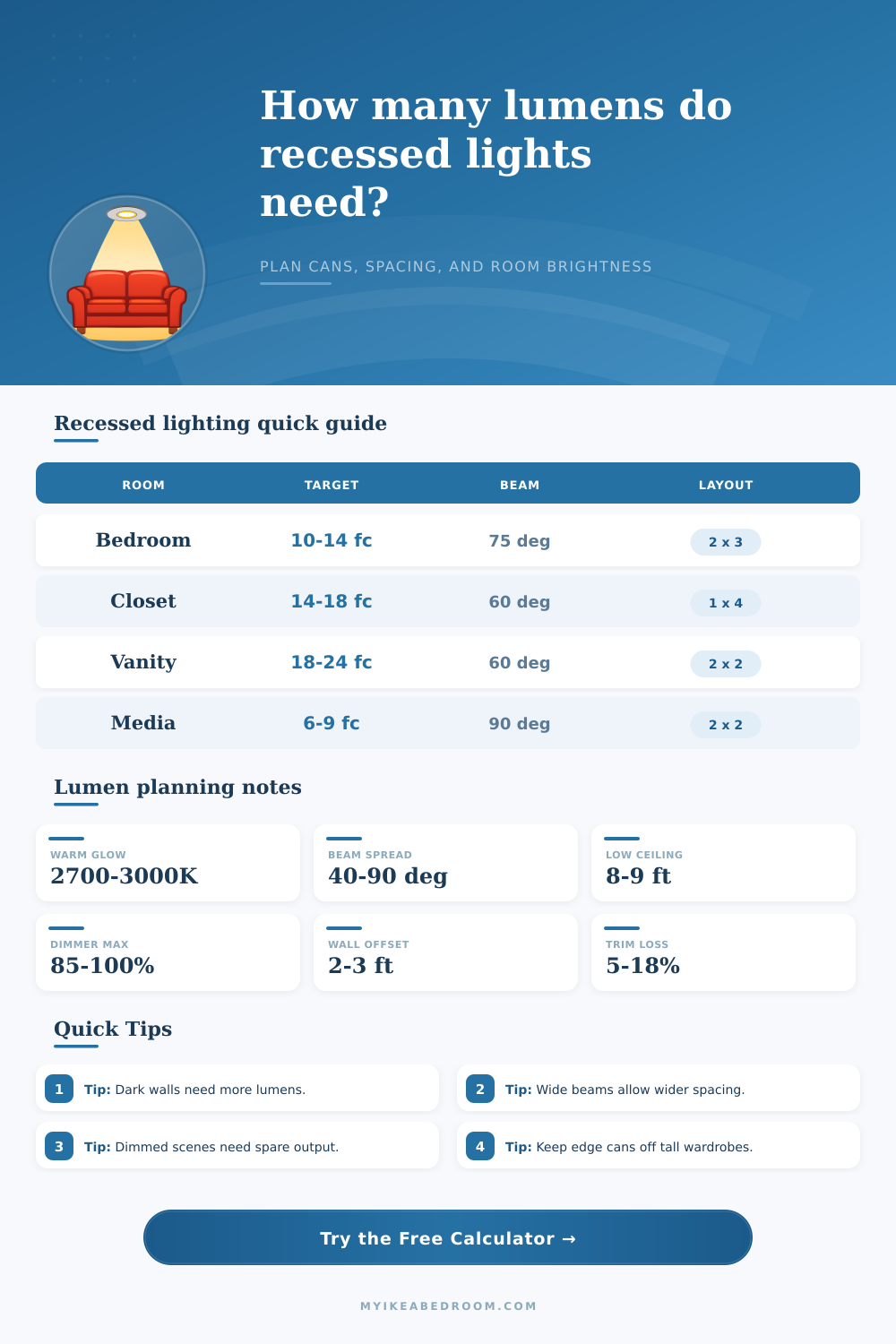
| Media bedroom wind-down | 6-9 fc | 65-95 lx | Leave room for dimmed scenes and screen comfort |
| General bedroom ambient | 10-14 fc | 108-151 lx | Comfortable whole-room ceiling light without harshness |
| Nursery or guest setup | 9-12 fc | 97-129 lx | Gentle fill that still helps with storage and cleanup |
| Walk-in closet and wardrobe wall | 14-18 fc | 151-194 lx | Color sorting and shelf visibility benefit from more output |
| Dressing and reading tasking | 18-24 fc | 194-258 lx | Use tighter spacing or stronger modules for detail work |
| Module | Typical lumens | Beam family | Best fit |
|---|---|---|---|
| 4 in soft ambient | 450-600 lm | 75-90 deg | Smaller guest rooms, secondary glow |
| 4 in task trim | 600-750 lm | 40-60 deg | Reading corners and dressing zones |
| 5 in general trim | 750-900 lm | 60-75 deg | Most balanced bedroom layouts |
| 6 in broad trim | 900-1100 lm | 75-90 deg | Larger rooms or darker finishes |
| Directional gimbal | 650-950 lm | 35-60 deg | Artwork, wardrobe faces, sloped ceilings |
| Beam angle | Spread at 6.5 ft MH | Safe spacing | Visual feel |
|---|---|---|---|
| 40 deg | 4.7 ft | 4.0-4.7 ft | Focused pools with sharper contrast |
| 60 deg | 7.5 ft | 5.5-6.8 ft | Balanced bedroom flood |
| 75 deg | 10.0 ft | 6.0-8.1 ft | Softer blend between fixtures |
| 90 deg | 13.0 ft | 6.5-8.8 ft | Broad wash with the least scalloping |
| Ceiling height | Height factor | Typical effect | Why it changes |
|---|---|---|---|
| 8 ft | 1.00 | Baseline | Most bedroom spacing tables assume this starting point |
| 9 ft | 1.05 | Moderate bump | More beam spread, but less delivered brightness on plane |
| 10 ft | 1.10 | Higher lumen need | Extra throw and reduced intensity call for more output |
| 11 ft | 1.15 | Tighter grid pressure | Spacing can become the driver before raw lumens do |
| 12 ft | 1.20 | Strong bump | Rooms this tall often need stronger modules or more fixtures |
Recessed light can create uneven light patterns. Recessed lighting can also create shadows and glares within a room, especialy if the recessed lighting was not size correctly for the area to be lighted. A person may find that the recessed lighting create some dark corner within the area that needs to be lighted.
This may be due to not calculating the lumens that each recessed lighting fixture should emit correctly. If a person calculates the lumens and the number of recessed lighting fixture necessary according to the size of the area to be lighted correctly, the recessed lighting will even light that area. The number of lumens that each fixture emits is one of the factors to consider in determining the number of recessed lighting fixture that are needed for a room.
How to plan and place recessed lights
However, lumens isnt the only factor that must be considered when determining the number of recessed lights needed. For instance, the height of the ceiling and the color of the walls can also impact the number of recessed lights that is necessary. In rooms with ceilings as low as nine feet, the light from the recessed lighting fixtures will travel a greater distance to the floor.
Greater distance that the light must travel will result in a reduction of the number of recessed lights. Additionally, dark walls will absorb some of the light that the recessed lights emit. Therefore, rooms with dark walls will have a reduction in the amount of light that fill those rooms.
Calculating the number of recessed lights based solely on the square footage of the rooms may lead to under-lighting of those area. The beam angle of the fixtures and the trim style can also impact the light output of each fixture. For instance, trim styles for recessed lights may trap ten to twenty percent of the light output of the recessed lights.
Therefore, recessed lights with narrow beam will require more recessed lighting fixture to evenly fill the area than areas with wide beam. The beam angle of the recessed lights will help to determine the spread of the light. A narrow beam angle, such as forty degrees, will create a spotlight within the area.
Using narrow beam angles will limit the spread of the light, but will provide better focus on specific area within the rooms. A sixty-degree beam will create a flood of light within the area. The light created by such beam is beneficial in rooms like bedrooms, where even lighting is needed for activities like reading.
In rooms with low ceiling, wide beam angles allow for recessed lights to be spaced further apart. This prevents dark band from forming along the ceilings or walls in those spaces. The color of the walls in the rooms may impact the performance of the recessed lights.
Walls that are pale neutral color will allow the light to reflect off the walls into the rooms. Deep color like wood tones or charcoal will absorb much of the light from the recessed lights. Therefore, rooms with such colors will require more recessed lights to provide the same light as a space with pale colors.
Additionally, if the space will include a dimmer switch, there should be some spare capacity built into the light level of the recessed lighting. Most individuals tend to use the dimmer lights at eighty-five to ninety percent of the maximum brightness. Therefore, to provide full light coverage within the space, the light levels of the recessed lighting should be sufficient to reach the brightness needed when the recessed lighting is used at its intended level.
Different area within the house will require different light levels. For instance, a twelve-by-twelve-foot guest room may require eleven footcandle for ambient lighting. However, the walk-in closet in that guest room may require sixteen footcandle to allow for better visibility of the clothing shelves.
Areas like media zone may require lower levels of light, but reading nooks may require more light. If the recessed lights are located in a room that also has a ceiling fan, those recessed lights may be obstructed by the fan. Five to ten percent of the light output of the ceiling fan may be shade from the recessed lights due to this obstruction.
In determining the total lumens that will be needed to evenly light an area, a person must account for a percentage of that light that will be lost in the area. Therefore, if the recessed lights are to be six feet apart, the area may need to have a grid of recessed lights that are closer together in order to avoid creating dark lanes in the area. Areas like bedrooms may need to be ten to fourteen footcandle.
However, the percentage of the light that overlap into the next beam may need to be calculated. If there is too low of an percentage of overlap, there may be some scalloped light pattern in the area. Many people tend to make mistakes when installing recessed lighting.
For instance, many people think more is always better. Using lights with high lumens and narrow beam may not allow the light to even reach into the area with tall ceiling. Additionally, people may place the lights too close to the walls.
Lights that are too close to the walls may highlight part of the room while leaving other area too dark. These problems can be fixed by using recessed lighting to even the lights in the area, while using task lights for designated areas in the room. For example, if the room include vanities, task lights may be used for those areas instead of the recessed lights.
Additionally, tape may be used to mock up the recessed lighting on the floor to determine the placement of the lights in the drywall. This can help to determine where the shadows caused by the furniture will land within the room. In addition to the lighting described above, you can make adjustments to the recessed lighting based off the needs of each individual room.
For instance, if the ceilings within the room are sloped, gimbal recessed lighting fixture may be used. Such fixtures can be placed at an angle to follow the angle of the sloped ceiling. Twenty-seven hundred Kelvin lights are warm lights that is suitable for the areas to be lighted.
Five-inch module containing seven hundred fifty lumens may be the best light level for most bedrooms. The safe center for mounting these lights is calculated by multiplying the mounting height by a number near one. The distance that the fixtures need to be offset from the walls is half the calculated number.