🏖 Sand Depth Calculator
Calculate exact cubic yards, bags & weight for any sand project — instant results
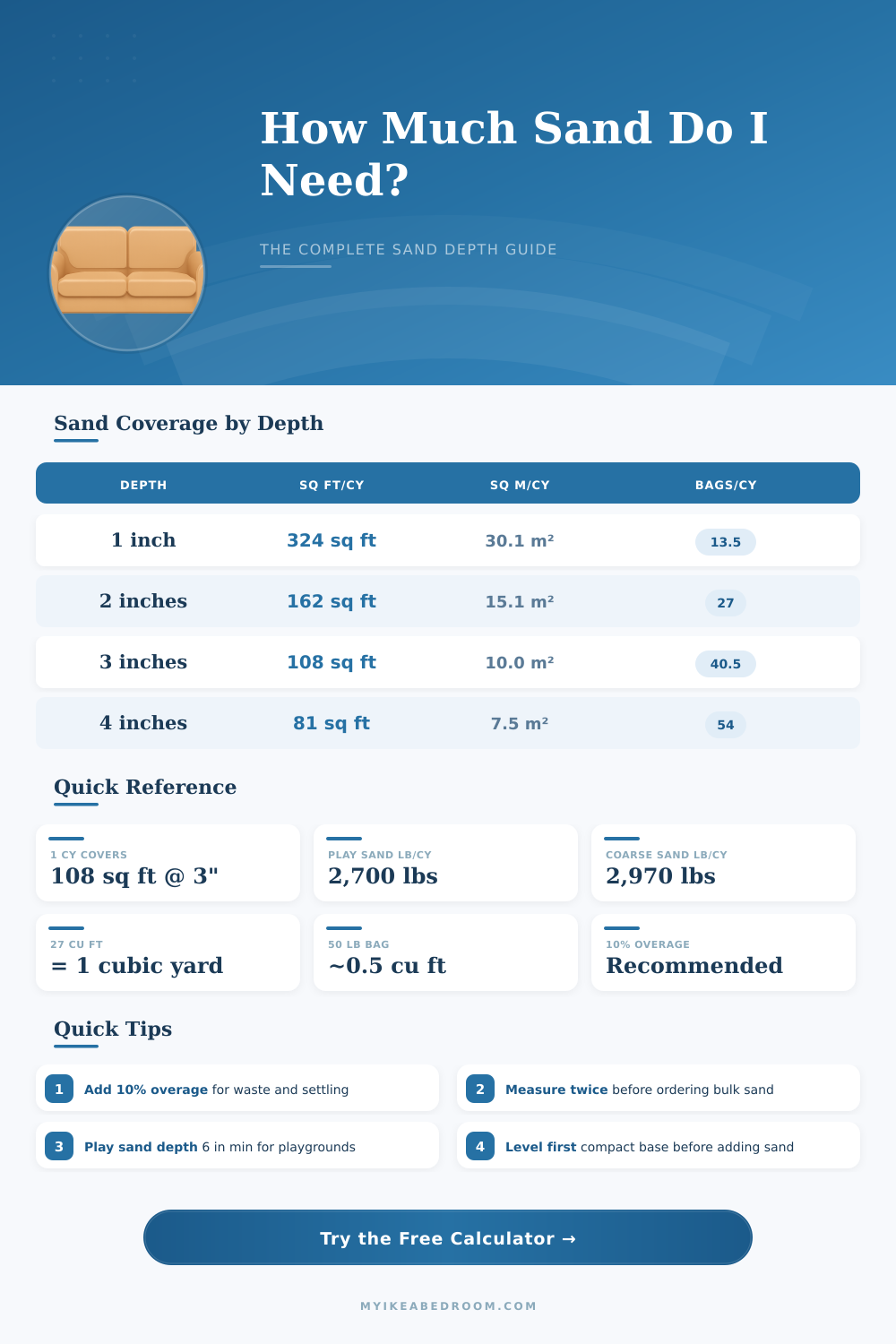
| Depth | Sq Ft per CY | Sq M per CY | Cu Ft per CY | Cm Equivalent |
|---|---|---|---|---|
| 1 inch | 324 sq ft | 30.1 m² | 27 cu ft | 2.54 cm |
| 2 inches | 162 sq ft | 15.1 m² | 27 cu ft | 5.08 cm |
| 3 inches | 108 sq ft | 10.0 m² | 27 cu ft | 7.62 cm |
| 4 inches | 81 sq ft | 7.5 m² | 27 cu ft | 10.16 cm |
| 6 inches | 54 sq ft | 5.0 m² | 27 cu ft | 15.24 cm |
| 8 inches | 40.5 sq ft | 3.8 m² | 27 cu ft | 20.32 cm |
| 12 inches | 27 sq ft | 2.5 m² | 27 cu ft | 30.48 cm |
| Bag Size | Volume per Bag | Bags per CY | Coverage @ 2 in | Coverage @ 3 in |
|---|---|---|---|---|
| 50 lb bag | ~0.5 cu ft | ~54 bags | ~3 sq ft | ~2 sq ft |
| 60 lb bag | ~0.6 cu ft | ~45 bags | ~3.6 sq ft | ~2.4 sq ft |
| 2 cu ft bag | 2 cu ft | 13.5 bags | ~12 sq ft | ~8 sq ft |
| 3 cu ft bag | 3 cu ft | 9 bags | ~18 sq ft | ~12 sq ft |
| Bulk 0.5 CY | 13.5 cu ft | — | ~81 sq ft | ~54 sq ft |
| Bulk 1 CY | 27 cu ft | — | ~162 sq ft | ~108 sq ft |
| Project | Typical Area | Depth | Cu Yards Needed | 50 lb Bags |
|---|---|---|---|---|
| Small Sandbox | 64 sq ft (8x8) | 3 in | 0.6 CY | ~33 bags |
| Medium Sandbox | 100 sq ft (10x10) | 3 in | 0.9 CY | ~51 bags |
| Playground Area | 225 sq ft (15x15) | 6 in | 4.2 CY | ~228 bags |
| Patio Base | 240 sq ft (12x20) | 2 in | 1.5 CY | ~81 bags |
| Volleyball Court | 1,800 sq ft (30x60) | 12 in | 66.7 CY | Bulk only |
| Pool Surround | 800 sq ft (20x40) | 4 in | 9.9 CY | Bulk only |
| Garden Path | 200 sq ft (4x50) | 2 in | 1.2 CY | ~67 bags |
| Lawn Leveling | 600 sq ft (20x30) | 1 in | 1.9 CY | ~100 bags |
To determine the amounts of sand needed for the project, you must first calculate the area of the project and the depths of the sand. Calculating these two values allow for the calculation of the total volume of sand that will be needed to complete the project. By calculating the total volume of sand needed for the project, you ensure that you will not purchase either too little or too much sand for the project.
If you purchase too little sand, you will have to go to the supplier to purchase the remaining sand. However, if you purchase too much sand, you will have wasted money purchasing the sand that you wont be able to use for your project. The area of the space that will be covered in sand are determined by the shape of the area.
How to Figure Out How Much Sand You Need
For rectangular areas, multiplying the length of the area by the width of the area calculates the area. For areas that are in the shape of an circle, the mathmatical constant pi calculates the area when you multiply it by the square of the radius of the circle. For areas that are in the shape of a triangle, multiplying the base of the triangle by the height of the triangle and dividing that value by two calculates the area.
Each of these calculations will provide the area in square unit. The area of the area to be covered in sand must be accurately calculated in order to ensure that the volume of sand that is calculated will be accurate as well. The depth of the sand is the third value that must be calculated in order to determine how much sand will be needed for the project.
The depth of sand can vary according to the purpose of the sand in the completed project. For instance, thin layers of sand, such as one inch of sand, are often laid down on lawns to level the ground or to fill the joints in pavers. Three inches of sand are often used for sandboxes to provide stability to the area.
Finally, six inches of sand is often required for the construction of playgrounds to provide a cushion for the children to land from playground structures. The type of sand that will be used in the project will impact the weights and the density of the sand that will be purchased. Play sand is a type of sand that is fine in texture and soft to the touch, and typically weighs around 2,700 pounds per cubic yard of sand.
Builder sand is a sand that has coarse grains, and is typically used for constructing driveways. Concrete sand is used to pack tightly together to form bases for construction projects, as is masonry sand, which is used for constructing smooth brick work. The volume of sand that will be purchased is the amount of space that the sand will cover.
Volume is calculated by multiplying the area of the project by the depth of sand. One cubic yard of sand contain 27 cubic feet of sand. One bag of sand (approximately 50 pounds) contains around 0.5 cubic feet of sand.
To purchase one cubic yard of sand, therefore, ten bags of sand (50 pounds each) will be needed. Bulk sand can be purchased in quantities in excess of one cubic yard. Bulk sand is typically less expensive per bag when purchasing bulk sand than when purchasing sand in bags.
Finally, it is recommended to order sand in amounts that is around ten percent more than the calculations for sand needed for the project. The extra ten percent of sand will account for sand that might settle in the area upon placement of the sand. A standard pickup truck or a trailer and bulk delivery truck can deliver sand to the project.
It is recommended to call the sand supplier in advance to confirm how much sand will be delivered and what the weight will be of that sand. Sand is very heavy. The sand will be raked to ensure that it is even across the area to be covered in sand.
Finally, the sand can be watered to help it to settle into the area. For playgrounds specifically, sand will be placed over a geotextile fabric to ensure that no weed grow up through the sand. In order to determine the amount of sand that will be needed for a project, it is first necessary to measure the area that will be covered in sand.
The depth of the sand must also be determined. Once the area and depth are known, multiplying the area by the depth can calculate the volume of sand. Finally, the calculated amount of sand should of been increased by ten percent to account for settling.
Following these steps will ensure that there is enough sand to complete the project.