🏖 Sand Depth Calculator
Plan compacted depth, loose spread depth, order volume, bags, and dry weight for sand bedding, play zones, leveling layers, and drainage beds without stacking the form beside the results.
📌Project presets
🔧Sand depth inputs
📈Sand depth results
📊Sand comparison grid
📋Reference tables
| Project | Compacted depth | Loose target | Best use |
|---|---|---|---|
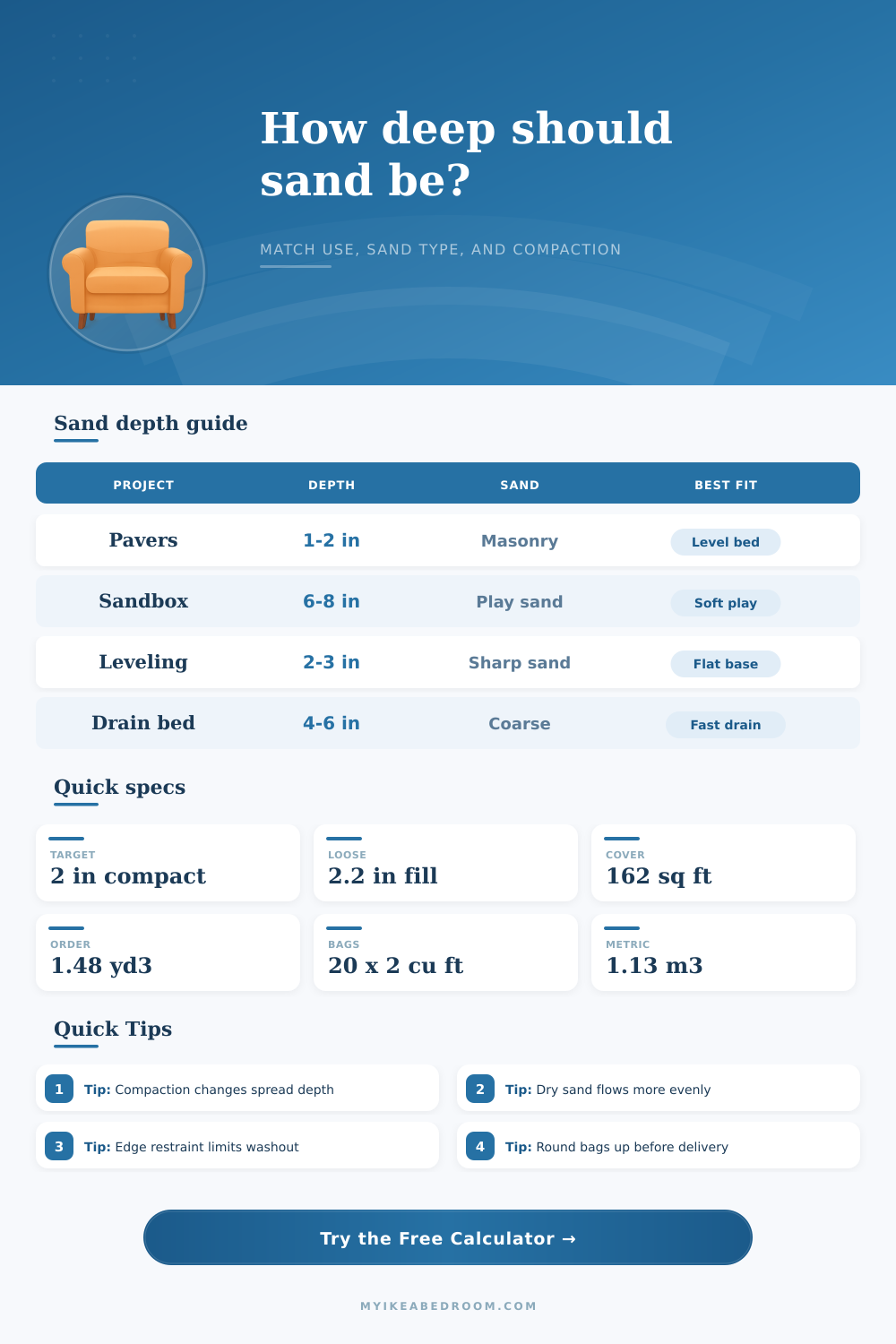
| Paver patio bedding | 1.0-2.0 in | 1.1-2.3 in | Screeded setting bed |
| Leveling under slabs | 2.0-3.0 in | 2.2-3.4 in | Straightening minor grade changes |
| Sandbox or play area | 6.0-8.0 in | 6.6-9.0 in | Soft play depth after settle |
| Drain or dry bed | 4.0-6.0 in | 4.4-6.8 in | Extra buffer for moisture movement |
| Depth | Sq ft per yd3 | Sq m per m3 | Typical use |
|---|---|---|---|
| 1 in | 324.0 | 32.4 | Thin paver bedding |
| 2 in | 162.0 | 16.2 | Leveling and smoothing |
| 4 in | 81.0 | 8.1 | Drain and base cushion |
| 6 in | 54.0 | 5.4 | Play and deep fill zones |
| Supply mode | Volume each | Units per yd3 | Planning note |
|---|---|---|---|
| 2 cu ft bags | 2.0 cu ft | 13.5 bags | Easy for small patio touchups |
| 3 cu ft bags | 3.0 cu ft | 9.0 bags | Fewer lifts for medium jobs |
| Half yard bulk | 13.5 cu ft | 2.0 loads | Useful for staged deliveries |
| Full yard bulk | 27.0 cu ft | 1.0 load | Best for wide area fills |
| Adjustment | Depth effect | Loose fill effect | When to use it |
|---|---|---|---|
| Dry and covered | +0.0 in | Low loss | Interior or protected prep areas |
| Damp or shaded | +0.2 in | Moderate loss | Normal patios with retained moisture |
| Open edge | +0.4 in | Higher loss | Exposed borders and walk edges |
| Plate compaction | No depth add | More loose fill | Dense bases needing final tightening |
💡Practical tips
When you are preparing a project that requires the use of sand, it is important for the individual to understands the difference between the depth of the loose sand versus the depth of the compacted sand. The depth of the sand that is measured when the sand is loose is the depth of the sand prior to compaction. The depth of the sand that is measured once it has been compacted is the depth of the sand after it is compacted.
The volume of sand decrease when it is compacted due to the settling of the sand; the sand particle compact together and become closer together. The amount of settling that occurs within the sand is dependent upon the type of sand that is being used and how much pressure are applied to the sand. The type of sand that is used will impact the amount of settling that occurs within the sand.
How to Measure and Buy Sand for a Project
For instance, angularly sharp sand will settle more than soft play sand due to the angular shapes of the sand particles; the angles of the particles allow for them to lock into place with other sand particles. Thus, more settling will occur with angular sharp sand than with play sand. Fine masonry sand is used for projects like patios because it is even with the ground when leveled, and the sand naturaly settle in a predictable manner.
Play sand is soft in texture and is used for the construction of sandboxes. However, play sand may drift away from the edge of the sandbox if there is no frame to contain the sand within the sandbox. Coarse utility sand drain water quickly from the area.
However, because the sand particles do not compact together as closely as the fine sand particles, more depth is required for projects that use coarse utility sand. The type of project that is to be constructed will determine the depth of sand that is required. For projects like patios, a depth of sand that is shallow may be required for these areas because thick layer of sand may cause the stone within the patio to sink below the surface of the ground.
For sandboxes, six to eight inches of compacted sand is recommended because the children will compact the sand within the sandbox. For projects related to drainage, such as drainage beds, four to six inches of sand is recommended. Two to three inches of sand are recommended for any projects related to leveling the ground.
The volume of sand that is to be purchased for any project can be calculated by determining the square footage of the project that will be performed, and the depth of the sand that will be used for that project. One cubic yard of sand will cover 162 square feet if the depth of the sand is two inches after compaction. One cubic yard of sand will only cover 81 square feet if the depth of the sand is four inches after compaction.
Sand is often sold in bags. Thirteen and a half bags of two cubic feet of sand is equal to one cubic yard of sand. The amount of sand that is purchased should be greater than the calculations for the project.
In addition to the settling of sand that will be used within a project, sand should be purchased in amounts that provide for a ten to twenty percent overage for the sand needed; buying extra sand will ensure that there is enough for the project. Furthermore, the amount of moisture that is contained within the sand will also impact the amount of sand that should be purchased. Sand that is damp may appear to contain more sand than dry sand; however, if the sand is damp, it will compact more once the sand become dry.
Thus, if the sand project is to be performed in areas that are shaded from the sunlight, dry sand should be purchased and an extra layer of sand should be bought to account for the damp sand that will naturaly occur in those areas. Additionally, if the sand is allowed to settle within the project, there may be low spot within the project once it is completed. In order to avoid low spots within a project, the sand should be contained to the edges of the project.
Using a frame that is made of wood or metal will keep the sand from moving outward from the project. If sand is contained within a frame, it will remain within the project. However, if there is no frame for the sand, the sand may move away from the project over time.
Thus, by measuring the sand, tamping it to the proper depth, and containing the sand to the edges of the project, an individual will be able to create a sand base that lasts for a long time.